
Inxmail Email Marketing Benchmark 2026: Every fourth newsletter is opened
The eleventh edition of the Inxmail Email Marketing Benchmark Study analyzes 4 billion emails and shows that the open rate remains stable at 24.1 percent. However, the effectiveness of communication is declining—the effective click-through rate fell by 1.7 percentage points. Tourism and culture lead the way in industry performance.


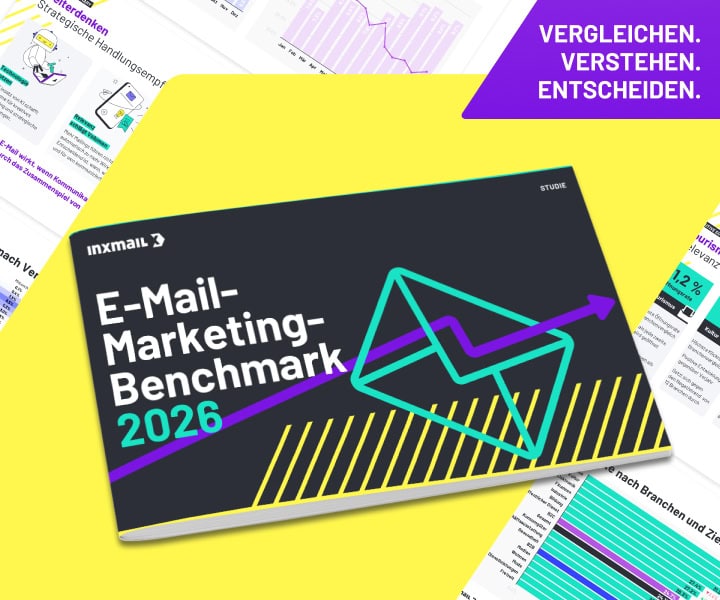
The Inxmail Email Marketing Benchmark 2026 provides a comprehensive evaluation of 4 billion emails from 342,400 mailings from 1,022 senders. The study analyzes key performance indicators such as open rate, click rate and effective click rate, differentiated according to 15 industries, target groups (B2B/B2C) and time of sending. This provides marketers in the DACH region with a sound basis for comparing their newsletter performance.
Key performance indicators remain stable, interaction becomes more demanding
The key performance indicators remained largely constant in 2025: the open rate was 24.1% (-0.3% compared to the previous year). In a target group comparison, B2C mailings achieved a higher open rate of 24.7% than B2B mailings at 22.8%. The click rate fell slightly by 0.3% to 3.3%.
Particularly striking: the effective click rate, which measures the ratio of clicks to openings, fell by 1.7 percentage points to 14.8%. This development shows that although attention is still present, it is becoming increasingly difficult to convert openings into real interaction.
Tourism and culture as benchmark setters

Tourism and culture set the standards in a sector comparison in 2026. The tourism sector achieved the highest open rate at 51.2%. Culture led with a click rate of 17.3% and an effective click rate of 36.5%. These figures show that relevance is more important than high mailing frequency.
The consumer goods sector delivered a remarkable performance: Companies from the drugstore, food and stationery sectors increased all relevant key figures without increasing their shipping frequency. The click rate grew by 48.1 percent and reached 4 percent - a value in the top third of the industry comparison.
Time of dispatch determines visibility

The benchmark study clearly shows that the most popular mailing day is not automatically the most successful. Thursday remains the most popular mailing day, but in B2C, newsletters at the beginning of the week achieved the highest open rates (Monday: 26.9%). In B2B, Friday and Saturday were the most successful (Saturday: 25.2%).
There is a clear pattern when it comes to sending times: 70 percent of all mailings are sent between 6 a.m. and 3 p.m. - precisely when competition in the inbox is at its highest. The highest open and click rates were achieved by newsletters sent between 3 and 6 a.m. (open rate: 41.2%, click rate: 14.6%).
Petra Maelzer, Member of the Management Board at Inxmail, explains: "Different target groups need differentiated mailing strategies. If you want to make an impact, you have to think along the customer journey - not according to a fixed mailing plan."
January shows record opening and click rates
January proved to be the most successful month: with an open rate of 26.4% and a click rate of 4.1%, this period clearly outperformed all other months. In B2C, it was also shown that performance figures fall with increasing mailing volumes. More mailings therefore do not automatically lead to greater impact.
Bounce rate remains low and stable
Marketers continue to do a good job in terms of deliverability: the bounce rate remained low overall and stable at 0.4%. However, the risk of inactive addresses increases as the size of the mailing list grows. Financial companies are particularly affected, with a bounce rate of 1.3 percent. This underlines the importance of consistent list hygiene.
Strategic recommendations for action for 2026
The study shows four key success factors for effective email marketing: Firstly, interactive content creates a better experience in the inbox and shortens the path to action. Secondly, relevance beats volume - the decisive factor is when, why and for whom communication takes place. Thirdly, the use of AI allows scope for creative storytelling and strategic decisions. Fourthly, technical hygiene ensures visibility, because without reliable delivery, even the best content remains invisible.
Petra Maelzer adds: "Many companies react to decreasing interaction with higher frequency. However, our data shows that sending more does not automatically generate more impact. If you want to be successful, you have to segment more precisely and consistently focus content on relevance."
Data basis and method
The Inxmail Email Marketing Benchmark 2026 is based on the evaluation of anonymized sending and performance data from the Inxmail platform. Emails from Germany, Austria and Switzerland that were sent between January 1 and December 31, 2025 were analyzed. The majority (57.2%) of senders came from the B2B segment, 42.8% from the B2C segment. All evaluations are based on the median, which makes the results more robust against outliers.
The complete study is available at www.inxmail.de/benchmark ready for download.


