
Business travel of the future: Perfectly coordinated through new technologies


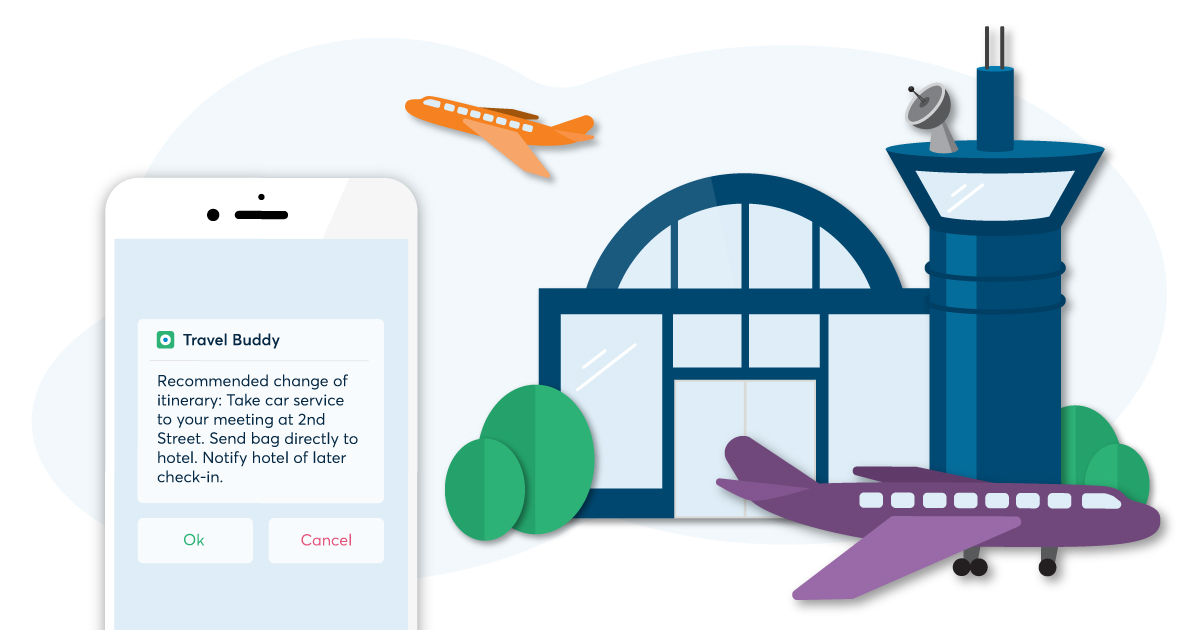
The arrival: goodbye stress
Your plane is just about to land and your business lunch starts in an hour. You had hoped to freshen up in your hotel, but unfortunately this is not possible due to the late arrival. Time pressure: the WLAN on the plane is deactivated due to the landing approach. As soon as the plane touches down, turn off your smartphone's airplane mode. This activates the AI assistant in the background. It checks your current location and performs a cross-check with the status of your flight. It recognizes that you have landed but are delayed. After checking your calendar and local traffic, it determines that you can still make it to your appointment on time, and your smartphone reports that a message has arrived:Recommended route change: Book a ride to the meeting in Bismarckstraße. Send your luggage directly to the hotel. Notify the hotel that you will be checking in later.You tap on OK In the background, the assistant app coordinates your cab and hotel apps. It books two cars: one to take you to the meeting and another to transport your bag directly to the hotel. It then informs the hotel that your bag will arrive before you and should be taken to your room, and a text message arrives: the driver who wants to pick up your bag and find out how big it is has contacted you. He is already at the airport to pick up a passenger who is also going to your hotel. Your bag may not take up much space, but it is an awkward shape. It's easier to describe it on the phone. You tap "Call" in your ride-sharing app and are connected directly to the driver, then you remember that you should let the person you're meeting know that you might be late. Before you have typed in the number, the assistant tells you that it has already sent you a message with a link to your status. Your business partner replies in a friendly manner: "No problem, take your time! See you later!" The app analyzes the reply and notices that there is no need to rush. From your previous trips, it knows that there is a period of about 25 minutes after landing in which you only reply to important and urgent notifications.you take your hand luggage and get off the plane. When you get to the arrivals area, you see that the two drivers of your ride-sharing service are already waiting for you: one for you and one for your bag. Then off you go.
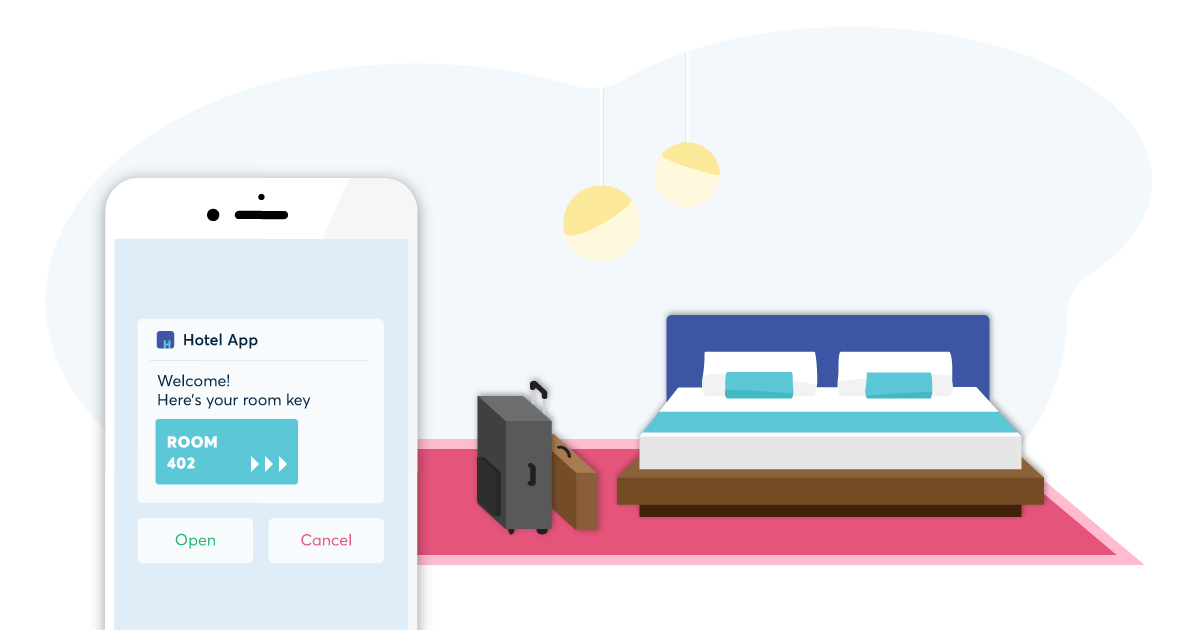
The check-in: Open sesame
The meeting went well. The sun is shining and it's not too warm. You walk the short distance from the office to the hotel. Your hotel chain's app registers that you are approaching the hotel. So far, your AI assistant and the various apps have collected your data via the mobile network, GPS and publicly available information (such as flight status). The moment you enter the hotel, this changes: the digital concierge of your hotel chain is already installed on your cell phone. This app recognizes that you have entered the hotel and connects you to the hotel WLAN. The Wi-Fi not only has the task of providing guests with a reliable connection to the Internet - it also acts as the core of the hotel's indoor positioning system (IPS). Similar to GPS, the IPS determines your location, but uses internal beacons (in this case wireless access points) instead of geostationary satellites. As you approach reception, your photo and booking details appear on the receptionist's screen and he greets you with your name, tells you your room number and informs you that your bag is already waiting for you. You walk to the elevator; the digital concierge recognizes via IPS that you are entering the elevator and selects the correct floor for you before you have even touched the button. A screen in the elevator reminds you of your room number and tells you which way to go, and the virtual concierge follows your steps as you walk down the corridor. It ensures that LED arrows light up on the carpet to show you the way to your room. It has also set the temperature in your room. But instead of the temperature you specified in your guest profile, it thinks 20 degrees is appropriate. He knows that you set the heating to this temperature every time you enter a room, so you come to your room door, take your smartphone out of your pocket and tap the home button twice. There is a card with the hotel logo in your Wallet app; you select it and hold your phone up to the door. It vibrates and the door opens.
The room: every detail is right
Your bag is exactly where the receptionist described. The temperature is perfect and the lamps provide the warm light you like so much. The music from the playlist you listened to on the plane is playing through the speakers, and despite the slight jet lag, you are relaxed and in a good mood as you sit down on the bed to take off your shoes. Spontaneously, you think of all the little things that used to annoy you about hotel rooms:-Televisions that blasted a commercial for the hotel's spa services at you as you entered the room-Sticky air or arctic cold-The fumbling with magnetic cards that were so sensitive that just the hint of a magnet nearby rendered them useless-The problem with a foreign language that you don't speak well, so you couldn't order room service or another pillowYour smartphone buzzes. It seems to be room service, but it's a chatbot with voice capabilities. The hotel's management system has determined that you have requested an extra towel within ten minutes of entering the room during your last three stays.Hello, Mrs. Scheinberg! This is room service. May we bring you some more towels?You confirm that you would like another towel. You think how attentive the room service in this hotel is and how friendly your conversation partner seems to be; of course, you have no idea that you are talking to a bot.No problem. The towels will be here soon.Before you hang up, ask where you can play tennis that evening.Tennis - that sounds good! Just a moment, I'll hand you over to someone who can help you.The flesh-and-blood receptionist intervenes. He tells you that the hotel has its own new tennis court and that you can find a tennis partner with the help of the digital concierge. You end the call and a schedule appears on your display with the free times of the other players. You arrange a match in an hour's time and of course you would prefer to sleep in your own bed, but you realize that hotels are much cosier these days than they used to be. The technology: a look behind the scenesLet's take a look back at our business traveler's day. Let's take a closer look at the technologies behind the personalized service, starting with the landing: Nothing earth-shattering happens here. A pseudo-AI tool in the cell phone's operating system has access to the apps. It observes the user and learns what it should do based on simple machine processes. The tool draws conclusions from the context in which it is operated and the available information. Then try Google Now on an Android smartphone. You will see that we are only a few steps away from what is described in the airplane landing in our story.Now to the hotel. This part of the story is essentially based on five technologies:-Indoor positioning systems are already being developed and used. A 360-degree view of the customer provides the hotel with detailed information about its guests where it is needed: from the reception desk to the room thermostat.-Simple chatbots can combine natural language and machine learning with the 360-degree customer view - even if they are not yet fully developed. This makes it possible to offer an even more personalized service without the need for an employee to answer the phone for every question.-Tests for keyless room access are already underway at Hilton and Marriott hotels via app. There is no reason why NFC and e-wallet technology should not become the more secure alternative to the normal hotel keycard.the fifth technology that holds the whole thing together is cloud communication. Because the most important part of our story is the smooth flow of information between the different communication channels at every single stage. With the use of an API communication platform, all types of communication channels are available to developers from any provider on virtually any device: SMS, chat and voice.Importantly, the developer doesn't really have to worry about which method to use for a particular user. A message about a possible delay, for example, can be sent via Facebook Messenger just as easily as by voice message, and hotels will soon have to combine all these technologies - and more - if they want to be successful. Only then will they be able to offer their guests a seamless, personalized customer experience that engages visitors much more effectively than bonus systems or discounts. The more precisely hotels know their guests' preferences, the less it will be about prices - and more about making them feel at home.


