
Authenticity in times of automation - why personal encounters are once again becoming the art of communication
So much works perfectly these days: communication is fast, accurate, and efficient. And yet, it’s precisely those moments when things don’t go quite as planned that stand out to us the most. Why authenticity emerges precisely where people become visible—beyond scripts, processes, and perfect control.


 Why we suddenly notice authenticity again
It's hard to say exactly when it started. Perhaps we only realize it in retrospect: that many things work smoothly today. Answers come quickly, processes are clear, communication is friendly and correct. And yet sometimes a faint impression remains that something is missing, without being able to name it immediately.
All the more noticeable are those moments when something is not perfect. When someone pauses for a moment. When an answer seems unprepared. When a person becomes visible behind the function.
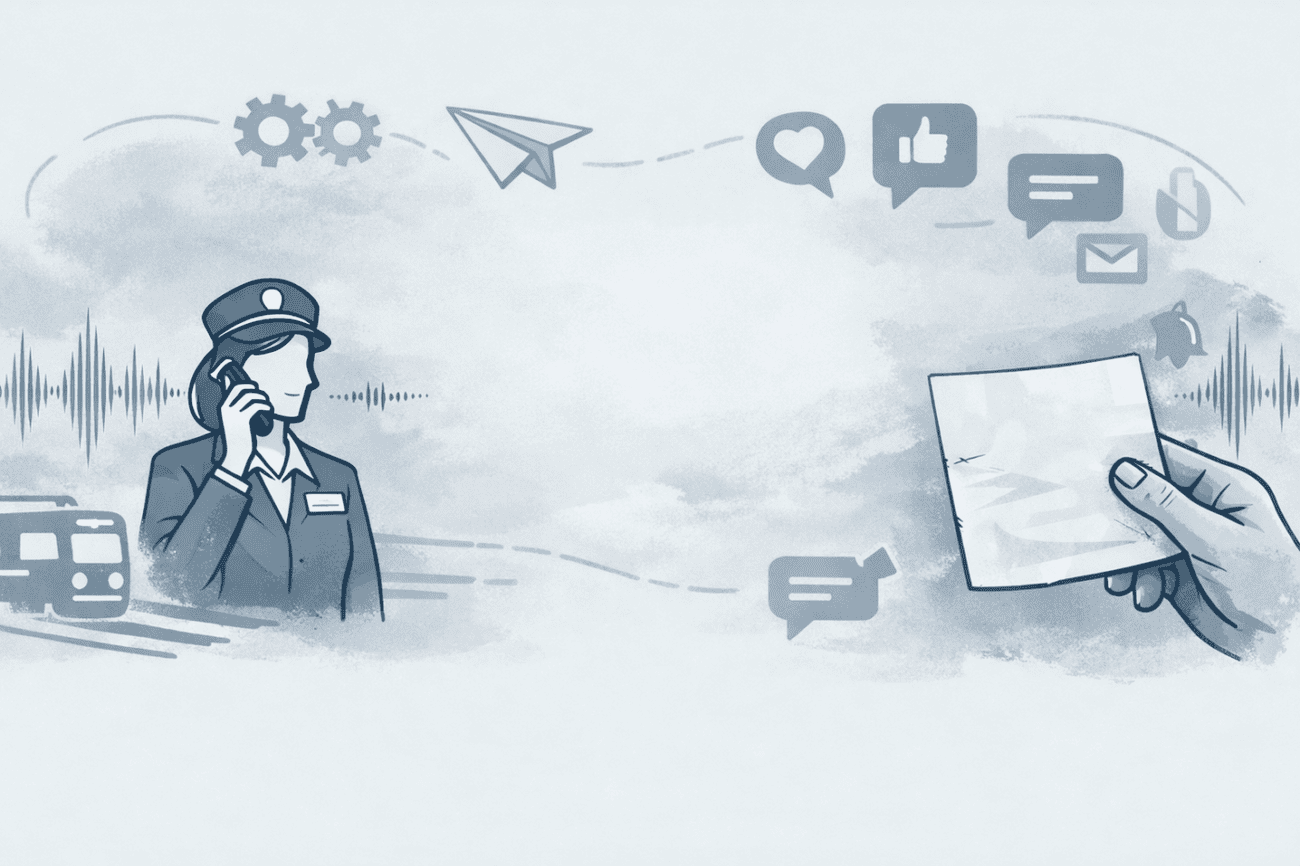
An employee at the station counter says to a passenger: "I don't know, but I'll make a quick call to the control center." No script, no process - just a moment of sincerity. Or a baker who doesn't post a prepared statement in response to a social media question, but a photo of a handwritten note: "Yes, the bread was too dark yesterday. I'm sorry."
They are small scenes. And perhaps that is why they are so moving. Not because they are extraordinary, but because they remind us of something that has long been taken for granted: that authenticity does not come about when everything is done right, but when someone is really there.
When communication works - but nothing happens
Many organizations have learned to optimize communication in recent years. Processes have been accelerated, tones standardized and responses standardized. For good reasons: Efficiency creates reliability, and reliability creates trust.
But with perfection comes a new challenge. Today, communication can be correct without triggering anything. It fulfills expectations, but leaves no trace.
This has less to do with technology than with perception. People sense very precisely whether a response arises from a situation - or whether it was already predetermined. The more communication is automated, the more sensitive we become to small signs of presence: uncertainty, reflection, the brief hesitation that shows someone is really listening.
Authenticity does not come from mistakes. But it becomes visible when someone does not try to make mistakes immediately invisible.
Why personal encounters are becoming more important again
Precisely because so much has become digital and scalable, the value of personal encounters is changing. It is not becoming more important because technology is failing, but because it cannot achieve something: genuine reciprocity.
In a personal situation, not everything can be prepared in advance. People react to each other, adapt, change their tone. Communication becomes something common again, not something played out.
This also explains why simple gestures are more effective today than big campaigns. An honest answer, an open admission, a conversation without visible intent - all of these create closeness because they are not completely controlled.
For brands and organizations, this does not mean a rejection of professionalism. On the contrary. It demands a new form of professionalism: the ability not to control every moment.
Authenticity cannot be manufactured - but it can be made possible
Many companies are currently trying to actively stage authenticity. But this is precisely where a contradiction arises. As soon as authenticity is planned, it loses its effect.
What can be shaped, however, are the conditions. Spaces in which employees are allowed to react not only correctly, but also humanely. Communication that is not immediately judged. Leadership that does not see uncertainty as a weakness.
Authenticity is not a communication tool. It is a consequence of attitude.
This makes them difficult to plan - and valuable at the same time. Because in an environment in which many things have become interchangeable, trust is created where people feel that not everything is interchangeable.
Final thought
Perhaps this is the real change of our time: not that we have less technology, but that we are learning to differentiate more precisely again. Between what works and what touches.
And perhaps this is where the art of communication begins today - in the willingness to become visible again.
By the way ...
You can feel the real thing, even if you don't know why.
Laura Colledani and Klaus Ammon have more than 40 years of combined experience in consumer research and marketing research. Over the years, they have developed a keen sense of what moves people - even beyond the numbers. Both authors advocate a communication culture that listens before it broadcasts. With the new approach of consumer listening management tools, they want to support marketing managers in not only questioning consumers in the traditional way, but also entering into a genuine relationship with them.


