
The power of emotions
The 2008 HarbourClub Symposium Focused on Emotions.


A year ago, the organizers of this year's symposium could not have imagined how topical the choice of venue would become. In our days, the stock exchange symbolizes the connection between business and emotions like no other place. The Chairman of the Board of Directors of SIX Group, Prof. Dr. Peter Gomez, recommended directing emotions in our difficult times in such a way that they sustainably link society and the economy. This means that not only the economy, but all stakeholders, down to the individual shareholder, employee and consumer, must show understanding for the whole. And that also means, for example, building up risk acceptance. General uncertainty can only be reduced if responsibility is not only demanded, but also assumed.
Games, the new leading medium?
Much has been written about the crisis in the print media and also that young people are beginning to turn away from television. What is less well known is that sales of sound recordings, including downloads, as well as films and DVDs, have also been falling steadily in Switzerland since 2006. However, the sales curve for games is on a steep upward trend. Prof. Daniel Süss from the Zurich University of Applied Sciences sees electronic games as the leading medium of the future. He recommends that corporate communications managers learn to better understand the gamer generation. Gamers are characterized by a greater willingness to take risks, prefer trial-and-error strategies, are less easily discouraged by failure, and display a strong social orientation with a willingness to benefit from the expert knowledge of others. According to Süss, the more negative characteristics of this new generation are that gamers trust information too easily, are strongly influenced by emotional signals and show an increasing reduction in attention span. However, he was unable to provide any patent remedies for communications managers. On the one hand, it is certainly important not to miss the trend of online communication, including the creation of game offers. On the other hand, this flood of online and mail information triggers great stress experiences, which could reactivate the willingness to use "old" media such as print.
Clear trend toward emotainment
Miriam Meckel, Professor at the Institute for Media and Communication Management at the University of St. Gallen, gave an impressive presentation on the trend away from the pure communication of information. To this end, she looked at Barack Obama's communications during the presidential election campaign. The campaign team consciously used social networks. It was no longer television that set the agenda, but rather Obama's supporters themselves, inspired by SMS messages, video clips on YouTube or personalized e-mails, who disseminated the election messages tens of millions of times, thus demonstrating the potential of viral community communication in an impressive way. This was accompanied by what Meckel calls emotainment. In addition to the level of factual information, it encompasses the participation of the target groups and relies on the highest possible level of transparency and authenticity.
HARBOURCLUB
The HarbourClub offers its members, heads of communications at major Swiss companies and organizations, a platform for personal exchange of experience. Founded in 2000, the club also aims to promote the professionalization of the corporate communications function and to communicate its importance. Once a year, the HarbourClub organizes a public symposium on the current state of corporate communications in Switzerland. www.harbourclub.ch

Prof. Daniel Süss, Zurich University of Applied Sciences
Sciences.
Sciences.
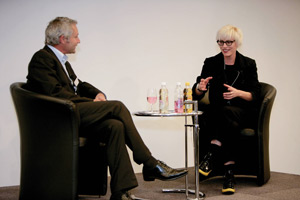
Moderator Dani Nieth and Gabriela Manser.
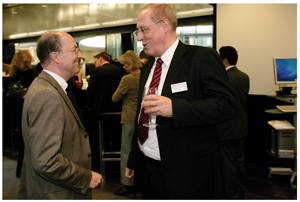
Bruno Schmidt, Metadesign, and Erhart von Ammon,
Amoeba.
Amoeba.
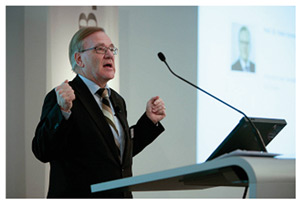
Peter Gomez, Six Group.


