
„The Ambassadors“ with a remarkable message
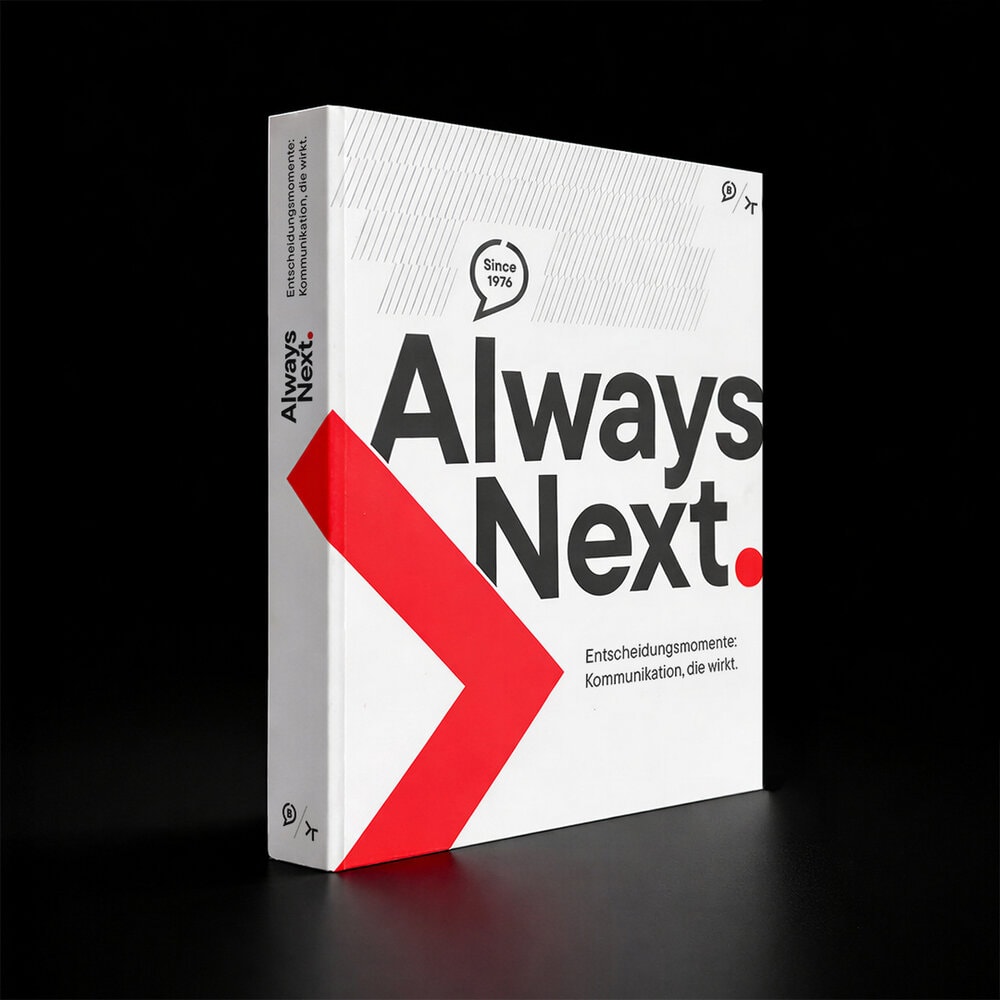
The agency „Die Botschafter“ celebrated its 50th anniversary on the summit of Säntis. They also published the book *Always Next*—featuring over 130 contributors. Axel Thoma answered questions from m&k.


m&k Die Botschafter is celebrating its 50th anniversary—a remarkable milestone in an industry that is constantly changing. What makes it particularly special for you personally to celebrate this anniversary at a time when the communications landscape is undergoing such a profound transformation due to artificial intelligence?
Fifty years is a remarkable milestone in any industry. In ours, it’s especially so. This anniversary evokes three feelings in me at once: humility, pride, and curiosity. Humility toward everything that was built and achieved in the decades before my time. Pride in the developments and strategic decisions our current team has implemented. And curiosity about the opportunities and challenges that artificial intelligence will still bring. What makes this anniversary special is that it doesn’t fall during a „business as usual“ period. We are in the midst of a transformation that extends far beyond our industry and permeates every facet of our lives. These are not calm waters for an anniversary, but perhaps exactly the right moment to pause, look back, and at the same time look clearly ahead.
You celebrated the anniversary not only with a celebration on the summit of the Säntis, but also with the publication of the book *Always Next*—featuring over 130 contributors. What was the reasoning behind not only celebrating the anniversary but also using this book to spark a substantive discussion about the future of communication?
In keeping with our philosophy, we didn’t want to simply celebrate this anniversary or look back on past successes. We’re always thinking two steps ahead. That’s why it was important to us to create a catalyst that would spark genuine reflection among decision-makers. And celebrating is more enjoyable when you’re not doing it alone. That’s why we invited over 130 thought leaders to join us in discussing the future of communication. The result is not a mere retrospective, but a collective look ahead. Added to this is a conscious decision to go against the grain: In a world full of fast-paced digital content, AI-generated posts, and superficial recommendations, this book—both in terms of content and physical feel—stands as a statement for greater depth. Less business, more reflection. This isn’t just a whim; it’s a stance.
The book brings together more than 130 perspectives on five key questions—attention, relevance, dialogue, trust, and integrity—in the age of artificial intelligence. How did the idea for these five specific questions come about, and why did they strike you as the central themes for the future of communication?
These five themes follow an internal logic that we’ve come to understand through years of practical experience. We work with clients from a wide variety of sectors, ranging from the public sector to B2B and B2C companies. And time and again, we find that, fundamentally, the same success factors apply regardless of industry or context. We like to say internally: The message is created in the mind of the recipient. This means that, first and foremost, you need attention—without it, you won’t reach anyone. Relevance ensures that people stay engaged. Genuine dialogue sparks interest and is the prerequisite for trust. And integrity is the foundation of every lasting relationship, whether between politicians and citizens or between companies and their customers. We have deliberately examined these five dimensions through the lens of artificial intelligence. Because right now, at a time when it’s becoming increasingly difficult to determine which information is genuine and which is not, these principles of effective communication are taking on even greater importance. We wanted to start at the decision-maker level and spark a reflection that goes beyond day-to-day business and «prompting.».
The 130 contributors include regional governors, members of the National Council and Council of States, business leaders, and communications experts. What surprised you when you read through the various perspectives—were there any surprising commonalities or contradictions among these different stakeholders?
What really surprised me as I read through the contributions was the consistency across all areas. Whether it’s a district administrator, a business leader, or a communications expert: no one assumes that artificial intelligence will replace communication itself. In interactions of low personal significance, agents will communicate with one another. But where it really counts—in dialogue, in building trust, in persuasion—humans remain the decisive factor. What also impressed me was that the contributions are, at their core, decidedly humanistic. There is no scaremongering, no hostility toward technology, but also no blind enthusiasm. The contributors call for mindfulness and approach this development with remarkable composure. This is not naivety, but maturity. The conviction that emotions, credibility, and genuine human connection cannot be delegated runs like a common thread through all 130 voices. This has reinforced my own perspective: Impact arises between people. AI changes the means, not the standard.
A central theme of the anniversary event was the role of artificial intelligence in decision-making processes. How does the book address the relationship between AI-supported decision-making and human intuition? What opportunities and risks do the contributors see?
The book does not address this relationship as a direct question to the contributors, but it runs like a common thread through all the chapters. It becomes particularly clear when it comes to trust and integrity: AI can prepare, accelerate, and scale decisions. But the responsibility for their impact remains with humans. This is not a limitation, but a mindset. The opportunity lies in the fact that AI improves the basis for decision-making, recognizes patterns, and reduces complexity. The risk arises when responsibility is unconsciously handed over to technology. In this context, integrity means precisely not doing that: whoever communicates must take responsibility for the impact of their communication, regardless of the tool they use to do so. Especially in the public sphere, this is understood as a leadership issue. Susanne Hartmann Gillessen, State Councilor and Head of the Department of Construction and Environment for the Canton of St. Gallen, writes: „AI can draft construction plans, but it doesn’t take responsibility if the roof leaks.“ And she sums up the attitude: „Integrity is demonstrated by the fact that at the end of a chain of automated processes, there is still a person who says, “I take full responsibility for this.’” Human intuition remains indispensable, especially where context, emotion, and relationships play a role. And that is almost always the case in communication.
The panel agreed that direct exchange and structured dialogue are becoming increasingly important. How is this topic addressed in the book—and what specific examples illustrate how trust is built through communication?
The book devotes an entire chapter to dialogue, and the message is clear: Direct, human interaction is becoming increasingly important, precisely because AI seems poised to replace it. What concerns me personally is that dialogue between people is often exhausting and tedious. It requires time, patience, and a willingness to question one’s own opinions. Yet that is precisely what is needed for mutual understanding and sustainable solutions. With AI, there is a risk that this very willingness will diminish. When it comes to controversial topics, opinions today seem to be formed more quickly, and the willingness to engage in discourse appears to be waning. Algorithms confirm what we already think. That’s convenient, but dangerous. Trust isn’t built through efficiency, but through personal interaction. Mathias Müller, mayor of Lichtensteig, provides a concrete example in the book. He describes an encounter on the street in which a citizen directly addressed him about a problem. He listens, agrees to resolve it, and for the citizen, the matter is settled. „I promised to resolve it. For Werner, the matter was settled.“ Here, trust is not built through grand gestures, but through direct exchange, commitment, and the feeling of being heard.
Is the book more of a theoretical treatise on the future of communication, or will readers also find concrete guidelines and best practices that they can immediately apply in their work?
This book does not claim to be exhaustive, nor does it offer any magic formulas. That was never the intention. What it does offer are over 130 perspectives from thought leaders who speak from their own practical experiences. This makes it very practical, even though it doesn’t contain step-by-step instructions. Ultimately, readers decide for themselves what they take away from it. Our goal was to provide inspiration that encourages reflection. Readers of this book won’t walk away with ready-made answers. But they will walk away with better questions. And in decision-making, good questions are often more valuable than supposed certainties.
With contributors from the worlds of politics, business, and academia, the book covers a wide range of contexts. Are there sector-specific insights, or do the core principles of effective communication apply across all sectors?
Ultimately, these contributions reflect our work and the decision-makers who entrust us with their responsibilities. We have always been convinced that diversity leads to better insights and, consequently, to better results. It is precisely this diversity that we wanted to highlight and make actionable. No sector-specific insights can be derived from this. What has been confirmed once again, however, is that the fundamental principles of effective communication apply across all sectors. Whether in politics, business, or academia, attention, relevance, dialogue, trust, and integrity are not industry-specific concepts. They are universal.
In his speech, Peter Thoma emphasized that there have been massive upheavals time and again—with the computer, the Internet, and now with AI. How does the book address this question: What remains constant in communication, and what is truly new?
Nothing is as constant as change. This is especially true in the field of communication. Our book clearly illustrates this: From the color lab to the Mac and the Internet to generative AI, the range of possibilities has steadily expanded. At the same time, the diversity in media usage among target audiences is greater than ever before. But budgets aren’t growing at the same rate. So what remains? The need to make conscious decisions, set priorities, and do without. The courage to focus our message and resources, rather than communicating in all directions at once. And the goal of touching both the heart and the mind. That was true in 1976, and it remains true today. The five success factors—attention, relevance, dialogue, trust, and integrity—are not new. What is changing are the tools of the trade, the means of communication, and the channels. But anyone who believes they can achieve impact with the latest tool alone is mistaken. Impact comes from attitude, not technology.
Integrity is one of the five core issues. In an age of disinformation and polarized discourse, how does the book address the ethical dimension of communication and the responsibility of decision-makers?
For us, integrity is not an academic concept, but a way of life. As a communications agency, it has always been—and remains—our commitment to act in accordance with our principles. Even when that’s uncomfortable. Even with clients. This occasionally leads to friction. But friction generates energy, and that is ultimately the standard by which we want to be measured. Especially in times when AI generates content at breathtaking speed and the line between real and artificial is becoming increasingly blurred, integrity takes on greater importance. Jussi Saunamäki of Grapevine Helsinki sums it up: Without human judgment, speed quickly replaces responsibility. Linda Müntener of the Department of Education of the Canton of St. Gallen adds: Integrity is the moment when we pause before we optimize. Not everything that is technically possible through automation is also socially desirable. This reflects our conviction exactly. Anyone who communicates bears responsibility for the impact of their communication. This responsibility cannot be delegated to a machine.
The book features perspectives «from Switzerland and abroad.» Which international insights differ most markedly from Swiss perspectives on communication and decision-making?
To be honest, the book does not reveal any clearly discernible cultural differences between the international and Swiss contributions. This surprised us a bit, but it is ultimately an insight in itself. Just as „good management“ is considered universal, the basic principles of effective communication in the age of AI also seem to apply across cultures. This may be partly due to our briefing, which steered the contributors in a certain direction. More likely, however, is that the five success factors are situated at the right meta-level. Attention, relevance, dialogue, trust, and integrity know no national borders.
If you were to summarize the 130 chapters—what is the book’s central message to readers who must grapple with the fact that communication is becoming increasingly important in an ever-more-complex world?
Reaching a consensus was never the goal of this book—and that was intentional. Contradictions are part of everyday life for decision-makers. The book aims to encourage personal reflection, not to provide a blueprint. Those looking for a clear-cut message will not find it here. And that’s a good thing. What I personally take away from this and would like to share: Let’s not let ourselves be driven by efficiency. Let’s use the opportunities that AI opens up to strengthen genuine dialogue between people, not to automate or replace it. For we face major challenges—socially, politically, and economically—that we as humans must solve together. And solving them together means: talking to one another, listening, grappling with issues, and understanding. We cannot delegate that to machines. That would not only be a loss of quality. It would be a loss of humanity.
The answers were generated with the help of AI. They were always based on the interviewee’s thoughts, key points, and approvals. The AI was used solely for linguistic refinement.


