The brand doctor
Heusser Communicates has been conceiving and designing corporate and marketing communications for 19 years. With the new, specialized unit Healthexplained, the agency underlines its special expertise in health communication. In both business units, owner Thomas Heusser is concerned with building companies as brands.


Knowledge is power, could be the motto of Thomas Heusser (50). Heusser is the founder and owner of the design and communications agency Heusser Communicates as well as the new business unit for health communication Healthexplained. For Heusser, it is clear that knowledge transfer is an effective marketing tool in many industries. Companies can share their knowledge in a way that positively resonates with their brand and is always associated with it. Heusser also knows how to achieve such an effect: "People decide within seconds whether an offer appeals to them or not. Seemingly insignificant signals are enough to bring about a decision. Non-verbal codes such as images, symbols, colors or shapes have a particularly strong signaling effect. We develop these brand-specific codes and use them specifically in the right environment."
Heusser regards each of his clients as a brand. And for each of these "brands" he defines an individual communication style that correlates with the client's corporate culture. Because the recipient should recognize at first glance where a publication comes from and the attitude of its author - and establish a positive connection with the sender of the information. Heusser refers to this customer-specific style of language and images as knowledge rhetoric. "Knowledge rhetoric that is precisely aligned with the brand guarantees that the brand always resonates when knowledge is conveyed," explains Heusser. "In this way, the target group always associates the provider with the same values. This strengthens its image and anchors it with the target group. Knowledge rhetoric is thus part of the brand architecture."
What sounds abstract seems to work: Heusser reports on a client who tried for years to acquire certain customers. He was not perceived on the market, he outlined his problem. "We defined how the company should appear on the market, built a website, created basic communication tools such as image brochures and sales documents, and a trade show booth," Heusser reports. "After a few weeks, this client gave us feedback: the customers he had previously tried unsuccessfully to win over for years had suddenly approached him on their own. A great compliment for us."
Unmistakable handwriting
Heusser Communicates has been around since 1991, initially under the name "Studio Heusser Kommunikation Design". Heusser, his team of nine and additional freelance specialists develop branding concepts and communication strategies, logos, word marks and complete customer magazines, design websites, annual reports, brochures, company portraits as well as training and sales documents. Among the companies that have had their image refined by Heusser Communicates are Barry Callebaut, SRG SSR idée suisse, Nestlé, Künstlerhaus Boswil, Berner Kantonalbank and various SMEs. An important part of the agency's clientele is also recruited from the healthcare sector: Among others, the Hirslanden private hospital group, the Hirslanden Clinic, the "Im Park" Clinic, the Hirslanden Heart Center, the Swiss Tumor Institute, Nestlé Professional, Astra-Zeneca and the Swiss Heart Foundation have relied on Heusser's flair for the essential.
Over the past 19 years, Heusser Communicates has developed unique expertise in preparing health topics for experts and laypersons. The agency is particularly strong in the development of communication
concepts, in the expressive illustration of publications and in the creation of illustrations. "We have worked out our own illustration technique," says Heusser. "On the computer, we combine anatomical illustrations with photos. For example, we show a photo of a leg, but we depict the knee joint as drawn." The illustrations serve a dual purpose: They make diseases and complicated treatments understandable to laypeople. And they look attractive. The agency also conceives and designs e-magazines. The reader of the e-magazine of the Hirslanden private hospital group (http://emagazine.hirslanden.ch/eMagazine_1_09/) can not only browse through the entire magazine online and call up contact addresses and glossaries at the click of a mouse. They can also view animations in the magazine that accompany individual illustrations. The perfect symbiosis of print and online.
Special operation for health
Because more and more medical service providers were commissioning Heusser Communicates, Thomas Heusser came up with the idea of spinning off healthcare communications into a separate business unit. He launched Healthexplained at the end of last year. "By combining our conceptual and design expertise in the healthcare sector under the label Healthexplained, we responded to our clients' needs," explains Heusser. "The label is intended to emphasize our expertise in this segment more strongly. We have almost twenty years of experience in health communication. But it's nowhere near as well known as it should be." Healthexplained offers full service: the agency develops content, devises strategies for design and text, and creates concepts for marketing and image measures, strategic brand building, and integral brand management. And anyone who simply wants to use one of Healthexplained's medical illustrations can download it from the agency's website. With this offer, the unit is targeting hospitals and foundations, physicians and physician networks, pharmaceutical companies, medical technology companies, as well as manufacturers of functional food or other health-related products.
Healthexplained is part of Heusser Communicates. Heusser's employees, who were previously responsible for health communication, also remain the same. However, Health¬explained is staffed by experts specializing in medicine and health. In addition, the new unit is backed by a Scientific Board of doctors and scientists, who provide the agency with specialist advice as required.
Take patients seriously
Thomas Heusser is enthusiastic about working with medical topics: "Health is highly exciting and affects us all," he says. "We conducted a study* with our customers in 2009, which revealed that 99 percent of respondents are interested in health. They are concerned with nutrition and fitness, or even specific medical treatments." Lay people quench their thirst for information by looking through magazines, reading books and brochures, or going online to learn about products and treatments. Of course, they also ask doctors, pharmacists or other professionals for advice. But the trend toward gathering information on one's own is clear. This means that medical information such as clinic websites, patient magazines or brochures must be of high scientific quality and at the same time easy to understand so that they provide reliable orientation for laypersons in the information jungle. "Both patients and medical companies have a strong need for well-prepared medical data," says Heusser. "To achieve high quality in such information, you have to be a specialist. This consideration was the trigger for the founding of Healthexplained."
Apparently, Heusser's approach is well received. Many patients collect the "Mittelpunkt" customer magazine of the Hirslanden Clinic and the "Im Park" Clinic, for which the agency is responsible for the design. "I was amazed when I heard that," Heusser admits. "There aren't many corporate publishing magazines that readers wait for. With most, you're lucky if the post office forgets to deliver them. But our magazines are taken seriously and kept." Which proves: When a publication is well done and adds value to its readers, it enjoys support from the readership. Just like its publisher.
"For any company, honest and competent communication pays off," Heusser is convinced. "In Web 2.0, it is not unlikely that medical offers and products will soon be rated by patients. At the latest then it is important that they have established their knowledge rhetoric with patients and built trust with them." If a patient has to decide between two equally qualified clinics or doctors, sympathy and trust can tip the scales. Or as Heusser says, "The right combination of knowledge and image lead patients to make a confident decision. That's why health information should always be branded. After all, the reader benefits from the company's knowledge. So he should also associate this knowledge with the company." From light cosmetics to complicated surgery, Healthexplained knows which interventions companies can use to build a positive brand image in the healthcare market.
Passion for design
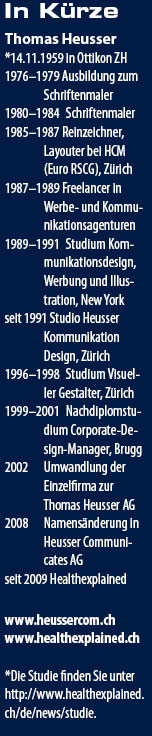
As a boy, Thomas Heusser was fascinated by architecture. Nevertheless, he decided to train as a sign painter. However, the profession did not fill him up. Heusser began working as a freelancer in various design agencies. "During this time, I realized that I didn't have the right basic training," he says. Heusser went to New York to study communication design, advertising and illustration at Pratt Institute. After a year and a half, he returned to Switzerland, took a job and realized that his education still wasn't enough. He graduated as a "visual designer" from the Hochschule für Gestaltung (College of Design) and, after working for a few more years, added a "corporate design manager" degree at the Fachhochschule Nordwestschweiz (University of Applied Sciences Northwestern Switzerland). "I have always been interested in communication topics," Heusser emphasizes. "I'm particularly moved by the question of whether our work actually makes a difference - or rather, how to go about making it make a difference." He seems to have found the answer by now.
Heusser has been self-employed since 1991. Right from the start, Heusser Communicates received orders from medical service providers. "A PR office brought me on board for the corporate design of a hospital magazine," Heusser says. "That was my start in this industry." The initial contact turned into passion: "It fascinates me to look behind doors that I wouldn't normally be allowed to look behind. It's not unusual for a doctor to say, 'Why should I explain everything to you? Come by and watch.' Two hours later, I'm in the operating room wearing a cap and mask." You can't get any closer than that.
Anne-Friederike Wilhelm
Heusser regards each of his clients as a brand. And for each of these "brands" he defines an individual communication style that correlates with the client's corporate culture. Because the recipient should recognize at first glance where a publication comes from and the attitude of its author - and establish a positive connection with the sender of the information. Heusser refers to this customer-specific style of language and images as knowledge rhetoric. "Knowledge rhetoric that is precisely aligned with the brand guarantees that the brand always resonates when knowledge is conveyed," explains Heusser. "In this way, the target group always associates the provider with the same values. This strengthens its image and anchors it with the target group. Knowledge rhetoric is thus part of the brand architecture."
What sounds abstract seems to work: Heusser reports on a client who tried for years to acquire certain customers. He was not perceived on the market, he outlined his problem. "We defined how the company should appear on the market, built a website, created basic communication tools such as image brochures and sales documents, and a trade show booth," Heusser reports. "After a few weeks, this client gave us feedback: the customers he had previously tried unsuccessfully to win over for years had suddenly approached him on their own. A great compliment for us."
Unmistakable handwriting
Heusser Communicates has been around since 1991, initially under the name "Studio Heusser Kommunikation Design". Heusser, his team of nine and additional freelance specialists develop branding concepts and communication strategies, logos, word marks and complete customer magazines, design websites, annual reports, brochures, company portraits as well as training and sales documents. Among the companies that have had their image refined by Heusser Communicates are Barry Callebaut, SRG SSR idée suisse, Nestlé, Künstlerhaus Boswil, Berner Kantonalbank and various SMEs. An important part of the agency's clientele is also recruited from the healthcare sector: Among others, the Hirslanden private hospital group, the Hirslanden Clinic, the "Im Park" Clinic, the Hirslanden Heart Center, the Swiss Tumor Institute, Nestlé Professional, Astra-Zeneca and the Swiss Heart Foundation have relied on Heusser's flair for the essential.
Over the past 19 years, Heusser Communicates has developed unique expertise in preparing health topics for experts and laypersons. The agency is particularly strong in the development of communication
concepts, in the expressive illustration of publications and in the creation of illustrations. "We have worked out our own illustration technique," says Heusser. "On the computer, we combine anatomical illustrations with photos. For example, we show a photo of a leg, but we depict the knee joint as drawn." The illustrations serve a dual purpose: They make diseases and complicated treatments understandable to laypeople. And they look attractive. The agency also conceives and designs e-magazines. The reader of the e-magazine of the Hirslanden private hospital group (http://emagazine.hirslanden.ch/eMagazine_1_09/) can not only browse through the entire magazine online and call up contact addresses and glossaries at the click of a mouse. They can also view animations in the magazine that accompany individual illustrations. The perfect symbiosis of print and online.
Special operation for health
Because more and more medical service providers were commissioning Heusser Communicates, Thomas Heusser came up with the idea of spinning off healthcare communications into a separate business unit. He launched Healthexplained at the end of last year. "By combining our conceptual and design expertise in the healthcare sector under the label Healthexplained, we responded to our clients' needs," explains Heusser. "The label is intended to emphasize our expertise in this segment more strongly. We have almost twenty years of experience in health communication. But it's nowhere near as well known as it should be." Healthexplained offers full service: the agency develops content, devises strategies for design and text, and creates concepts for marketing and image measures, strategic brand building, and integral brand management. And anyone who simply wants to use one of Healthexplained's medical illustrations can download it from the agency's website. With this offer, the unit is targeting hospitals and foundations, physicians and physician networks, pharmaceutical companies, medical technology companies, as well as manufacturers of functional food or other health-related products.
Healthexplained is part of Heusser Communicates. Heusser's employees, who were previously responsible for health communication, also remain the same. However, Health¬explained is staffed by experts specializing in medicine and health. In addition, the new unit is backed by a Scientific Board of doctors and scientists, who provide the agency with specialist advice as required.
Take patients seriously
Thomas Heusser is enthusiastic about working with medical topics: "Health is highly exciting and affects us all," he says. "We conducted a study* with our customers in 2009, which revealed that 99 percent of respondents are interested in health. They are concerned with nutrition and fitness, or even specific medical treatments." Lay people quench their thirst for information by looking through magazines, reading books and brochures, or going online to learn about products and treatments. Of course, they also ask doctors, pharmacists or other professionals for advice. But the trend toward gathering information on one's own is clear. This means that medical information such as clinic websites, patient magazines or brochures must be of high scientific quality and at the same time easy to understand so that they provide reliable orientation for laypersons in the information jungle. "Both patients and medical companies have a strong need for well-prepared medical data," says Heusser. "To achieve high quality in such information, you have to be a specialist. This consideration was the trigger for the founding of Healthexplained."
Apparently, Heusser's approach is well received. Many patients collect the "Mittelpunkt" customer magazine of the Hirslanden Clinic and the "Im Park" Clinic, for which the agency is responsible for the design. "I was amazed when I heard that," Heusser admits. "There aren't many corporate publishing magazines that readers wait for. With most, you're lucky if the post office forgets to deliver them. But our magazines are taken seriously and kept." Which proves: When a publication is well done and adds value to its readers, it enjoys support from the readership. Just like its publisher.
"For any company, honest and competent communication pays off," Heusser is convinced. "In Web 2.0, it is not unlikely that medical offers and products will soon be rated by patients. At the latest then it is important that they have established their knowledge rhetoric with patients and built trust with them." If a patient has to decide between two equally qualified clinics or doctors, sympathy and trust can tip the scales. Or as Heusser says, "The right combination of knowledge and image lead patients to make a confident decision. That's why health information should always be branded. After all, the reader benefits from the company's knowledge. So he should also associate this knowledge with the company." From light cosmetics to complicated surgery, Healthexplained knows which interventions companies can use to build a positive brand image in the healthcare market.
Passion for design
As a boy, Thomas Heusser was fascinated by architecture. Nevertheless, he decided to train as a sign painter. However, the profession did not fill him up. Heusser began working as a freelancer in various design agencies. "During this time, I realized that I didn't have the right basic training," he says. Heusser went to New York to study communication design, advertising and illustration at Pratt Institute. After a year and a half, he returned to Switzerland, took a job and realized that his education still wasn't enough. He graduated as a "visual designer" from the Hochschule für Gestaltung (College of Design) and, after working for a few more years, added a "corporate design manager" degree at the Fachhochschule Nordwestschweiz (University of Applied Sciences Northwestern Switzerland). "I have always been interested in communication topics," Heusser emphasizes. "I'm particularly moved by the question of whether our work actually makes a difference - or rather, how to go about making it make a difference." He seems to have found the answer by now.
Heusser has been self-employed since 1991. Right from the start, Heusser Communicates received orders from medical service providers. "A PR office brought me on board for the corporate design of a hospital magazine," Heusser says. "That was my start in this industry." The initial contact turned into passion: "It fascinates me to look behind doors that I wouldn't normally be allowed to look behind. It's not unusual for a doctor to say, 'Why should I explain everything to you? Come by and watch.' Two hours later, I'm in the operating room wearing a cap and mask." You can't get any closer than that.
Anne-Friederike Wilhelm