The eurozone becomes an online dream
About 80 percent of all marketing decision-makers plan to invest more in online marketing in 2009 than they did in 2008. A survey conducted in 14 European countries confirms expected trends but also reveals some surprising insights.


With its sixth "Digital Marketing Compass" study, Neo@Ogilvy has once again presented an interesting PR and analysis tool. Together with market researcher Skopos, the German branch of Ogilvy's global digital and direct media network took a close look at 873 media decision-makers in 14 European countries. They were asked about their investments, budgeting and their attitude towards online marketing.
First the unsurprising fact: Online advertising in all its forms is enjoying growing popularity. "79 percent of the media decision-makers surveyed - from both large companies and SMEs - say they plan to invest more in online media in 2009 than in 2008," says Nicolas Noth, Head of Switzerland and Austria at Planetactive/Neo@Ogilvy. "This includes mobile marketing as well as search engine marketing, direct e-mail and classic display advertising." It has also been shown that online media is already used as frequently as traditional media in Europe.
Significant country differences
Nevertheless, there are clear differences in the weighting of digital measures in the various countries. In Germany or Switzerland, display advertising or web services are used more frequently than on average, while email marketing is less important. This contrasts with countries such as Turkey, Italy, Belgium and Sweden, which use email marketing more frequently than average.
In addition, the growth of digital marketing varies greatly from country to country: while in Belgium the share of online media in the media budget is likely to rise from 14 to 16 percent (2009), the corresponding share in the UK will increase from 27 to an estimated 30 percent (2009). The information provided by the Swiss media decision-makers surveyed indicates a share of 17% in 2008 and a potential increase in this share to 20% in 2009. The European average is 22% and 24% respectively.
Nevertheless, Swiss expenditure is surprisingly high at 17 and 20 percent. It should be noted that this figure includes all forms of digital marketing, including online presence. In addition, the actual expenditure in the online sector is likely to be somewhat lower, as these are survey figures. In any case, they indicate where the media mix is heading: the 17 percent spent on online marketing in 2008 compares with 17 percent on sponsorship and events, 13 percent on PR, 6 percent on other and 48 percent on traditional advertising. In 2009, online will gain three percent and PR two percent, while traditional advertising and other forms of advertising will lose.
Online: Advertising overload as the greatest danger
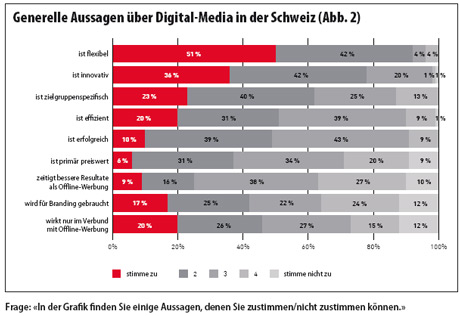
When it comes to the greatest strengths of online marketing, the responses from media decision-makers paint an unmistakably clear picture. The following statements received a lot of approval: better target group reach, high reach, speed and flexibility. There are a few differences between Switzerland and the national average. Abroad, many respondents saw online marketing primarily as a cost-effective tool. In Switzerland, significantly fewer respondents shared this simplified view. On the other hand, the Swiss are more skeptical about the success of digital marketing measures and still believe that traditional media works better (see Fig. 2).
Other major differences between Switzerland and other countries are that in Switzerland the budget for online media is determined much more individually for individual campaigns and activities. E-mail marketing with external addresses plays only a minor role in Switzerland, whereas search engine marketing and optimization are used more than average in this country. However, Switzerland and other countries are equally of the opinion that advertising overload is the main danger of online media.
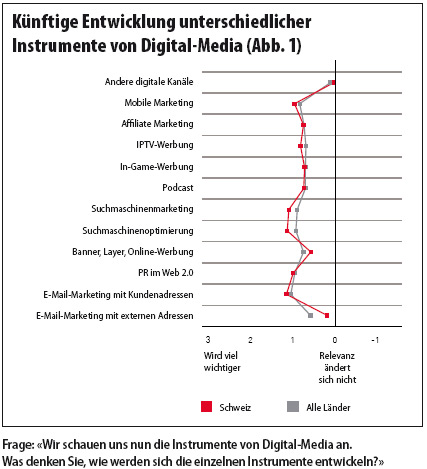
With regard to the growth prospects of online instruments, people in Switzerland are very optimistic overall (see Fig. 1), more optimistic than in most other countries. The Swiss see the greatest potential in mobile marketing, search engine marketing and optimization and email marketing with customer addresses. Just as Swiss media decision-makers are more optimistic in the online sector, they are more pessimistic with regard to traditional advertising media. According to their assessment, poster advertising and TV are facing zero growth, cinema and radio will be weak and print will lose somewhat more.
The survey also showed that media budgets are primarily split between online and offline. The allocation of funds is often made dependent on current market activities or the success of the previous year. Only 15 percent of respondents draw up a general annual plan. All in all, the study found a clear trend towards quality and professionalization in the online sector. More and more digital marketing tools are being implemented by specialized agencies.
Michael Koller
Digital Marketing Compass 06
The "Digital Marketing Compass" study will be published for the sixth time in May 2009. It was conducted by Neo@Ogilvy together with the market research company Skopos. With the subtitle "Digital marketing in times of crisis", the question of how budgets will change in 2009 compared to previous years is of particular interest. The survey questioned 873 media decision-makers from large companies to SMEs with budgets ranging from under 1 million to over 100 million euros. The survey was conducted in the 14 European countries of Switzerland, Italy, Germany, France, the UK, Belgium, the Netherlands, Sweden, Turkey, Portugal, Poland, Spain, Denmark and Austria.