"Marketing is too focused on the individual"
The consumer goods industry is in despair, says Simonetta Carbonaro. Many brands no longer know who they are—or what customers want. *Die Werbewoche* spoke with the consumer psychologist about brands that have lost their way, overwhelmed consumers, and marketing mistakes.


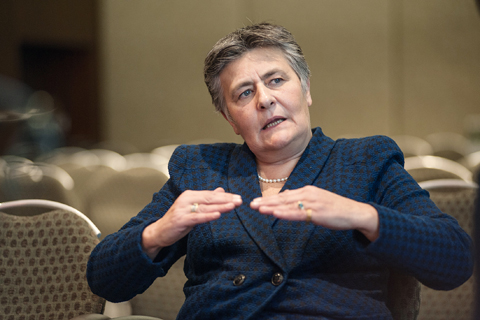
WW: Simonetta Carbonaro, you have been advising companies on brand management and communication for over 20 years. What keeps you most busy at the moment?
Simonetta Carbonaro: Something I would call brand archaeology. Many of the big historical brands have lost their identity in the last two decades. I work with them to excavate the core of their brand again - hence the term archaeology. I advise them strategically on the level of brand management and revitalize the core cell of the brand. This means first and foremost to establish brand principles and to cast them into operational business rules for all core areas of the company - from innovation management to sales. This is the only way to ensure that the brand can once again fulfill its leadership function and become tangible for both employees and customers. Communication comes second. If you know who you are and why you do what you do, it is easier to appear convincing and up-to-date.
Why have brands lost their identity?
Many were seduced by lifestyle marketing and the very fashionable experiential marketing. They followed short-term trends, ran after the wishes of the customers and called it all customer orientation. In the process, they forgot what their real role is in business and in society: namely, to give the customer orientation. As a result, these brands stopped being what they were and became what they thought they had to be according to customers. A good example of this is greenwashing, which marketers used to try to appeal to new critical consumers. But people don't want greenwashing, they want honesty.
Can you give an example of a brand that you have revitalized?
Coop Italia. About four years ago, the cooperatively organized retail chain wanted to raise the profile of its brand in an increasingly competitive environment. We accompanied them in the repositioning of their communication and brand identity and developed a radical but very authentic new form of communication together with them. The primary aim was to convey the values of the Coop brand to customers in a simple, direct and honest language (see figure). For example, on posters featuring private-label products, we expressed what Coop stands for: good, safe, ethical, affordable, and ecological products. On other posters, we conveyed the brand's principles: "Foie gras, no grazie." - "Test on animals, no thank you." - "GM food, no thank you ..."

//www.youtube.com/watch?v=a1pSDXX83Nw
In other words, companies must define their own values, pursue them consistently and communicate them to the outside world?
You can sum it up like this: "Being what you say you are. And saying what one is." It is no longer a matter of communication of seduction. Just the idea that communication should seduce is passé ... The emotional dimension in communication remains, of course. If customers know what is essential about a brand, what it stands for, they are quite receptive to emotional stimuli or rather "emotive messages".
What is the trigger for the reconsideration on the part of the companies?
The crisis. It may be less noticeable in Switzerland so far, but it is very present in many neighboring countries. Sales have plummeted dramatically. The wake-up call, as we all know, always comes from the Excel spreadsheets. But there is also a second dimension. People have realized that we are not in a temporary crisis, but in a profound transformation. We don't come back to the starting point like in Monopoly and start all over again. This has arrived on the brand management floor. Brand managers who understand something about brand management recognize that the upheaval has to do not only with the market economy, but with society as a whole. And that they cannot simply adapt to it, but must also see themselves as a kind of agent of this transformation.
What does this transformation look like?
In times of crisis, as history has shown time and again, people realize that they cannot make it as individuals. Under uncertainty, people instinctively tend to band together. Not for altruistic or ideological reasons, but purely pragmatically on the basis of selfish altruism. It is understood that public spirit is needed. Societies historically have always been based on communities. The sense of community was only temporarily lost in modernity, which was oriented towards individuality.
What about politics?
This no longer represents a reference point. People have understood that they have to take their fate into their own hands.
For years, they have been talking about the affluent society, about "over-muchization. Material abundance overtaxes people and makes them tired. Now a change in thinking is taking place. This change is limited to Western countries, right?
Yes, especially Europe. The emerging markets currently want to experience the same fairy tale of the economic miracle as we did in the 1950s. That is, of course, their right. But: While it took half a century for our Western societies to achieve this abundance, the emerging markets have adopted our consumption habits much more quickly. At the same time, criticism has also been sparked more quickly. Many people in Brazil, China and India are already questioning our consumption model and the values behind it.
How did "over-multiplication" come about?
The "over-multiplication" is a result of hypersegmentation. Marketing has been too focused on the individual for years. First it was target groups with a certain lifestyle. Suddenly we had arrived at one-to-one categorization. Finally, the target group was the individual. It's exasperating to stand in front of the store shelves today and see the countless products that all claim to be different, and yet in the end are all the same. Consumers are overwhelmed by the range of products on offer. And for companies, it's very expensive. Because the cost of hyper-differentiation is not offset by sales. This shows how desperate the consumer industry is. It no longer knows what the customer wants, nor who it is.
Given the large number of consumer surveys, isn't that downright paradoxical?
Very! It's time to reorient ourselves. Consumer research with conventional methodology is old news.
What is the problem?
Consumers should no longer be viewed top-down, from above, and analytically deterministically divided into market segments, as is often done in market research. People are not the monsters described in marketing manuals. He is not a multi-optional, volatile, schizophrenic being whose needs are unpredictable. Especially in uncertain times, consumer needs can be anticipated very well. But to do so, it is necessary to understand the sociocultural drivers of our society via social science approaches and their impact on people's lives via participatory methods. This is an inductive process and contrasts with the deductive mechanistic practice of classical marketing, which includes neuromarketing, which has become fashionable. In analyzing the response of individual brains to external stimuli, I learn very little about people's actual concerns and problems.
Isn't the problem also that marketing has become distanced from the rest of the company?
Yes, marketing has become a separate department in many places in recent years, interpreting and seductively implementing customer surveys and benchmark studies. Marketing runs parallel to other departments - and comes too late in the value chain. This results in product ideas that have little to do with the brand. How can new products be designed if you don't start with the brand? It is the brand that designs products from the idea. The brand i s the company.
We have now talked about brands that have lost themselves. Surely there are also those that have remained true to themselves...?
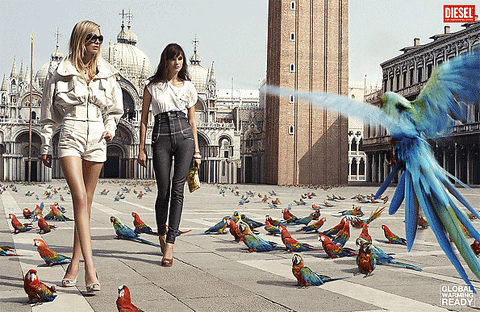
Sure, let's take the fashion industry as an example. Here there are some brands that have held on to their identity. Some of them very cynically. Diesel, for example, has even allowed itself to mock the big wave of responsible consumption - ecology, fair trade, climate change. For example, with a big campaign in which colorful parrots flew around Venice instead of pigeons. The example shows: Sticking to brand values does not mean being a sustainable brand. That is independent of any morals.
At the same time, new fashion brands dedicated to sustainability have emerged in recent years.
Yes, I find Honest By by Bruno Peters, a young designer, particularly interesting, for example. His fashion is based on sustainability and transparency - without becoming health food fashion. On the website (Honestby.com), the entire value chain can be tracked transparently. Not only where the material comes from, but also the profit margin becomes visible. Complete price transparency. A model like this is a bomb! Let's imagine that all brands were at this level of transparency ...
Patagonia also has an interesting culture of transparency. The brand is not only known for the Footprint ChroniclesThe other thing that's interesting is the disclosure of the supply chain. What also impresses me is that the brand communicates in which areas it has managed to be sustainable - and where it is not yet sustainable. That's very bold. Most big brands only highlight their assets.
What advice do you have for brands that have lost their core - and not yet found it again?
I always ask my customers the following question: "What would the world be missing if they didn't exist? "If you can't think of anything clever to say, goodbye! Today, we are flooded with products and services. There is less and less room for brands that don't make sense. Consumers today no longer define themselves by what they buy. It's no longer "I store, therefore I am," but "I am, therefore I store." When we're willing to spend our money today, we don't just want to consume. We want to invest in something meaningful. In something that helps us as human beings.
Interview: Isabel Imper
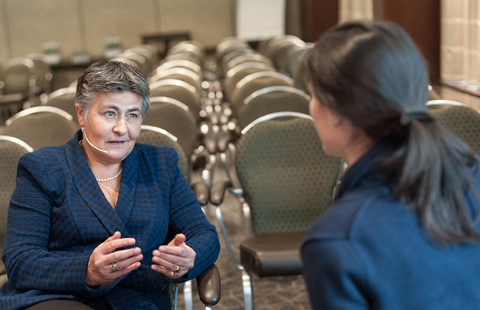
In a nutshell
Simonetta Carbonaro is one of the thought leaders and pioneers in today's world of retail and the consumer goods industry. She is a consumer psychologist and expert in innovation and brand management. As Professor of Humanistic Marketing and Design Management in Sweden and Visiting Professor at the London College of Fashion, she researches in the fields of consumer behavior and social and cultural change in our global societies. She is a member of the Advisory Board of the International Trade Conference (IHT) of the Gottlieb Duttweiler Institute (GDI) in Rüschlikon/ Zurich and has been advising international companies on brand management, communication and product development for over 30 years.
New business models
//www.youtube.com/watch?v=pYX65D0ceXA
Crowdsourcing Website Quirky.com.
Changemaker: Ethics kisses aesthetics: Changemaker.ch.
Clothes with a story: Iouproject.com.
Merci: Merci-merci.com.
"Management changes and sales thinking prevent sustainable brand management"
At the invitation of Ogilvy & Mather, Simonetta Carbonaro gave a talk in Zurich at the end of January and gave clients and potential new clients of the agency an understanding of "over-multiplication" and the transformation process (you can find an article on this in here). This has shown: The developments mentioned by the consumer psychologist also concern the Zurich communications agency.
Gaby Zimmerli, Managing Director of Ogilvy & Mather, elaborated on four topics for Werbewoche.

Brands in search of identity
We repeatedly experience that companies or customers "work" on their brand identity, but that frequent management changes and short-term sales thinking prevent sustainable brand management. Many companies prefer to initiate short-lived initiatives and activities instead of reflecting on the real identity of the brand and working out how this brand identity should be expressed and presented in today's world. To engage with the brand means to deeply engage with the brand and also to closely observe, study, understand and interpret the relationships that the target groups have with the corresponding product or service. And that is hard back-breaking work.
"Over-multiplication"
The "over-muchization" presents us with great challenges every day.
- I'm thinking of the ever-changing new channels, new technologies, new information to communicate and report on that we all have to deal with.
- But I'm also thinking of customers and companies that want to communicate as much and as extensively as possible about their products and services over and over again instead of limiting themselves to the essentials.
- And I am thinking of the countless product range extensions, product variations and other "optimizations" of a product or service, which clearly contribute to "over-multiplication" and whose sense and purpose could be questioned.
(Too) many channels to interact with customers - (too) little budget
"Essentiality" is the answer here. We persistently try to get the customer to focus on what is most important and essential and to set clear priorities. It's imperative to avoid getting bogged down. A clear message, a clear communication and media strategy and a strong idea are key. Most of the time, less is more or, to quote Simonetta Carbonaro, "perfect enough" is good enough.
New sense of community?
We clearly perceive this change. Social media are nothing other than a clear expression of the "Me" to the "We. The more anonymous, multicultural and multi-optional society becomes, the greater the desire and longing for security, orientation and community. Social networks, associations, spiritual or religious communities, etc. are possible answers. Crowdsourcing is another good example. We also create platforms for customers, which in turn are forums for exchange and promote a sense of togetherness.