
The eye on the point
Using a new method, eye-tracking can also provide cost-effective yet valuable insights online when pre-testing campaigns.


Cost effective method thanks to online
With the help of a new tool, eye tracking can now also be carried out online - at low cost and with a manageable effort. The method is offered in Switzerland by Marketagent. com Zurich. The system was developed in Vienna by the university spin-off company Dr. Berger Consult. Sebastian Berger is a university professor and lecturer at the University of Vienna and Megatrend International University Vienna. Among other international awards, Berger has been nominated twice for the Vienna Future Prize. In 2002, the development of the first online eye tracking methodology "Spotlight-Viewer" began at the Department of Marketing at the University of Vienna as part of a doctoral thesis. Since then, numerous publications and awards have proven the quality of this measurement tool. In 2012, the method was awarded by the editors of the renowned European Journal of Marketing and published in the top US scientific journal "Psychology and Marleting".
Sharp or blurry? That is the answer here
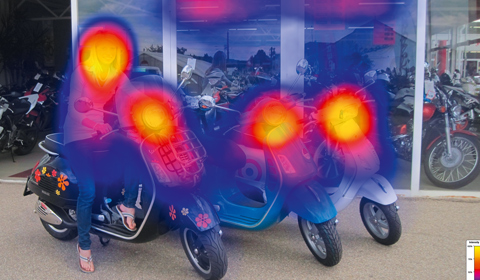
In the online eye tracking patented for university spin-off activities, the centrally sharp and peripherally blurred vision is projected directly onto the computer screen of the test person according to the physiological conditions of the human being. The test persons move the sharp field of vision with the computer mouse to those sections that interest them. On the basis of the viewing history recorded in this way, the advertiser learns what is paid attention to and what is ignored. Online eye tracking is now being used successfully by market research companies and panel providers, advertising and web agencies, media companies and media agencies, and advertising companies. These want to use it to optimize their advertising in terms of its attention-grabbing effect.
Science knows: 95 percent of advertising is not seen. That's why pretests must be conducted as early as the design process to ensure that the target group pays attention to the key advertising elements, in order to minimize the financial risk associated with advertising expenditure. Conventional infrared eye tracking was too expensive for this, "and the results are also distorted due to the artificial laboratory situation," says Sebastian Berger. Similarly, in previous methods, "the recording of mouse tracks and clicks do not form a reliable indicator of attention, because, for example, the mouse arrow rests when the user is reading something". The Spotlight viewer now measures much more accurately what the consumer perceives. This new online gaze registration has the following advantages: Participation takes place in a familiar atmosphere, for example at home.
Large sample numbers and target group comparisons are possible because online eye tracking is fast, simple and cost-effective. Online eye tracking can be easily integrated into existing online surveys and flexibly combined with other instruments such as mindspotters. All visual advertising stimuli such as advertisements, brochures, posters, product arrangements, packaging and websites can be tested. The Mindspotter can also record the memory traces left by these attention processes in the brain using "brain scanning". pan

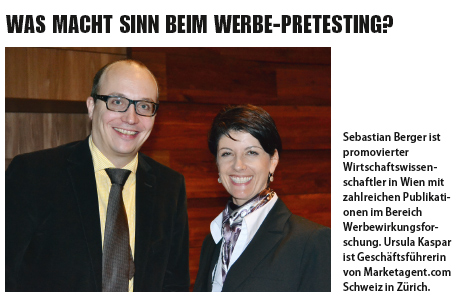
WW: What does a customer need to know when they want to pretest?
Ursula Kaspar: First you have to know: What do you actually want to achieve with the advertising pretest? Is it to test alternative ideas, is it to determine optimization potential, do you want to filter out the best spot or just learn for the future? If you don't think about this beforehand, you have a fundamental problem.
Why does it make sense to test a campaign in advance?
Although the world has turned massively, a study from 2003 that illuminated the mechanisms involved in pretesting is still relevant. Agencies and clients were unanimous in this: with more than 80 percent agreement in each case, they want to "track down potential for optimizing a campaign". In second place in importance, with around half of the agreement, is "finding out the specific impact mechanisms." Support for a "go or no-go" with a campaign was important for around 29 percent of the agencies surveyed. Clients obviously want a bit more certainty here. Of these, 45 percent want to support the decision to continue with a pretest. The will is usually strong, and the intentions are louder. But when it actually comes to implementing the pretest, many hurdles lurk. Often, timing is already a problem, and pretesting is thought of when the spot is about to air. But pretesting should not be an end in itself. If you already know what campaign you want to launch, then it's hardly worth testing. And if a TV spot has already been shot, hardly any changes or improvements will be made. It has been found that more than half of the spots that were tested at a very early stage for their optimization potential later performed exceptionally well in the market, whereas the spots that were only tested at a final stage had a significantly lower success rate.
What role do the target groups play?
It is necessary to precisely describe the target group. You can't apply the same scheme to everyone in a test. If a test is to be integrated into an "omnibus" because the budget is tight, one has to ask oneself: Is it really worthwhile to show concrete ideas for a campaign to a general population? Most of the time it is more promising to make socio-demographic or psycho-demographic restrictions or to directly ask the category user.
Other stumbling blocks?
If you only want to send one spot into the race, it becomes a bit difficult. If the test shows that the campaign could go down the drain, you have a small problem - because there is probably no alternative in the short term. It may be that one wants to compare differently designed advertising media - mostly because one already prefers a design route. However, the subject's imagination is relatively limited, and so the more elaborated advertising medium often performs better. Direct comparison of advertising media is also difficult, just as when comparing old against new. After all, if a well-known spot is presented that already has a positive effect, it will probably do better in the test than a new concept.
Interview: Andreas Panzeri


