
Customer Analytics Greetings from Las Vegas


CUSTOMER ANALYTICS The 15th Gartner "Business Intelligence & Analytics Summit 2014" took place in Las Vegas between March 31 and April 2. Around 2,300 attendees were keen to keep up to date with the latest developments and recognize trends at an early stage with the latest presentations and keynotes.

Is customer analytics simply gambling at a slightly higher level?FROM CHRISTOPH OGGENFUSS*The fact that the conference was held in the Venetian Hotel, with its medieval-like ambience and next to hundreds of slot machines and gaming tables, got me thinking. How real is customer analytics really? Isn't it just gambling on a slightly higher level? Is the analytics spook over as soon as you leave the conference, fly away from Las Vegas and return to sober everyday life?"Technology is everywhere"As we entered the conference, Kurt Schlegel, Vice President from Gartner, on: "Technology is everywhere" In this regard, he raised the following questions:- Will we see the last generation learning to drive a car?- When will pizza be delivered by drone?- Will our future revenues come primarily from the networking of devices and no longer from sales? (Philips)Such statements are indeed thought-provoking - at least the last one sends shivers down my spine - what is the point of marketing, sales and communication?Marketing significantly more analyticalHowever, one thing can already be anticipated: In the future, business life and thus also marketing will be significantly more analytical. The quantity and quality of the available data and the user-friendly evaluation tools will inevitably lead to a more quantitative approach to solutions. In addition, marketing, sales and service activities will become more measurable in the digital world. Naturally, this pleases the management, which is responsible for the use of resources.Important development steps of Customer AnalyticsWell over 1000 charts were shown at the conference - but the one below is certainly one of the most central. It essentially illustrates two things. On the one hand the compelling connection between data and decision/action and on the other hand the development that the tools have gone through in the last years.
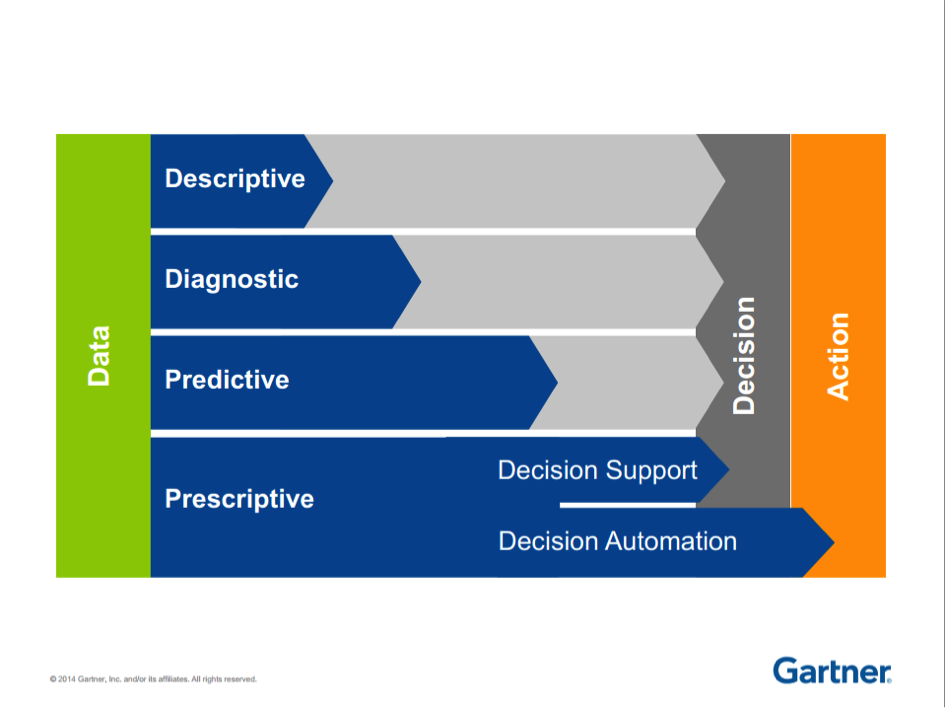
Companies and marketing departments strive to make better decisions with the help of available data. So far, this has only been partially successful. First efforts were on the descriptive level with simple analysis tools.Logical connections visibleAn answer could be given to the question "what happened? However, to get from this insight to a decision or a relevant action is the big challenge that only a few companies have been able to master so far. Increasingly, diagnostic tools emerged that could make logical connections in the data visible. "Then came predictive tools that help us to sharpen our view of the future. Multi-dimensional evaluations allow us humans to recognize invisible patterns in the data, to make them visible and comprehensible, and thus to make predictions, e.g. about the purchasing affinities of existing customers. This is a breakthrough in the direction of decision support. So-called "scored lists" can now be created that classify customers based on their purchase probability.Prescribing analyticsThe latest field that was the hot topic at the Gartner conference in Las Vegas this year is called "Prescriptive Analytics". Somewhat reminiscent of the family doctor who prescribes me something after I've been diagnosed. Prescriptive analytics is the ultimate bridge between data as the starting point, the relevant decision and, in particular, the instruction to act.Has the machine thus taken over the marketing function? Definitely not, but the "machine" creates a solid foundation for needs-based and personalized marketing, which has often been preached but not realized until now.Customer analytics becomes a realityWith the recent development, customer analytics has definitely become a strategic corporate reality - chief marketing officers are challenged to take advantage of the opportunities and prove to the CEO that the allocation of resources in marketing was correct.


