
Cross-channel purchasing behavior challenges retailers
A study by the University of St. Gallen shows which retailers are succeeding in Switzerland through cross-channel management.


The study examines the shopping behavior of 2,780 cross-channel affine customers. Cross-channel affinity is defined as customers who can name a retailer where they are familiar with both the online store and the store and where they can remember a specific purchase. The customer purchasing processes analyzed show that online stores are often used as a source of inspiration and a starting point for purchases. In the clothing sector in particular, many customers visit a retailer's online store first. Purchases from the electronics, entertainment media, food and cosmetics sectors still primarily begin in the retail store, but the online store is already in second place in the ranking. Looking at the entire purchasing process, the online store is now just as important as the retail store.
Search engines, price comparison portals and competitors' sales channels popular for cross-channel purchasing
In general, the online contact point (63.3 percent) has even become slightly more important than the retail store (62.6 percent), while a quarter of customers visit both channels. Search engines (39.4 percent), conversations with friends and acquaintances (18.6 percent), price comparison portals (16.7 percent) and the retailer's newsletter (14.5 percent) play a major role in the purchase decision. Consumers also frequently visit competitors online and in-store when shopping. Customers who visit several of a retailer's sales channels use competitors' sales channels more frequently than those who only shop online or in-store. In almost seven out of ten cross-channel purchases, a competitor is visited during the purchasing process. In contrast, a competitor is visited in only five out of ten pure online or in-store purchases. Cross-channel affine customers get an overview of the services of different retailers before completing the purchase at their preferred retailer.
Who wins the favor of choosy cross-channel customers
Swiss cross-channel retailers are particularly popular with Swiss consumers. Five of the ten most frequently named cross-channel retailers in Switzerland are domestic companies. Migros and its companies are particularly popular as cross-channel retailers in Switzerland and occupy the top three places. Coop and Interdiscount are also among the top 6 (see chart).
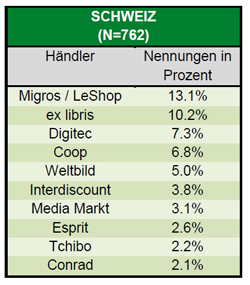
Compared to 2011, Interdiscount, Media Markt and Esprit have also become much better known among Swiss consumers. Compared to the two neighboring countries of Germany and Austria, cross-channel retailers from the food (25 percent) and entertainment media (21 percent) sectors are particularly well known in Switzerland, while in Germany and Austria it is mainly retailers from the clothing sector (40 percent and 32 percent respectively).
The online stores of cross-channel electronics retailers are very popular in Switzerland. Compared to German and Austrian consumers, Swiss consumers visit their electronics retailer's online store far more often and also spend proportionally more money there.
How retailers in the DACH region (Germany, Austria and Switzerland) are trying to respond to customer change
Retailers are trying to respond to changing shopping behavior by responding flexibly to customer wishes and steering customers from the online store to the store. The study shows that customers are particularly aware of some of their retailer's cross-channel services. These include the option to use the retailer's customer card both online and in-store (increase in awareness of 9 percent since 2011), click & collect services that allow products to be ordered online and collected in-store (increase in awareness of 13 percent since 2011), and the option to check the availability of certain products in the retailer's stores in the online store (increase in awareness of 18 percent since 2011). Measures designed to bring customer frequency from the retail store to the online store are declining from the customer's perspective. The service of being able to access the retailer's online store in-store via tablet or terminal is perceived 17% less frequently than in 2011. Customers are also less likely to notice references to the online store in the retailer's store (-15%).
Thomas Rudolph, Research Center for Retail Management: "30% of consumers already combine both online and offline contact points in the purchasing process. This widespread cross-channel behavior requires consistent, sustainable and synergetic marketing."
The study can be downloaded at this link be ordered.


