
Content marketing on the rise


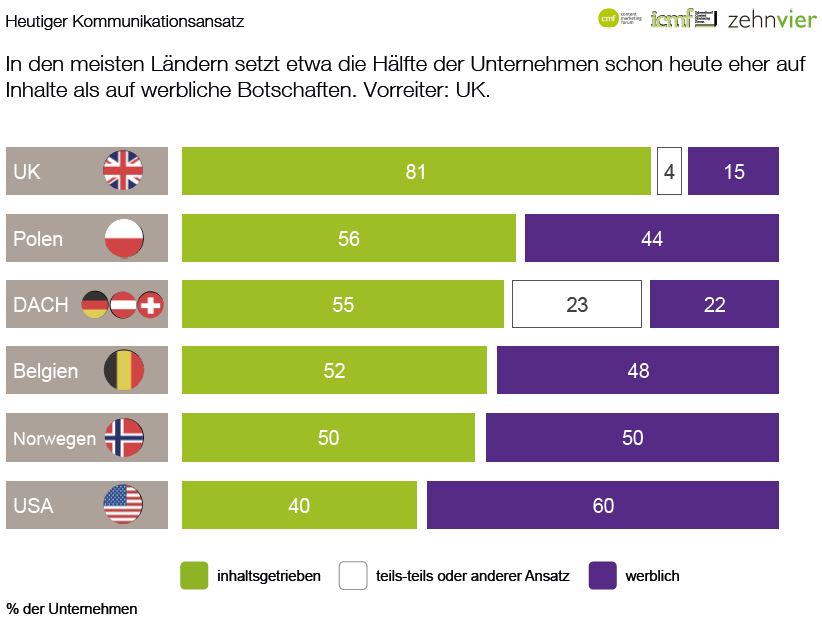
Content takes the lead: Internationally, more and more companies are turning to content marketing. This is confirmed by the first international content marketing study by the ICMF.For the study, over 700 communications managers from eight countries were surveyed on the "State of Content Marketing" and the future of content marketing. The study was initiated by the Content Marketing Forum, and designed by the market research and strategy consulting firm zehnvier, Zurich.The survey, which covers not only the German-speaking countries, the United Kingdom, and the United States, but also individual countries in Scandinavia, the Benelux countries, and Eastern Europe, shows that in most countries, about half of the companies are already focusing on content-driven communications: In most countries, about half of the companies already rely on content-driven communication rather than promotional messages (Poland 56%, DACH 55%, Belgium 52%, Norway 50%). The pioneer in terms of content marketing is the UK: Here, 81% of companies already say they are using the power of journalistic content and exciting stories to bind existing customers even more closely to the brand and win new customers. US companies, on the other hand, are currently relying even more on advertising impulses.
For the future, however, the formula on both sides of the Atlantic is: content marketing instead of traditional advertising. Three quarters of American companies (76%) plan to pursue a content-driven strategy in three years. In the European countries, between 80% (Norway) and 92% (Belgium) of the companies intend to rely primarily on journalistic content in their marketing and corporate communications in the future. "The study we initiated shows it clearly: we are - as far as marketing and communication are concerned - in the era of content," affirms Viviane Egli, CMF Switzerland board member.

Content marketing scores along the customer journey - and beyondWhat are the driving forces behind this internationally observable reorientation? First, of course, the limits of advertising. Consumers and other target groups often no longer perceive classic advertising messages at all, are tired of them, or place only limited trust in them. Against this background, it seems only logical that the decision-makers surveyed see the particularly high quality of contact as one of the core advantages of the content-driven communications approach compared to classic advertising (agreement between 56% in the UK and 72% in Norway).So where exactly are the strengths of a content-driven communications strategy? To find out, those responsible for communications were asked for each of the different communication objectives along the customer journey whether, in their view, they could be better achieved by a classic, advertising-based communication approach or a content-driven approach. The results show a very consistent picture internationally: the content-driven approach is seen as having an advantage in six of the eight areas surveyed. With informative, advisory or entertaining and journalistic content, the brand image can be optimized better and the credibility of the brand increased sooner than with advertising messages and impulses. The same applies when it comes to positioning one's own brand as an expert and thought leader. Those responsible for communications also see the content marketing approach as having an advantage when it comes to conveying brand and product information to the target group or winning new customers. The international vote is also clear at the end of the buying process: In terms of "customer loyalty," the study participants consider content-driven communication to be equally superior. The advantages of an advertising communication strategy are limited to increasing brand awareness and creating concrete buying impulses.

Employee-focused content marketing: importance increasing rapidlyIn the view of the study participants, the strengths of a content-driven communications approach also extend beyond the customer-side purchasing decision process: Useful content and exciting stories are also seen as the key to employees' hearts and minds. Communications decision-makers across countries are convinced that editorial content is very well suited to employer branding. It is a better way of presenting a company as an attractive employer and strengthening employees' sense of belonging than using messages with an advertising slant.Cross-country vote: Owned media take the strategic leadAgainst the background of these results, it is not surprising that the majority of communications managers internationally are convinced that owned media will increasingly take the strategic lead in communications. Depending on the country, between 48% (Norway) and 60% (Belgium) of the communications decision-makers see owned media in the lead over paid and earned media in the future. Only a minority of respondents - between 8% (DACH region) and 20% (UK) depending on the market - do not share this view.

At the same time, it is apparent that only a minority of companies across countries have a clearly defined, integrated content strategy: Only 19% each of the German-speaking and British, 13% of the American, 12% of the Belgian, and 7% of the Norwegian companies say they have a clearly defined strategy that covers owned, paid, and earned media.

What is content marketing?The proclamation for content marketing is permanently increasing in the professional world of media, communication and marketing. This refers to the discipline that used to be called custom publishing, corporate publishing, or corporate media and that is anchored in journalism. What is meant is the hustle and bustle - in an expanded sense - with owned, paid, and earned content. Content marketing in Germany, Austria, and Switzerland is defined by the CMF as follows:- Content marketing as corporate, brand, product, and employee communication is driven by relevant, editorial content.- Content marketing uses all available media channels such as print, video, mobile, and online - individually and in cross-media systems.- Content marketing has a measurable effect along the entire customer journey and in internal communication. The communication effects range from increasing awareness to image cultivation and customer loyalty to acquiring new customers and triggering immediate buying impulses.


