
"We developed 'Q' out of pure self-interest".
The advertising industry, too, is in the midst of a digital transformation. Jung von Matt /Limmat demonstrates what this looks like in practice: The agency has developed the internal app «Q,» ushering in a new era for day-to-day work. In an interview with Werbewoche, René Schwarz, Chief Experience Officer, explains how the app is changing and shaping life at the agency.


René Schwarz, Chief Experience Officer, has been part of the Jung von Matt /Limmat management team since 2016.
The Zurich-based agency Jung von Matt /Limmat has grown continuously in recent years and has undergone a fundamental transformation as a result: The approximately 120 employees work in five agile and interdisciplinary units in a project-oriented manner.
So that the teams continue to a Jung von Matt, a central pillar was needed to hold the tool landscape together and promote collaboration. Jung von Matt developed the solution itself: "Q" - named after the James Bond mastermind of the same name. The platform for all employees is intended to promote a common understanding of roles, projects and customers. In addition, "Q" enables a professional exchange, self-organization and personal development as well as an active feedback culture.
For this purpose, employees create their own profile. For example, they can get agency information at a glance, see their weekly schedule, create blog posts, contact all JvM employees in Switzerland directly, access information about past projects, and give or receive support through "do-with actions" - surveys, creative calls for help, openbriefs. With "Q", Jung von Matt /Limmat has made it onto the shortlist at Best of Swiss Apps 2019 - the awards will be presented on November 6 in Zurich.
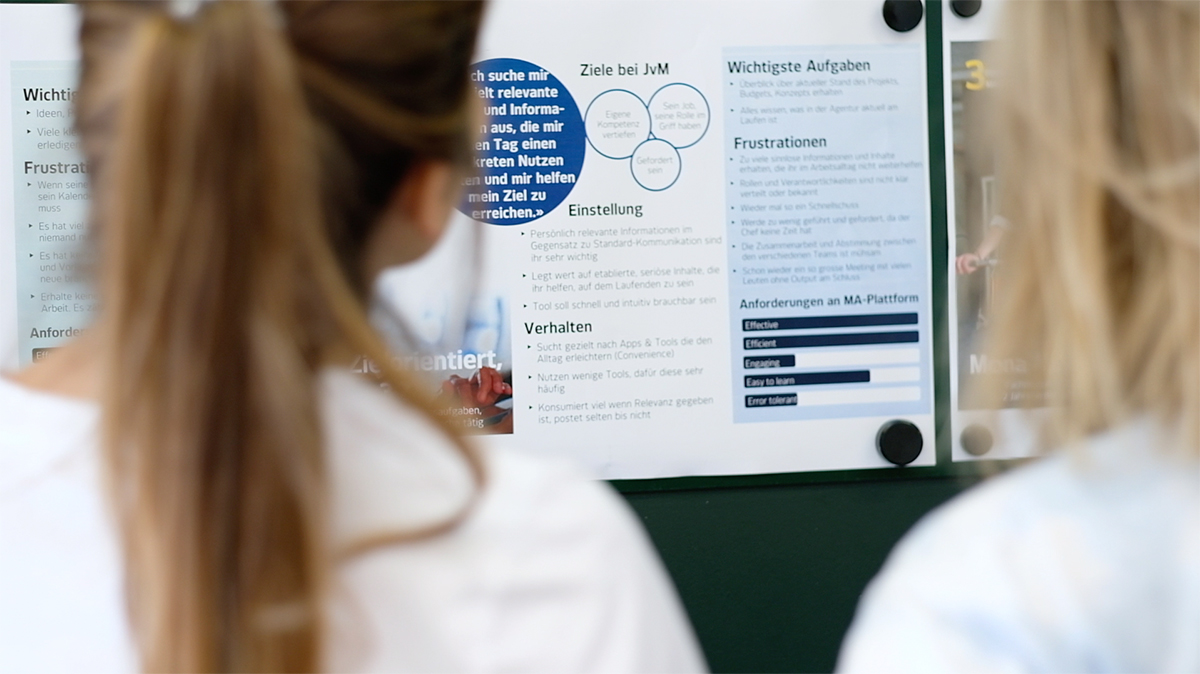
Advertising WeekRené Schwarz, the "Q" app was developed from scratch - probably an expensive affair. Are the investments paying off?
René Schwarz: Looking at today's outcome, the effort was definitely worth it. On the one hand, we were able to apply our way of working agile 100% during development and thus create a prototype project for how we would like to work with customers. We played the whole thing out internally with contractor and client. On the other hand, the project paid off because we were able to develop everything internally and use resources we already had. Also, we didn't have to develop everything from scratch, but could use technology we were already working with. For example, we already used the CMS for Migros' "Grillitarier" app.
Is there anything comparable in the industry that you could take a cue from, or is "Q" a pioneering project?
We don't rule out the possibility that there are already comparable projects in agencies somewhere, but we are not aware of anything in this form. "Q" is 100 percent geared to us and our processes, adopts our systems, our ways of working. Accordingly, we didn't develop "Q" with the aim of making it a kind of industry solution. "Q" was developed out of pure self-interest.
Q" was launched at the beginning of July. How has agency life changed since then?
"Q" has fully arrived in our everyday lives. You often hear here in the hallways, "Hey, did you see? I put this and this on 'Q'." As an info-sharing platform, "Q" complements existing tools very well. It's basically a one-to-many tool that allows you to reach out to the entire agency. It's certainly made a big difference already. And made it easier. We've digitized all our work and made it quickly available on mobile at any time, including the learnings from it. When you're in a meeting, you no longer have to spend a long time searching through a file server; instead, you search for the project in "Q" and all the information is immediately available.
To what extent does the app support internal project planning?
If you are looking for someone for a project, you can see in "Q" who has already worked where, which customers the person serves and you can contact them directly via mail or Slack. You can see who is scheduled for which projects and when. However, the actual planning is done in a separate planning tool by the project managers.
One of the main goals of "Q" is to create a sense of togetherness in the agency, despite the agile and interdisciplinary organization. Can an app compensate for the spirit of fixed teams?
The app is one of many pillars that support the sense of togetherness. To create a "we" across the entire brand, the digital track is central for us. It was clear to us that we didn't want to create an intranet that was only about everyday work and that you only look at in your browser in the office. We chose the mobile channel so that people can also take a look at interesting, inspiring articles posted by other employees while on the streetcar.
In other words, an extension of the workday into private life.
A very voluntary one, yes. No one is forced to look in. The point is that you can be inspired when you feel like it.
Not everyone is made for this kind of interaction. Can a social network like "Q" also create a certain pressure?
I emphasize here again the voluntary nature of the offer. We don't reprimand anyone who hasn't posted anything in the last week. It's the same with us as with all other social media networks: Ten percent post, 90 percent read.
The more that goes on via the tool, the more transparent the employee ultimately becomes?
Here we are transparent and say exactly what we do with the data and what not. We don't do anything with the data from this app, we don't evaluate it. The only thing we look at is the number of visitors and the different devices that access the platform - so that we know whether we have captured the full potential. But it's certainly not the case that we check who was on the app and for how long.
And if someone has never logged in after a year?
The goal is for "Q" to be so exciting and so integral that people go on it as a matter of course. At least on a par with Slack, where a lot of information is exchanged internally today. It would be the wrong approach to try to force anything.
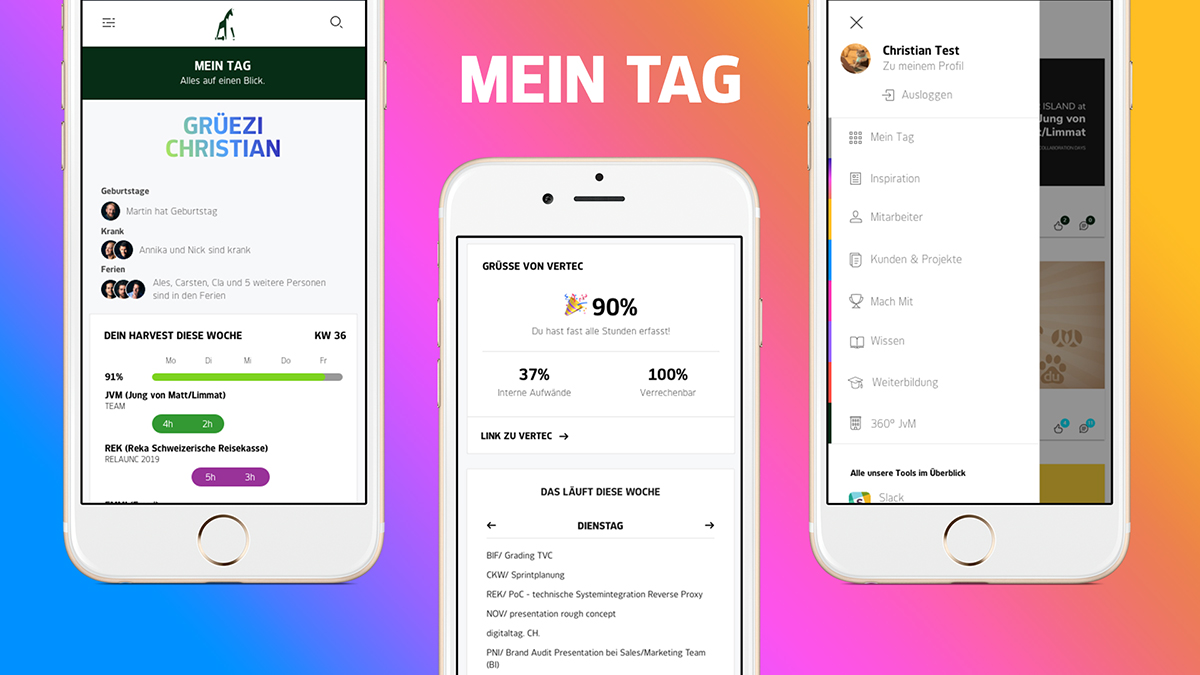
The entire agency in their pocket: The "Q" platform gives Jung-von-Matt employees a quick overview of their weekly planning, absences in the team or current customer projects, among other things.
Has there been any negative feedback or experience?
No, not at all. The employees see the platform as a service. When feedback comes in, it is questions about further expansion stages and desired functions.
For example, what is desired?
For example, being able to enter vacations directly in the app. We're working on that right now. Then there's the whole issue of time recording - something that's a challenge for every agency. There are many requests for this; there are still many possibilities and we are working on that as well.
The more functions you add, the more central data and data protection become, because a lot of personal data is also involved, such as sick days.
Absolutely. Sick days, of course, are not retrievable in a centralized way. The only thing we see is whether someone is sick on the current day. You can call in sick directly with a button - the relevant people are informed. But we are not creating a transparent employee. It is transparent at all times what happens with one's own data.
What role do customers play in this project?
We are currently launching a parallel project for this. Customers will be able to access their projects and call up key figures such as project budget, progress and planning at any time. This will again be a separate app - but for a different target group with completely different access.
That sounds exciting from the customer's point of view - are such tools already widespread?
There are individual solutions that allow you to share the budget with the customer. But proprietary apps that allow clients to keep their budgets under control don't exist, as far as I know. I reserve the right to make a mistake - I don't look into every agency.
A potential competitive advantage.
Exactly. The big advantage is transparency. There's a difference between having to do the math for three weeks first when the customer asks for budget information, and providing him with the figures he wants at any time.
But to what extent are customers already involved on "Q" today?
For example, in the navel review. This is a vessel in which we evaluate our work from the previous quarter internally and via "Q" four times a year. Our customers also evaluate their own projects as part of the navel review. These results can all be viewed on "Q".
What conclusions are drawn from these assessments?
Based on these customer and employee evaluations, we discuss together in the agency what went well and what went badly in a project. This also involves soft factors. Did we make a difference? Was the cohesion in the project team strengthened? Was the work enjoyable? The evaluation via "Q" is anonymous, which was important to us right from the start. It's not about the individual, but about getting a picture of the entire agency.
They are open about the "Q" project, describe in detail how it works and what it involves. A lot of work and resources go into its development. Doesn't that mean you run the risk of being copied and giving away your USP?
You could copy us - but you have to do that first. Concept and functions are very individual to us, do not fit for every agency. And even if they did: It's one thing to come up with the idea and the concept, but it's another thing to implement it, to get it onto employees' cell phones, to make it so performant that it's fun and that people use the app just as naturally as 20 Minuten, Instagram or Facebook.
Have employees placed the app on the coveted first page of the smartphone?
A relevant question - but we haven't evaluated that yet. But we have made tutorials so that employees know how to install the app on the home screen. Since it's a PWA - that is, a Progressive Web App - you can't download it from the App Store as usual, but access it via URL.
Is "Q" also a tool for employer branding?
Definitely. During job interviews, we can show directly what's happening in the agency and have the entire agency on the mobile device, so to speak. We still see a lot of potential for expansion in this area - that we can handle the entire applicant management via "Q," that all news about the application process can be called up, or that we include applicants in a pool so that they also receive a share of news. When a new employee starts working for us, he or she immediately has the entire "operating manual" for the agency available. Within a very short time, you get an understanding of the different roles, processes and the way we approach projects.
In which directions could "Q" develop in the future?
Certainly wherever we can digitize our own processes and benefit from digitization. The navel-gazing mentioned earlier is a small but beautiful example of how this can be done digitally in a light-footed manner rather than with crosses. Above all, processes that are complicated and are usually attached to the ERP somewhere - time recording, vacations, absences, illnesses, etc. - can be handled quickly and easily. And you can do it when you want to. Vacations are not planned in the office, but at home with family and friends. You don't want to open your laptop and look things up. With "Q", you'll be able to check this quickly on your cell phone in the future.
The article comes from the advertising week 10/2019.


