Gut feeling or logic: Who wins?
Should decisions be made rationally or emotionally? It depends on the circumstances, says Professor Stefan Michel of IMD Lausanne. He suggests a combined approach.


In marketing, in advertising, in politics, in private life: When decisions are made, some trust their intuition, others seek the best solution with logical reasoning. As a consultant and lecturer, I find that many managers pretend to decide rationally, but in reality proceed emotionally and then justify their decisions rationally.
Since Herbert Simon's groundbreaking publication fifty years ago, science has also been concerned with the question of the extent to which decisions can and should be made rationally. Simon describes that many decisions cannot be made rationally because the problems are too complex and people cannot absorb, store and process any amount of information.
The logical method
Nevertheless, it makes sense to approach a problem logically. However, it should not be expected that a logical problem-solving methodology will lead to the only or best result. One widely used method is utility analysis (NWA): For a given problem, various alternatives are defined, as well as criteria against which the alternatives are evaluated. In a second step, the criteria are weighted and the alternatives are evaluated. In my opinion, the advantage of NWA is not so much that the best solution is found. Rather, NWA helps to formulate alternatives, determine target criteria, and evaluate the alternatives. This is especially important when several people are involved in the decision-making process. The people involved recognize where differences of opinion arise: For example, one person wants to keep investments low, another person wants to take risks, a third person wants to maintain the status quo. Another advantage of this quantification is the calculation of sensitivities. For example, one can check at which estimated sales volumes variant A is better than variant B, or how strongly the risk must be weighted so that variant G performs better than variant H. Third, such decision rules are often formally required, for example in tenders for public contracts.
The intuitive method
The logical approach is rivaled by intuition. Time and again, one reads in interviews how successful managers or politicians rely on their intuition when making important decisions. To put it somewhat bluntly: They refrain from systematically examining all the variants, but instead make decisions emotionally. Research results show that intuitive decisions can be more successful than rational decisions, but only under certain conditions. As Gerd Gigerenzer shows in his excellent book "Bauchentscheidungen" ("Gut Decisions"), intuition is based on rules of thumb (in technical jargon, "heuristics") that radically simplify the decision-making process. An often cited example is blitz chess, where grandmasters can play a game of very high quality in five minutes. Since they can only calculate a few positions in this time, they rely on rules of thumb (e.g. castling brings the king to safety, a rook is stronger on a half-open line, etc.). What is important in this example is the realization that grandmasters can rely on their intuition, precisely because they know hundreds of openings by heart and have already played through thousands of positions.
The best method
Even though I can only begin to show the contrasts between logic and gut feeling in this short article, I assume that all readers are familiar with the conflicts: a logical decision is summarily thrown overboard, or an emotional decision is subsequently backed up with an analysis that has been bent into shape.
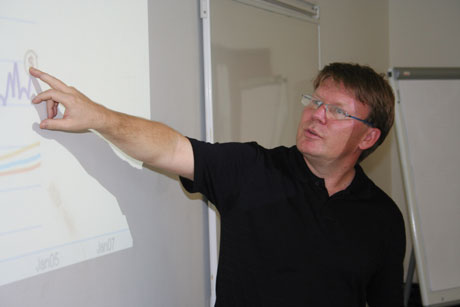
Stefan Michel: "Many managers pretend to make rational decisions, but in reality take an emotional approach."
For the solution of such everyday phenomena Edward de Bono proposes the method of the 6 hats. Each hat represents a decision-making approach (for example, logic, emotion, etc.). Instead of playing these methods off against each other in an uncontrolled way, the participants consciously try to solve the problem with different hats. First, the logic hat is put on and the problem is discussed objectively. Then the problem is discussed emotionally with the emotion hat, and so on. De Bono writes that teams that work with the 6 hats make better and faster decisions. In addition, there is less frustration because it is no longer a question of whether logic or gut feeling wins.
Links
The discussed book titles can be found on www.michel-partner.ch/books.htm.
Wikipedia describes the method of the 6 hats of de Bono on http://en.wikipedia.org/wiki/De_Bono_Hats.
Stefan Michel is Professor of Marketing at IMD in Lausanne (www.imd.ch).