
B2B Marketing Study: What Really Influences Purchasing Decisions
A new B2B marketing study by WARC, LinkedIn, and LIONS Advisory shows that recommendations, relationships, and transparency are key to the success of B2B campaigns—yet they have hardly been used systematically to date.


B2B Marketing Study Shows: Trust Is the Deciding Factor in Purchases
A new B2B marketing study by Warc, LinkedIn, and Lions Advisory takes a close look at the emotional factors that shape B2B purchasing decisions today. B2B purchasing processes have changed: buying cycles now last 272 days and involve 22 stakeholders, with social and emotional factors playing an increasingly important role. In addition, artificial intelligence is changing how B2B buyers discover, research, and validate brands: According to the study, 94 percent of B2B buyers will use LLMs during their buying journey by 2025.
An analysis of more than 700 award-winning B2B campaigns shows that the most effective creative work not only captures attention but also strategically helps build confidence in decision-making. According to the press release, the most impactful campaigns consistently helped buyers feel more confident in their brand choices.
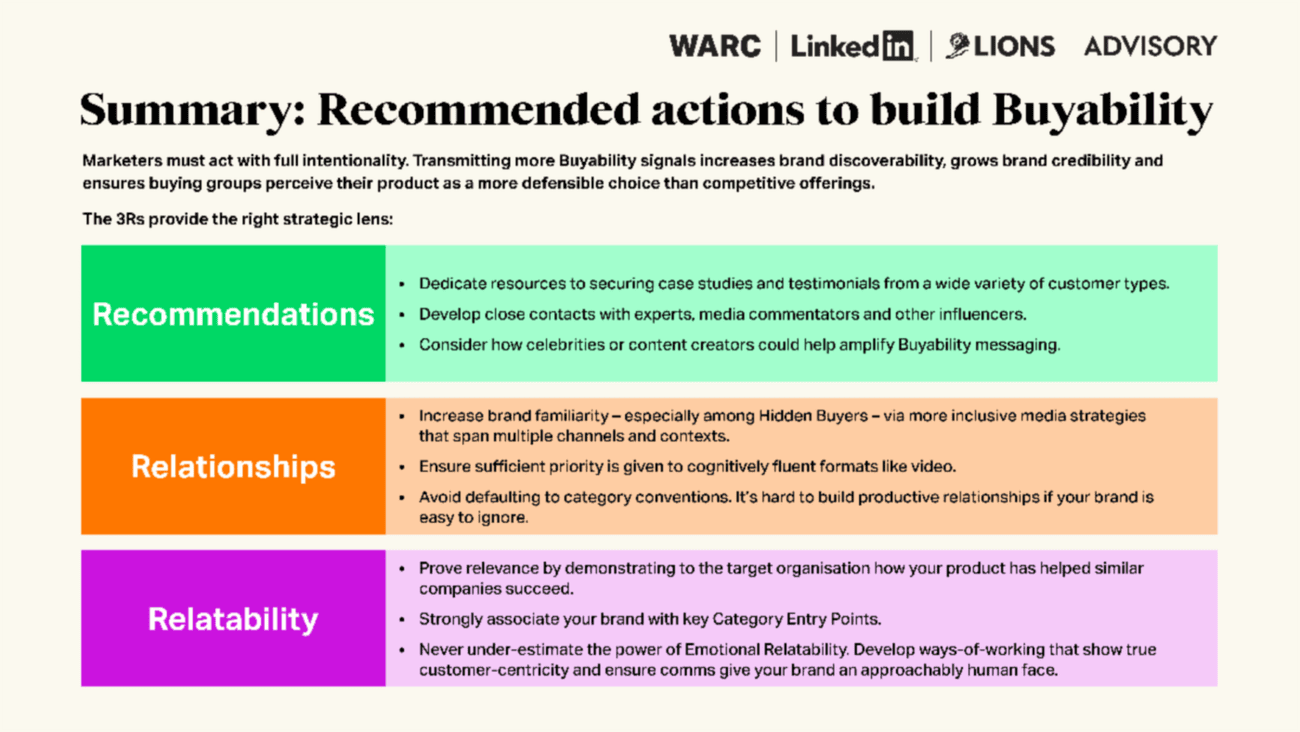
The Three Rs of Purchase Readiness: Recommendations, Relationships, Relatability
The study builds on existing research by LinkedIn and Bain & Company on the concept of «buyability» and identifies seven signals that boost buyer confidence. At the heart of the study are the so-called 3Rs: Recommendations, Relationships, and Relatability.
Recommendations include evidence and validation from customers, peers, experts, or trusted voices. Relationships signify long-term partnerships and existing familiarity. Relatability refers to real customer situations, use cases, and experiences that buyers can relate to. According to the study, personal experiences and trustworthy recommendations drive vendor selection more than performance or price, and messages referencing «similar customers» are said to outperform «market leader» claims.
Imaad Ahmed, Thought Leadership Director at Lions Advisory and Warc, is quoted in the press release as saying: «The Buyability model has been very well received throughout the B2B industry. This new study aims to demonstrate the impact of Buyability using real-world case studies. The goal of our research was to measure how frequently buyability signals appear in B2B campaigns and whether more signals lead to better results.»
Mimi Turner, Head of Marketplace Innovation at LinkedIn, adds: «Buyability provides us with a framework of seven signals that marketers can use to strategically improve campaign results, because it’s based on insights into what gives buyer groups confidence when making a purchase. The campaigns that succeed are those that make purchasing decisions easy to justify.»
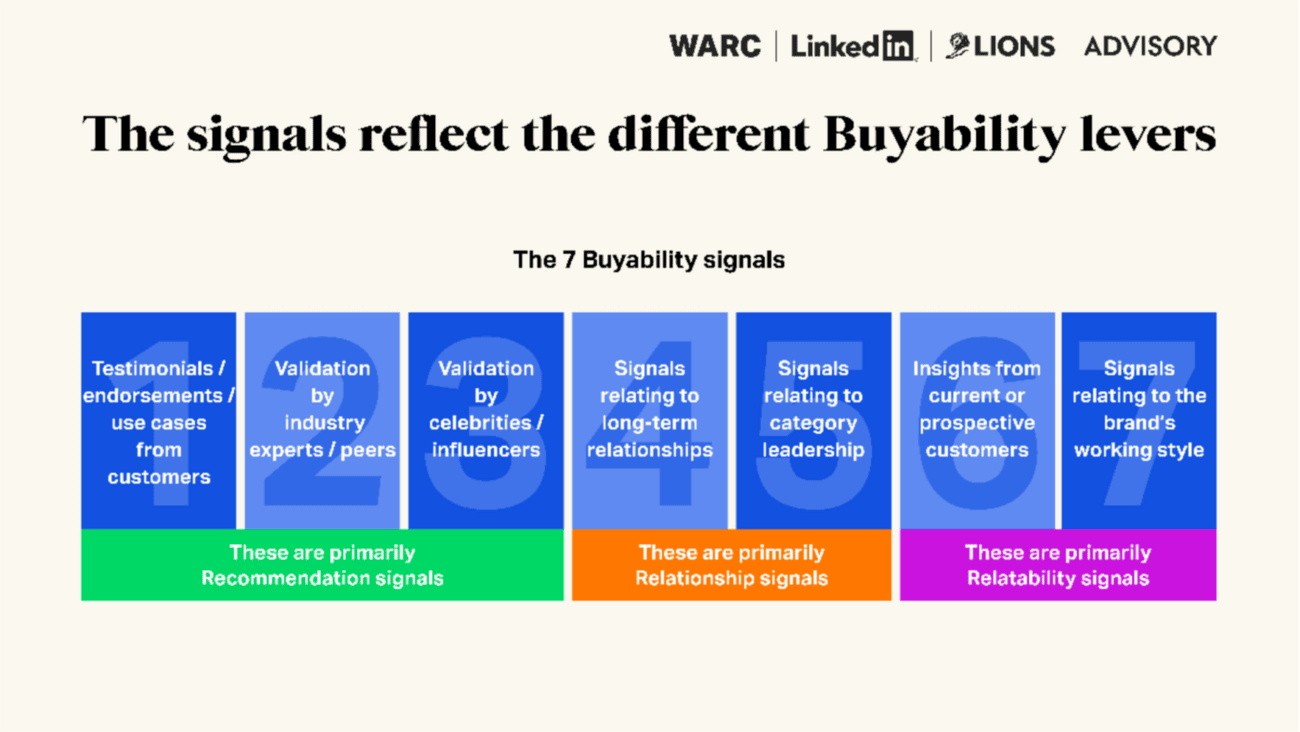
Seven Signals as a Framework for Marketing Professionals
The Buyability Framework describes seven signals for future campaigns, each of which is assigned to one of the 3Rs. These signals are intended to make brands discoverable in AI models, make them appear credible to various stakeholders, and position them as a justifiable, low-risk option. According to the study, it is no longer enough for B2B marketing to increase awareness and consideration—it must demonstrate that it directly generates sales.
The key findings of the study: Buyability signals are clearly underutilized, with an average of just 1.6 signals per campaign. Nearly one-third (30 percent) of campaigns use only a single signal, while 22 percent use none at all. Less than one-quarter of all campaigns use three or more signals.
According to the study, campaigns with stronger buyability signals improve relevant brand metrics significantly more often: High-buyability campaigns are reported to show improvements in brand awareness 24 percent more often and improvements in mid-funnel metrics—such as consideration, preference, and purchase intent—91 percent more often. There are also commercial benefits: Compared to low-buyability campaigns, high-buyability campaigns are 63 percent more likely to result in increased ROI and 110 percent more likely to result in increased incremental revenue.
For the study, 700 B2B campaigns from the Warc database spanning the years 2010 through 2025 were analyzed, including entries and winners from the Cannes Lions B2B category, the Effies, and the Warc Effectiveness Awards, across various regions and industries. The dataset was independently classified using the B2B Effectiveness Ladder developed by Warc, Lions, and the B2B Institute, and evaluated for buyability signals. High-buyability campaigns (three to seven signals) were compared with low-buyability campaigns (zero to two signals).
The full report, «How to Build More Buyable Brands: How Recommendations, Relatability, and Relationships Drive Campaign Success,» is available online at https://www.warc.com/en/article/how-to-build-more-buyable-brands-0c41b00d9bd14e189955507d7b6b7c76.


