
Outdoor advertising: interactive, immersive, creative
Digital Out of Home (DOOH) is currently experiencing a real quantum leap: AI-generated content, immersive 3D worlds, and interactive screens are opening up new ways for brands to engage their audiences. Which ones will catch on—and what that means for brands.


The feeling of being the first to race down a freshly groomed slope in the morning is a very special one. Louis Vuitton used this magical moment in winter with a large dose of creativity to anchor the brand with its target group: instead of fine lines, a specially created snowcat stamped the luxury label's logo into the snow - thousands of small monograms in white. And once again showed how versatile outdoor advertising can be today if you make the right use of its creative possibilities. The ski slope as a canvas, the mountains as a stage - an extraordinary brand move that attracted a lot of attention. Not on the slopes, however, but on social media. Because the campaign never really existed, the slopes in the luxury label look were AI-generated and therefore a classic case of fake out-of-home, virtual and purely digital.
AI changes outdoor advertising
This example illustrates how creativity in outdoor advertising is changing today. The boundaries between analog and digital are becoming blurred, AI is influencing quality and new technologies are being introduced. In digital out-of-home advertising (DOOH) in particular, they are opening up new ways for brands to reach target groups in ever more creative and innovative ways. And this is more important than ever for advertisers today: "Brands need visibility. And hardly any other channel currently delivers such strong attention as digital out of home," explains Mike Klostermann, independent expert for digital out of home at the DOOH Collective in Hamburg. "No fast scrolling, no adblockers, no bots. Just large screens with eye-catching campaigns that can be controlled very precisely. Many marketing decision-makers have recognized this potential and are seeing positive brand and performance uplifts. DOOH has become an integral part of the media mix and serves as a catalyst for brands and sales."
3D without VR glasses
The medium is currently experiencing a real quantum leap in terms of creative possibilities. For example, campaigns in 3D are no longer only available in Times Square or Piccadilly Circus, but now also in the city centers of the DACH region. Without VR glasses, AR technologies or corner screens, products can be staged in an expansive way - basically through a simple optical illusion. And thus reach people directly and effectively through a successful interplay of creativity, technology and location strategy. In the summer, Red Bull and Livesystems used animated 3D motifs at the POS in Migrolino convenience stores in German-speaking Switzerland, for example, to show how a mix of depth of field, perspective and targeted movement can even increase the advertising impact: For two weeks, the motifs were on display at the highly frequented locations, reaching over 1 million people with more than 2.4 million gross contacts. "3D effects make advertising more memorable and are a powerful addition to the marketing mix," said Marco Gasser, Chief Sales Officer at Livesystems.
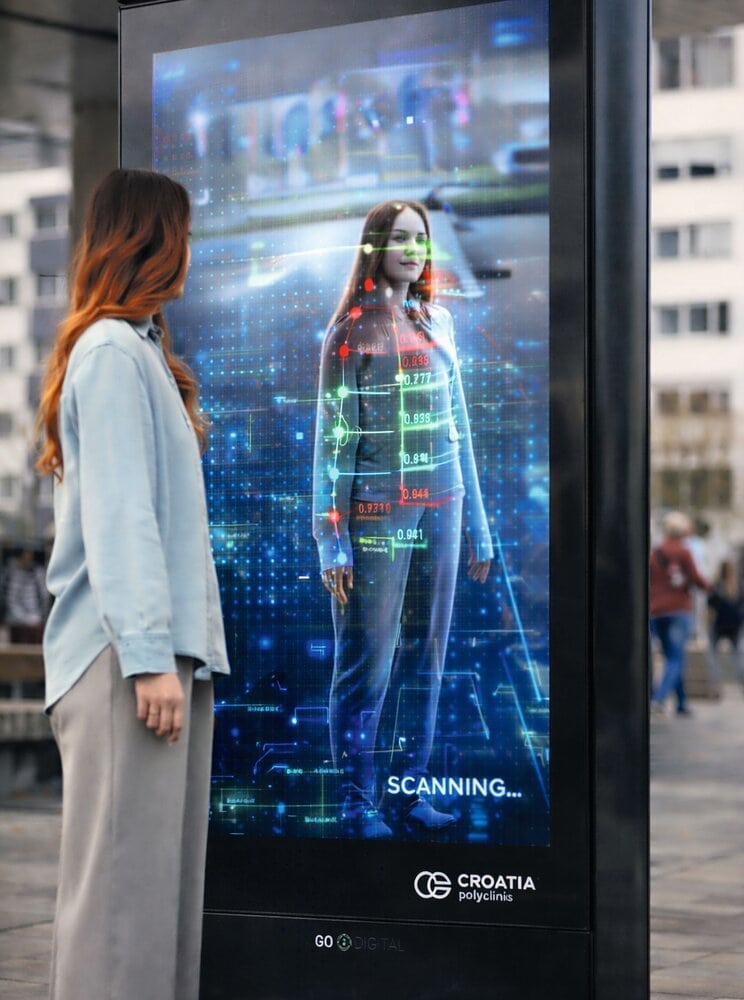
Check posture - with DOOH
Interactive screens also offer more and more creative possibilities for campaigns. For example, Polyclinic Croatia advertised last summer with a nationwide DOOH campaign in which screens at bus stops recorded the posture of passers-by in real time, gave feedback and directly provided a QR code for making an appointment. It was well received: More than 100,000 bodies were screened and preventive check-ups increased by 46 percent. In Germany, Neue Leben Versicherung relied on interactive screens and, together with the Curious Company agency, got people to talk to an older version of themselves for the "Meet your future self" campaign. This was also made possible by artificial intelligence, which served as a chatbot and realistically aged the person they were talking to. AI is considered one of the most important trends in the DOOH industry, opening up new possibilities for addressing target groups and demonstrably increasing the efficiency of campaigns. "AI can already help to achieve greater efficiency in almost all areas," explains Mike Klostermann. "For example, to identify the right screens from the multitude of data. Or to optimize advertising media based on pre-testing. And, of course, to better evaluate results from different tools. AI provides more speed here, leaving more time for the essentials: the strategy, the media mix and the creative idea behind it."
"DOOH has become an integral part of the media mix and serves as a catalyst for brands and sales."
Creativity remains the be-all and end-all
Klostermann is convinced that despite all the new technologies, creativity is still the key: "That sounds banal, but in my view it still offers the greatest opportunity for many companies. Because too often you still see campaigns that are boring and therefore lose their impact. The creative rules are simple: strong imagery, a clear message, minimalist design. Of course, I'm also a fan of DCO, 3D etc. But as long as the creative basics are not fully utilized, I recommend making the difference here." According to the expert, creativity and sensitivity are still often neglected: "DOOH remains just one line in the media plan, advertising material is taken from other channels and the measurement of success is often not clearly defined. In other words, the greatest potential lies in developing campaigns specifically for this channel and implementing them with strong, creative ideas - this is how real impact is created!"
"Creativity and sensitivity are still often neglected, leaving DOOH as just one line in the media plan."
Double effect of creative campaigns
A new, global analysis by JCDecaux and System1 of more than 1,000 (D)OOH campaigns shows what is important here - and why creativity pays off: according to this analysis, creative advertising with a clear brand message and emotional appeal is significantly more effective than average campaigns. It ensures greater recognition, stronger brand loyalty and measurably better business results - often with twice the effect of less creative implementations. The study identifies key success factors such as immediate recognizability, brand distinctiveness, consistent creative identity and emotional relevance. However, the authors of the study found that many campaigns (three out of five according to the study) have not yet exploited this potential. It also depends on the specific usage situation of the medium, says Mike Klostermann: "TV, for example, is a relaxed lean-back and clear 'comfort zone'. DOOH is aimed at people who are on the move and more active. Depending on the objective, there is an opportunity here to generate attention at exactly the right moment, e.g. in the middle of the gym, on the way to work or directly in the supermarket. The creation should be geared towards this, as it significantly increases awareness. The right context attracts a lot of attention."
Advertising that fits the current situation and is creatively implemented generates relevance for the viewer. On the screen - or on the ski slope.
SURVEY
How AI makes DOOH faster, more relevant and more effective
How is artificial intelligence changing the creative quality, relevance and impact of DOOH - and what opportunities do you see for the industry? We asked this question to relevant representatives of the Swiss out-of-home advertising industry. The answers show: AI is becoming a lever for efficiency and impact. But real impact can only be achieved through interaction with human creativity.
Adriano Beti, CEO Livesystems
Artificial intelligence currently acts primarily as a speed multiplier in DOOH creation. AI tools enable significantly more image variants in a short space of time, thereby increasing efficiency. An advantage from which our customers benefit directly. In conjunction with our data-based target group approaches, messages can be tailored even more easily to locations and situations. However, it is important to note that most commercials are still based on classically produced advertising media, as AI primarily supports planning and post-production. In the long term, AI will be a key driver for varied and strong campaigns in public spaces. We expect AI to have a lasting impact on the industry.
Tom Gibbings, CEO Goldbach Neo

Creativity comes from inspiration and expertise - the most effective campaigns are always based on human insight and emotional storytelling. The potential of AI lies in enhancing this process by expanding the possibilities while preserving the creative vision at its core. You can create and test faster, which is perfect for a dynamic medium like DOOH, where content can be adapted and activated with minimal lead time. This allows for an even closer connection between brands and their audience. Beyond maximizing creative impact, AI opens up opportunities for the industry behind the scenes to make the buying process smarter, faster and more efficient. It enables the optimization of placements according to customer demand and improves the overall customer experience through smart tools that adapt to changing needs.
Daniel Schönmann, Head of Advertising Research & Communication, Swiss Post Advertising

Outdoor advertising has to work in seconds - messages have to hit home immediately. AI-supported eye tracking helps with this by making it visible how a motif is perceived: which elements attract attention, whether the core message is received or where a layout appears overloaded. Such analyses enable well-founded decisions to be made without time-consuming real tests. AI provides impulses, but does not replace the human being who classifies and evaluates them. We are only at the beginning of this development; its potential for DOOH lies in making impact more clearly recognizable - without additional complexity. At the same time, new opportunities are opening up in terms of reach and contact figures: dynamic, context-sensitive analyses and more precise forecasts are changing the rules of the game. One thing is clear: In almost every profession, the ability to prompt well will be crucial in the future - because 'shit in, shit out' applies.
Markus Ehrle, CEO APG | SGA

Creative ideas still come from people in the creative industry, but AI tools enable faster and more diverse production at arguably lower costs than today. This leaves more resources for the use of media to play out dynamic and precise messages, which can be played out contextually (weather, traffic, time of day, etc.) or in real time (keyword: Dynamic Creative Optimization) using DOOH. The greater the relevance of the content, the greater the awareness of the advertised products or services. And in the age of AI with an explosion of "fake content" on social media, the message in the public space gains additional power; building trust through visibility, whether for brand building or for activation.


