Pink for Gazenergie: When limes suddenly become Laustärke
The Swiss Gas Industry Association (Gazenergie) has been working with Rosarot for a year. A campaign, complete with a landing page, aims to highlight that food scraps can be turned into biogas—and thus renewable energy. The initiative is being promoted at numerous events and street food festivals, where food waste is collected.


According to the Federal Office for the Environment, 1.67 million tons of biowaste are produced in Switzerland each year. About half of this ends up in the garbage bin, where it accounts for the largest waste reaction. What many people do not know: Renewable energy can be produced from biogenic waste in the form of Swiss biogas, which is then used for electricity, heat or even fuel. The demand for renewable energy is particularly high in winter, when electricity production from solar and hydro power is reduced. The increasing use of electrically driven heat pumps and the electrification of mobility also increase this so-called winter electricity gap.
Turning biogenic waste into climate-friendly energy
Environmentally friendly alternatives are therefore in demand that are independent of the season and can be used flexibly because, like biogas, they can also be stored. And this is where Switzerland is a pioneer: In 1997, the first Swiss plant went into operation to feed biogas into the gas grid for the first time in the world. Today, 42 biogas plants throughout Switzerland ensure that heating is largely CO2 neutral.
Based on the idea that it is literally up to you at home or at an event to decide whether something valuable is created from organic waste, Rosarot developed a headline mechanism that shows in a surprising way what can be created from food waste. But only if organic waste is collected and renewable energy is created thanks to biogas.


Collection actions at Züri Fäscht, Street Food Festival and Open Air
The campaign was staged with visuals that always combine food waste with the possible form of energy. The motifs are always based on the events at which food waste is collected for the production of domestic biogas.
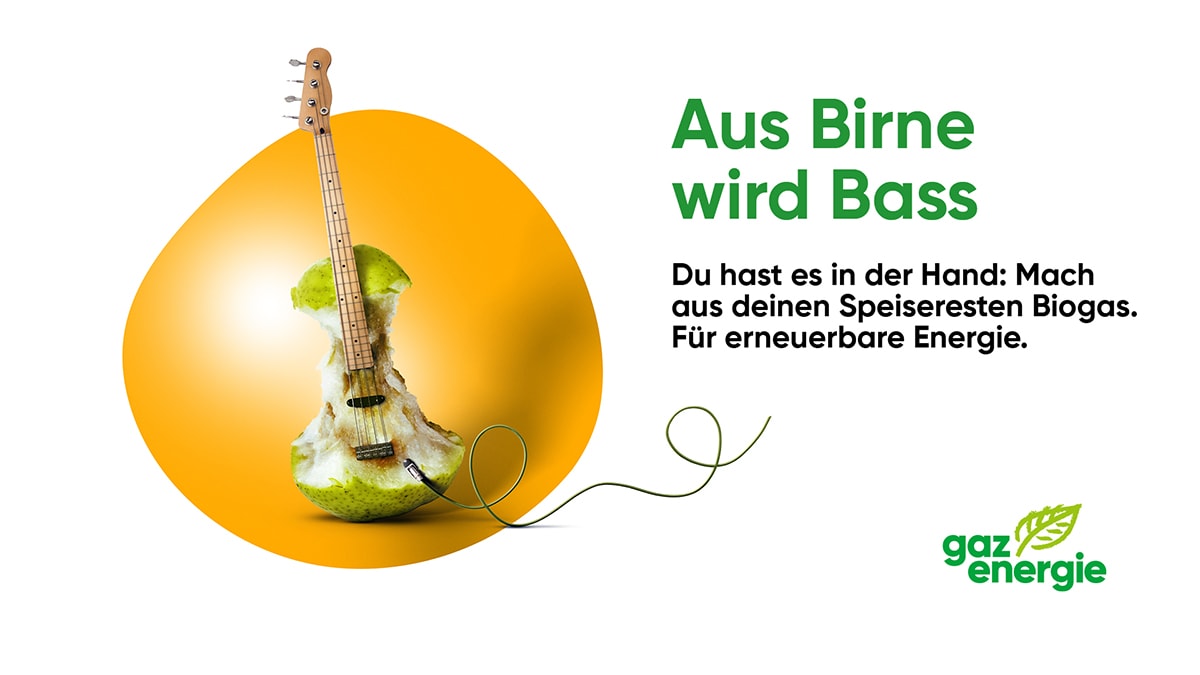
At open air festivals, for example, the core of a pear is turned into a bass, and at events like the Züri Fäscht, lime peels are used for cocktails. For the Weltklasse Zurich at the end of August, the banana peel, which is popular with many runners, is then turned into electricity for their sports watches.
The visuals each lead to a landing page that provides information about biogas and entices visitors with a competition.
Landing page and juice bar educate about biogas
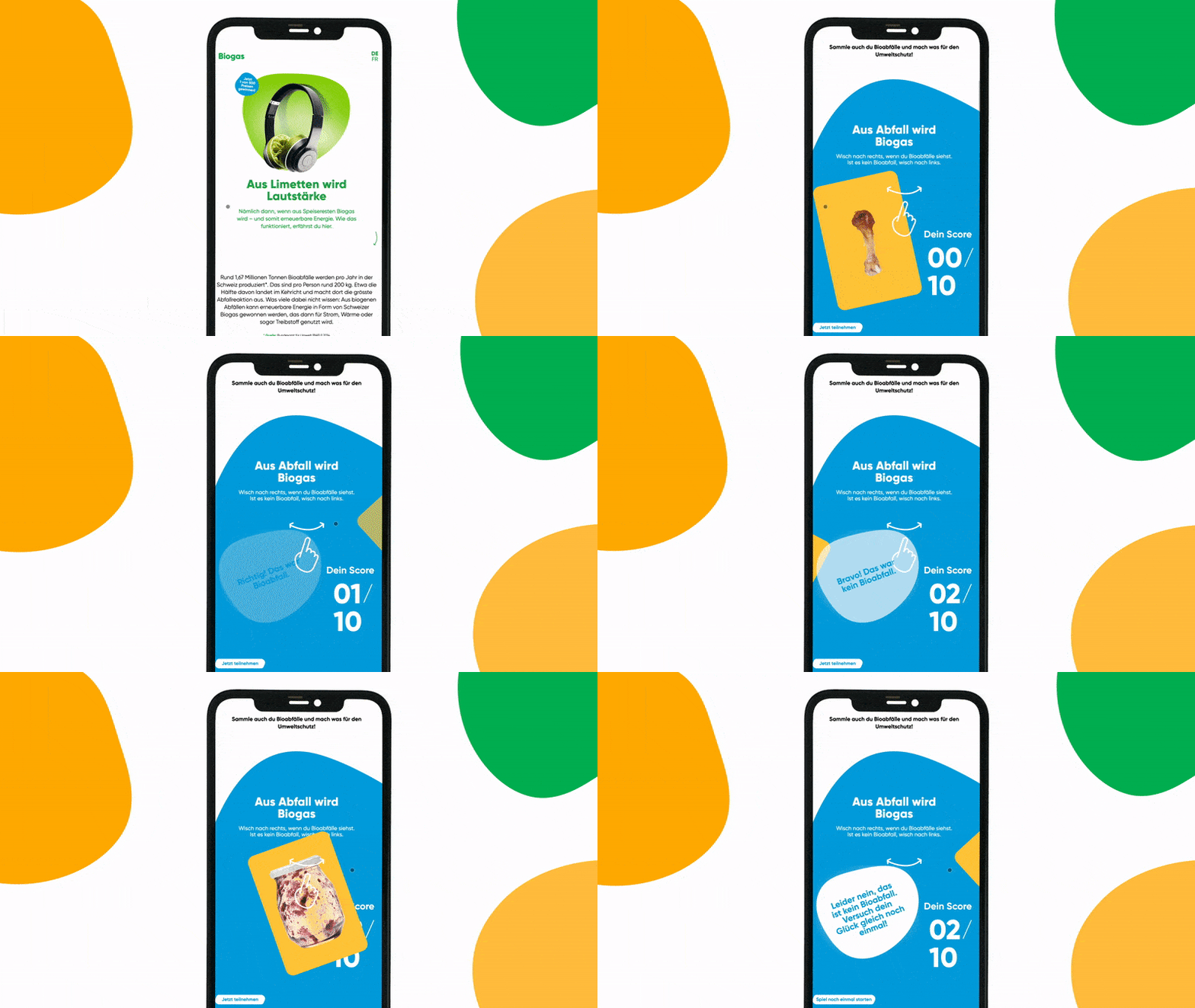
For the design and conception of the landing page Win-biogaz.ch is also the responsibility of Rosarot. With five W-questions it informs briefly and crisply about biogas, shows its cycle as well as all event dates on which collection actions take place. For the competition with 500 prizes, a game was also developed with which one can test one's knowledge about biogas with simple swipe mechanics.
The Zurich agency also had a hand in the events themselves. At the street food festivals in Olten, St.Gallen and Bern, for example, it developed the entire visualization of a juice bar where the waste from the freely offered juices could be disposed of by the guests themselves.
After the campaign was played at the Züri Fäscht, the Openair Etzikon and the Openair Gampel in summer, it will now be used at the athletics event Weltklasse Zürich. In addition, visitors to the Street Food Festivals in Langenthal, Lugano and Thun can once again expect a juice bar in September.

Responsible at the Swiss Gas Energy Association: Petra Thomann (Brand Management and Industry Communications). Responsible at Rosarot: René Karrer (Creative Direction), Labinot Gashi (Head of Digital), Antonia Lattarulo (Digital Campaign Manager), Bettina Walder (Consultant), Sarah Pietrasanta (Head of Content), Thorsten Hainke (Senior Copywriter), Franz Neugebauer (Senior Copywriter), Bianca Berger (Art Direction), Fabio Montefiori (Polygraf); External partners: Lily Metzker (Compositing).