When it comes to simple tasks, consumers prefer chatbots
According to a new study by LivePerson, 89 percent of consumers worldwide view the use of chatbots in customer service as neutral or even positive. For simple tasks, consumers prefer to communicate with a chatbot, but when it comes to more complex issues, they prefer to seek help from customer service representatives.


Chatbots are becoming more common in customer service as consumers expect faster and better service. Companies are therefore increasingly using bots for customer support to meet this need. In response to this trend, LivePerson, a leading provider of cloud-based messaging solutions in the mobile and online space, initiated a global survey of 5,000 consumers on their attitudes toward bots in customer service. It was conducted online by independent research firm Survata. Globally, 5002 consumers aged 18+ in six countries (United States, United Kingdom, Australia, Germany, France and Japan) were surveyed between April 7 and April 20, 2017.
Some of the key findings of the study:
- For simple tasks, consumers prefer to communicate with a chatbot, but when it comes to more complex issues, they want the help of customer service representatives.
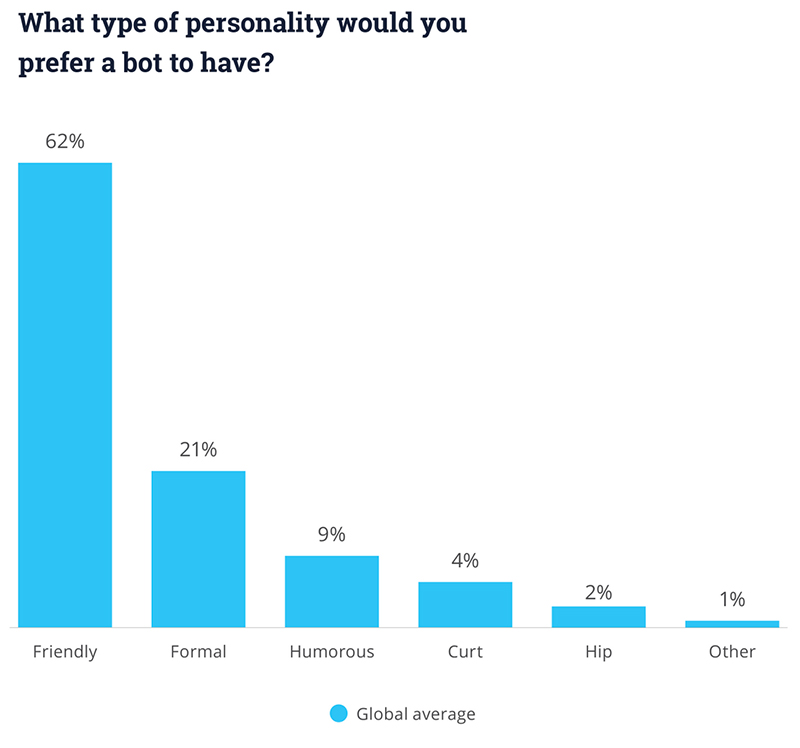
- A chatbot should most likely have a friendly personality. Almost one in five Germans favors a direct way of communicating with chatbots.
- The majority of consumers worldwide would describe a customer service experience as excellent if the wait time is no more than two minutes to speak with a customer service representative.
- The reason consumers prefer to wait for a customer service representative rather than talk to a chatbot is the fear of being misunderstood.
The results show that 52 percent of all consumers surveyed would not want to wait longer than two minutes to speak to a customer service representative - otherwise they would not rate customer service as "excellent". One-fifth of German consumers appear to be somewhat more patient and would even wait five minutes or longer and still rate customer service as "excellent".
Fast service is a priority for most consumers, which is why many large companies are implementing bots in their digital and customer care strategy, which are now also being accepted by consumers - as the study shows. The majority of consumers surveyed have a positive or neutral attitude toward using bots to communicate with a brand. Globally, 38 percent of respondents rate the use of bots as positive, while 51 percent classify it as neutral. 11 percent of them have a negative attitude toward bots. As acceptance increases, the previous perception that brands and companies only use bots to cut costs is fading.
In contrast to previous surveys, a higher number of consumers in Germany now believe that bots help them receive better and faster service. German Millennials in particular are of this opinion (57 percent).
Fear of misunderstandings
Although attitudes toward bots are becoming more positive, some consumers are still skeptical. This is because more than half of those surveyed worldwide (56 percent) would still prefer to speak to a customer advisor - even if they had to wait a short time - than to a bot with which they could make direct contact. In Germany and Japan, on the other hand, consumers would prefer to use the direct service of a bot. But the reason many would rather wait for a customer service representative is fear of being misunderstood. 60 percent of those surveyed worldwide believe that a human understands needs better than a bot. In Germany, almost a quarter (24 percent) of consumers are also convinced that customer advisors are more reliable. In addition, some consumers - especially those in Europe - said they also occasionally lie to or exaggerate a customer advisor to get what they want. Almost one in ten Germans (9 percent), the most in a global comparison, even said they do this often.
Bots are preferred for simple tasks
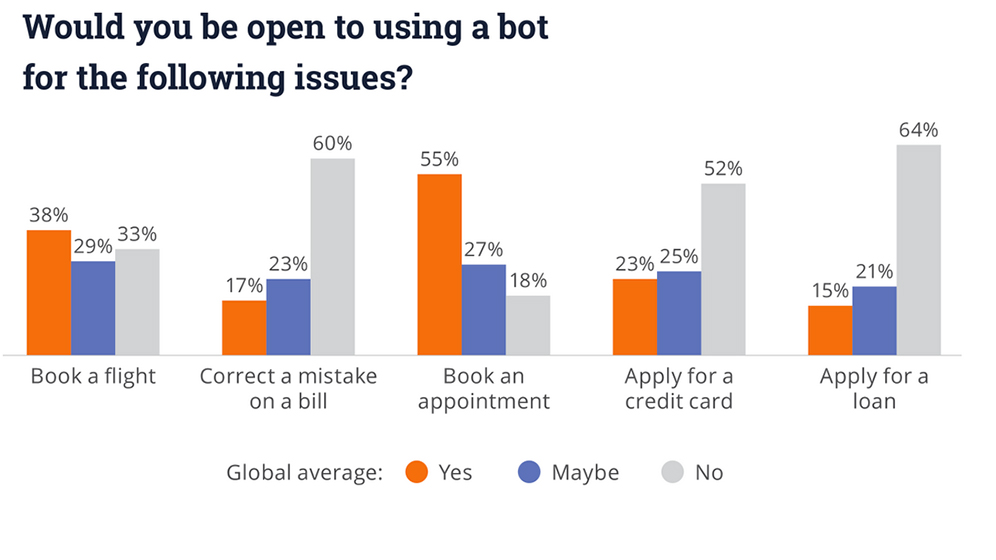
On the other hand, assuming that a bot is as accurate as a customer service representative, the majority of consumers worldwide (55 percent) would rather communicate with a bot than a human. The study also shows that they trust bots for simple tasks - such as updating an address or checking account balances. Complex issues such as correcting an error on an invoice are tasks that consumers prefer to have a human handle. In a global comparison, Germans are most skeptical of bots when it comes to making payments or checking account balances, although they would still prefer to learn the latter from a chatbot (see charts in header).
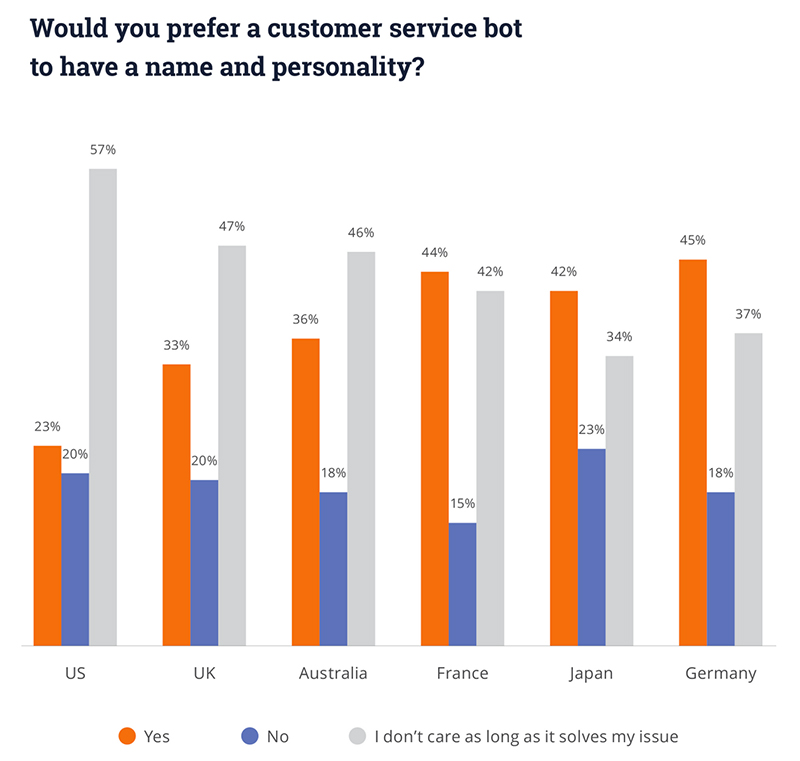
As more brands integrate bots on their websites, the question of whether bots should have a name or a personality comes up more frequently. The survey results show that many consumers, especially in the United States, do not care that bots have a personality or a name. Consumers in other countries, however, see it differently. Forty-five percent of Germans, 44 percent of French and 42 percent of Japanese think bots used in customer service should have a name or personality. These consumers would rather bots have a friendly personality than be formal or humorous.
The entire report (English) can be ordered by specifying name, e-mail and company here can be downloaded.