Fast loading AMP pages dominate Google search results
Searchmetrics has examined the ranking factors specific to the media industry and highlights the importance of a good user experience. News portals and publishers in particular that offer fast-loading Accelerated Mobile Pages (AMP) now account for the vast majority of mobile search results. As a result, it is becoming increasingly likely that those who do not adopt AMP will lose readers and advertising revenue.


In summary, three quarters of news-related results in mobile Google searches are AMP1-pages. For desktop Google searches, the data also demonstrates that high-ranking content in the media space prioritizes user experience. High-ranking content is significantly more relevant - relative to the search query - uses more words in the text to cover topics more comprehensively, and includes more links to lead searchers to other sites with related information.
"This study was set up to provide advice and observations for web publications, corporate blogs, news sites and other publishers who are struggling for traffic and revenue as news and information sources," said Marcus Tober, CTO and founder of Searchmetrics. "The competition among online media and publishers is enormous - most rely on advertising revenue. In the age of so-called fake news, it is increasingly important to deliver relevant content that meets users' search intent. That's the only way a site can be successful."
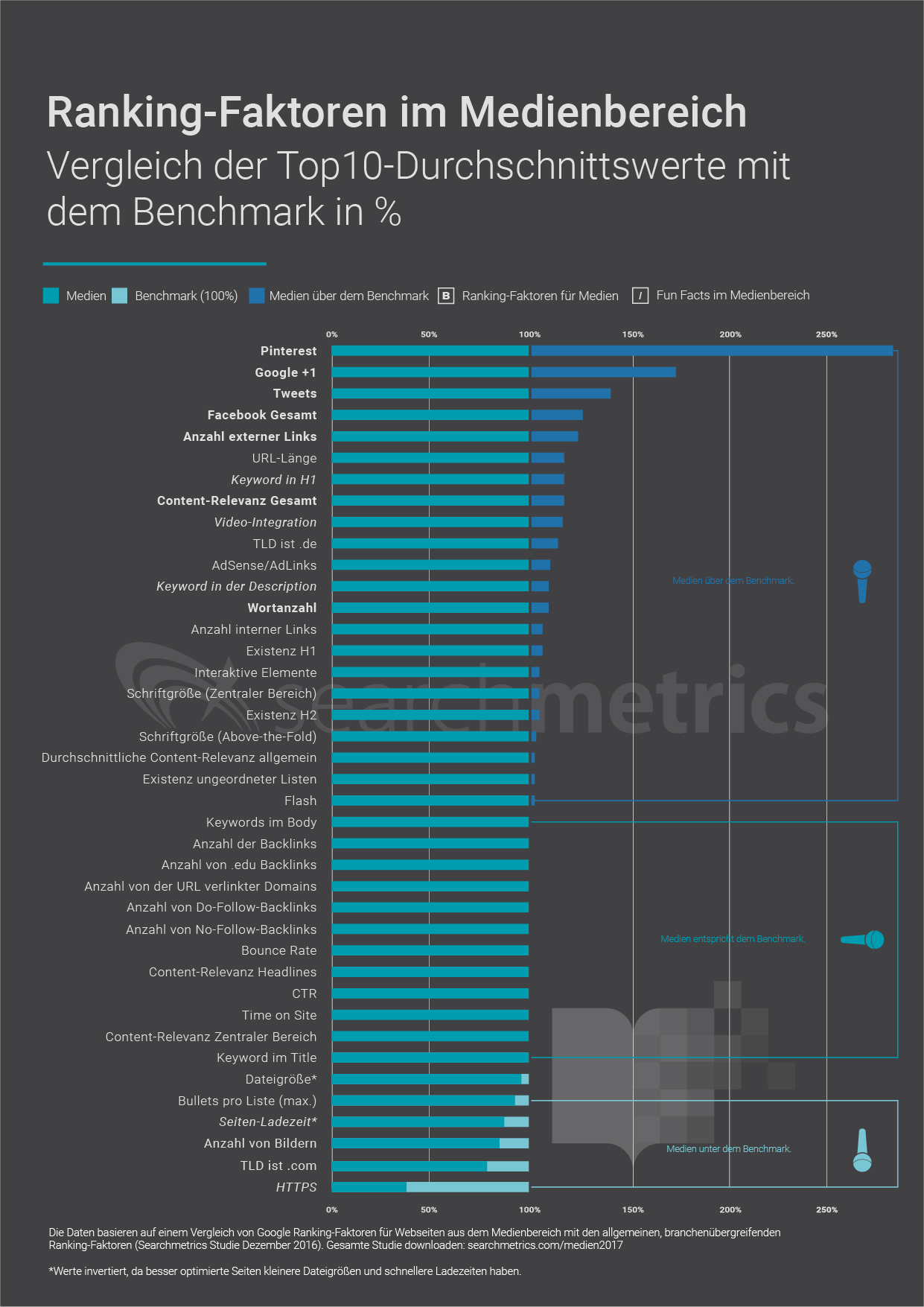
The study analyzed desktop search results on Google.de for approximately 6000 keywords related to the online media industry (including keywords such as: Football scores, Kim Kardashian and Weather Europe). The results were compared with a benchmark study that analyzed Google ranking factors for 10,000 general keywords across all industries with high search volumes.
The Four key findings of the Searchmetrics study are:
1) Fast-loading AMP pages make up majority of media and news results on mobile devices.
To investigate the spread of AMP, Searchmetrics conducted an analysis of mobile search results for 50 keywords that are currently trending on Google News. Over three quarters (76.6 percent) of results on Google.com implemented AMP - either in the organic search results (the familiar blue links) or in the "headlines," news integrations or carousels that Google uses to highlight news content in mobile search results.
"With so many people now able to read news and information 24/7 on mobile devices, it's increasingly important that media sites offer a convenient user experience so readers can quickly find the content they're looking for and navigate through it," Tober said. "To that end, AMP was introduced to display stripped-down, fast-loading versions of websites - and that's why AMP is growing in searches on mobile devices for news and current affairs."
2) Links to external pages do not affect rankings negatively
URLs among the first 20 desktop results on Google.com for media- and news-related search queries contain an average of 27 links leading to content on external websites. This is more than the cross-industry average number of external links Searchmetrics analyzed in its benchmark study. Therefore, it's important for anyone creating content for online media and publishers to understand that their rankings are unlikely to suffer just because they link to external sites. Links should serve the user experience by pointing readers to credible, related content or helpful sources.
3) More words can add value
Online media URLs that rank in the top 10 desktop results on Google.com contain 8 percent more text (about 130 more words) than the average in Searchmetrics' cross-industry analysis. If longer or additional text is relevant and helps fulfill searchers' intent, then content creators in the media space should feel free to use more words.
4) Media-related keywords increase content relevance
URLs that rank for media-related keywords have a content relevance score² that is 13 percent higher than the most relevant content in Searchmetrics' benchmark study.
Content relevance is measured using Big Data to compare the semantic relationships between search queries and the text content in search results.
Marcus Tober's advice for media and publishers is: "Create content that is as relevant as possible in relation to the search queries. Articles that have already been published, but also contain content that is valuable in the long term, should also be updated again and again so that they remain current and, above all, relevant. This will give you a better chance of staying in the top search positions."
¹ Accelerated Mobile Pages (AMP) are a joint project between Google, Twitter and other tech giants. AMP is an open-source framework that makes it possible to create websites that load as fast as an arrow on mobile devices.
² Content relevance is used to indicate how relevant a web page is in relation to a search term or topic. The topic relevance is of high importance for search engine optimization. Basically, the more relevant the text or content of a page is to a search query, the more likely it is to rank well. Content relevance can thus be counted among the ranking factors that Google uses to evaluate a website in its index.
The calculation of content relevance for this study is based on measurement methods that use, among other things, linguistic corpora and the conceptualization of semantic relationships between words via distances in the form of vectors. For semantic evaluation of a text, for example, the search term and the content can be evaluated separately. From this, a score can be determined for complete texts, which sets the relevance of the text in relation to the search term/topic used. The higher this relevance score, the more relevant the content of the analyzed landing page/s is for the corresponding search query. To make content relevance even more meaningful, the instances of the actual searched keyword are filtered out of the calculation.
The whitepaper of the Searchmetrics study "Ranking factors in the media sector" can be found at here download.