The five most important mobile trends for the coming year 2019
The global app economy is poised for a truly blockbuster year. The data experts at App Annie have compiled a list of the five trends that will have the greatest impact on the mobile market in 2019.


Key Facts:
- Consumer spending in app stores is growing five times faster than the global economy
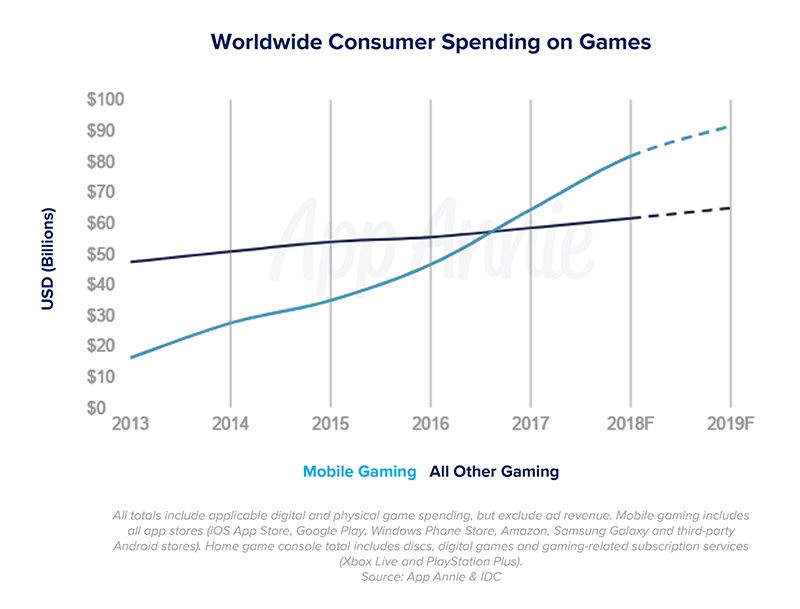
- Mobile gaming is growing up: it will account for 60 percent of the entire gaming market in 2019
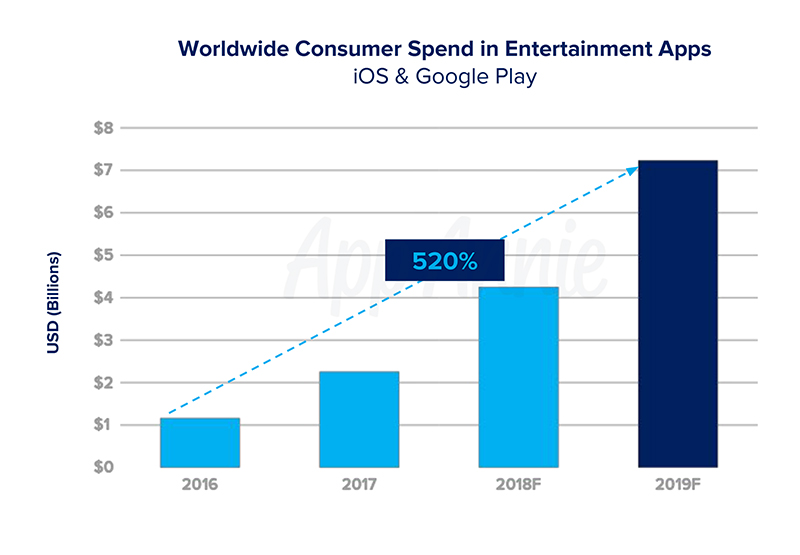
- Subscriptions are not dead: Global consumer spending on entertainment apps increases by 520 percent from 2016-2019 due to in-app subscriptions
Cell phones have become an irreplaceable part of consumers' lives and therefore an integral aspect of business growth. This year, both the iOS App Store and Google Play turned ten years old, ushering in a new era defined by mobile. As we enter the next decade of app stores, we are on the cusp of new developments and technological achievements in the app economy. The data experts at App Annie reveal the five most important mobile trends for 2019.
1. advertising, in-app subscriptions and gaming: mobile spending in 2019
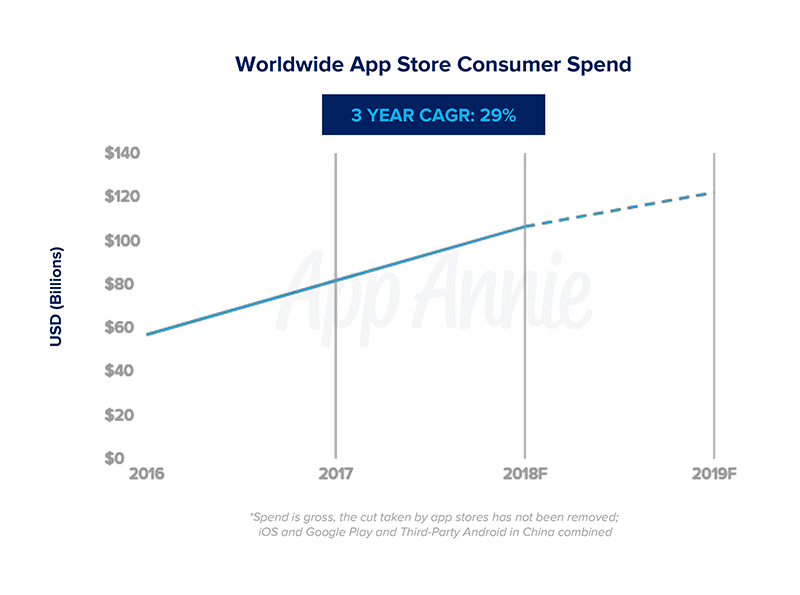
In 2019, global consumer spending in app stores will grow 5 times faster than the global economy, exceeding 122 billion US dollars. That's twice as much as the global box office market. This means that apps will continue to influence consumer thought leadership and shape business priorities. But consumer spending is only a fraction of the overall growth of the mobile economy. Spending will also increase, particularly on in-app advertising and purchases (e.g. Uber, Starbucks, Amazon) made outside of app stores. Above all, mobile games will drive the majority of consumer spending in the app stores with a share of 75%. Mobile gaming thus remains the fastest growing form of gaming. Despite the high market share for games, consumer spending on in-app subscriptions continues to drive the twice as fast growth rate for non-gaming apps.
China will continue to make the largest contribution to growth in consumer spending in app stores; however, a slight slowdown is expected in 2019 due to the freeze on game licenses in China.
Growth on a device installation basis is being driven by Android devices, particularly in emerging markets. The time spent in apps per device is also growing rapidly in countries such as Indonesia: on average, users spend 4 hours per day in apps.
2. mobile gaming will account for 60 percent of the total gaming market
In 2018, the mobile gaming experience has continued to mature on both sides of the spectrum - both casual games, which are games with simple gameplay, and hardcore games, which are similar to modern consoles. Fortnite and PUBG - along with improved smartphone specs - drove multiplayer game mechanics that put them on par with real-time strategy games and shooter games on PC/Mac and consoles in a way that hadn't been seen before. At the same time, existing mobile gaming habits were expanded to include this form of mobile gaming. An offshoot of this advancement in mobile technology has been the development of cross-platform games. As a result, games in 2019 will be less tied to exclusive platforms and more connected. For many publishers, mobile provides the framework and growth to make this a particularly compelling strategy. On the other end of the spectrum, we expect "hyper-casual games" with simple gameplay to continue to drive growth in downloads in 2019 and capture a large part of the market that does not traditionally identify as "gamers". It will primarily be these two ends of the spectrum - casual and hardcore games - that will drive growth in mobile gaming in 2019.
If the freeze on gaming licenses in China continues in 2019, Chinese companies will push harder for international expansion. Mergers and acquisitions could become more frequent. Advances in mobile multiplayer game mechanics and cross-platform gameplay as a by-product will also lead to experiments in streaming and e-sports, the latter of which is likely to boost the popularity of the former. Although 5G, along with improved battery life, will support advances in mobile gaming, it is still too early for it to have a significant impact in 2019.
3. streaming on YouTube, Tik Tok and co.: the growth of entertainment apps
The average person spends over 7.5 hours a day consuming media - whether reading, listening, watching or posting. The total time spent in video streaming apps per device will increase by 110 percent from 2016 to 2019, so that by 2019, ten minutes of every hour will be spent on mobile streaming in apps. Global consumer spending on entertainment apps will increase by a staggering 520 percent compared to 2016, largely due to in-app subscriptions to video streaming apps such as Netflix, Hulu and Amazon Prime. Short video apps will also continue to take up much of the overall streaming time. In addition, growth will be driven in part by the rise of social video apps such as Tik Tok and the importance of short videos in social media apps such as Instagram and Snapchat.
One thing in particular will cause a lot of excitement in the new year when it comes to streaming: Disney will shake up the market in 2019 with the launch of its Disney+ streaming service. With the new addition, Disney will then own four of the top streaming apps (Hulu, ESPN+ and ABC, which is mainly used in the USA). However, as the streaming market is similarly saturated to the cable TV sector, there could also be a resurgence in piracy, as access to content will increasingly require multiple subscriptions in the future.
Due to the growing competition, further partnerships as well as content bundling and acquisitions with and from streaming services are to be expected, as the cooperation between Paramount and Netflix shows, for example.
4. Harry Potter: Wizards Unite will generate more than 100 million $ in the first 30 days
Following the global success of Niantic's first AR game hit, Pokémon Go, the first trailer for Harry Potter: Wizards Unite, along with its 2019 launch date, generated a lot of conversation. Will Harry Potter put Pokémon GO in the shade? While the Pokémon franchise in its entirety is worth around twice as much as the Harry Potter franchise, Harry Potter, with its origins as a book series, has an enthusiastic fan base and could attract a new target group of casual gamers. Should Harry Potter utilize strategic partnerships like Pokémon GO, such as meetups and sponsored locations, the game could see a boost, especially in the early stages. Although the playtime spent in Pokémon GO was largely additive to overall mobile playtime, it is unlikely that users will actively play two different AR games. Nevertheless, both titles are aimed at different target groups and will expand the overall active user base for Niantic.
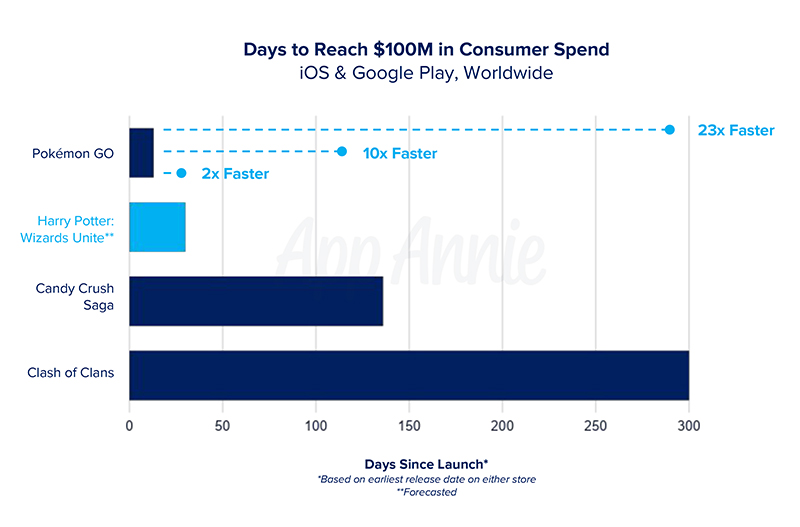
Pokémon Go broke all mobile gaming records when it raised $100 million in its first two weeks and became the fastest game to reach $1 billion in consumer spending to date. While it is unlikely that Harry Potter: Wizards Unite will surpass Pokémon GO, $100 million in the first 30 days is a remarkable achievement and one that can be expected for Niantic's new adventure.
5. 60 percent more apps are monetized through in-app advertising
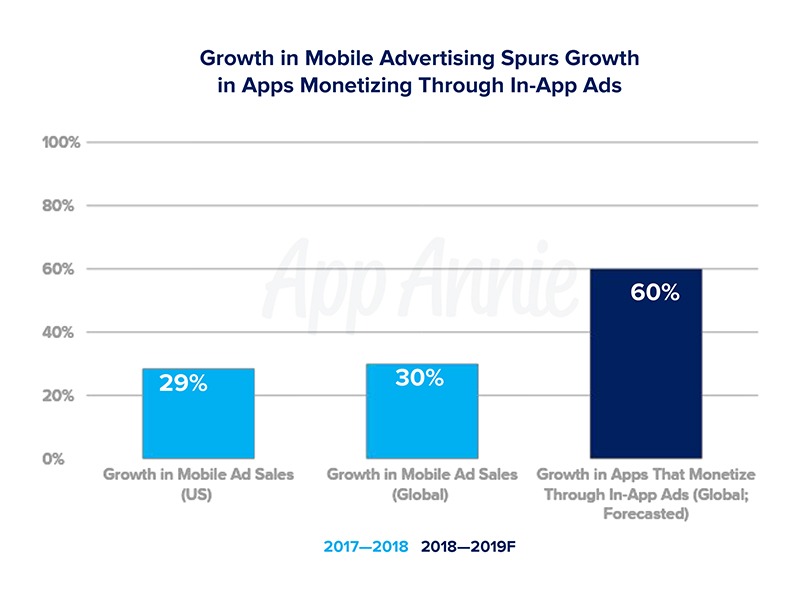
Mobile has long since claimed its share of marketing expenditure and is now the most important growth factor behind digital advertising expenditure. In 2018, mobile already accounted for 62% of global advertising expenditure (equivalent to USD 155 billion). In the previous year, this figure was 50 percent and growth will not stop in 2019. In the USA, mobile spending now even exceeds TV advertising. Mobile app publishers are therefore increasingly taking note of the changes in the advertising landscape. As 60 percent more apps will play in-app advertising, this will increase competition among advertisers. There is already evidence of a shift in advertising strategies for apps that use in-app ads as part of user acquisition (UA). In 2018, the top downloaded iOS apps in the U.S. promoted over 35 percent more ad platforms and used 170 percent more ad creative than in 2017, meaning app marketers are using more robust targeting and testing strategies. The same is true for top games. In 2018, the most downloaded iOS games in the U.S. used 10 percent more ad platforms and 20 percent more creatives. With more consumers using mobile devices than ever before and more time being spent on these devices, expect advertising costs to follow.
Conclusion: 2019 will be a real blockbuster year for the mobile economy.