Selling on the Internet? Create trust!


TRUST is a prerequisite for selling services or products online, especially for less-established brands or new business models. How trust is built online was the subject of a research project conducted by the Lucerne University of Applied Sciences and Arts in collaboration with the service platform Mila.

How is trust formed online? A research project at the Lucerne University of Applied Sciences and Arts provides insight.Destroyed rented vacation homes via Airbnb or pushy drivers with the private cab service Uber make it clear that buying online carries risks. Account information can be misused, services purchased online do not meet expectations and promises, one's own privacy is violated, or a great deal of effort is required for complaints or returns. Where there are risks, trust is necessary. But how is trust created online? In earlier times, when purchases were settled face to face, first impressions and how someone was involved in the community gave important clues as to whether a seller could be trusted or not. Equally important were the experiences that others had already had with the seller.Experience crucialThese are precisely the factors that are also decisive in online purchasing today. Experiences from other customers are crucial, especially for new offers or services. This can be seen, for example, with hotels on Tripadvisor, where no reviews are equated with negative reviews. The only thing that has changed is the scope of action. People no longer act in the local community, but in the digital space. That's where the first impression a company makes is created. Photos, text, interaction opportunities, online networking and online reputation are trust-building factors.In addition, the place where the purchase takes place plays an important role. As in the past, where people did not like to trade in dark alleys, today it is important to show that the virtual business space is also safe. On platforms where the purchase again takes place between individuals and not between an individual and a big brand, the collaborative idea also becomes more important again. As in the past, certain rules are needed to make a community work and build trust. Three aspects are important: Relationships, interaction and community. The question is, what does that mean online?Check identityThe development of trusting relationships can be supported online by verifying the identity of the seller. Platforms such as TaskRabbit rely on registration via a social media profile (social media connect) or verify the identity via a telephone callback. If providers appear competent, this also creates trust. The competent appearance can be promoted by content-rich and up-to-date information as well as professional portrait and service photos.Airbnb, for example, took the pictures of the offered apartments itself during its launch in order to underline the quality claim and create trust. If a provider is influential, it also appears competent and thus trustworthy. This influence is conveyed by reputation systems, which not only include ratings of services already provided or products sold, but also the reputation shown online through rankings or leaderboards.Whether a provider behaves benevolently or not also plays a role in how trustworthy prospective customers assess him and can be depicted, for example, with a badge for social behavior, a so-called social badge.User friendliness importantThe relevance of the design of the provider's website is also reflected in a survey of 1,000 people conducted by the market research institute forsa for Mila. 45% of the respondents would like to be able to select a cleaner themselves on the basis of the provider profile, for example. 53% rely on testimonials from other customers when making their selection.A platform also creates a trusting space simply by ensuring that the website is user-friendly and has a uniform and harmonious appearance. With a credit card guarantee and well-known trust seals such as Verisign, the platform minimizes the risk of credit information being misused. Likewise, 52% of the respondents from the forsa study appreciate it when payment is only due after work is done or a money-back guarantee is available.
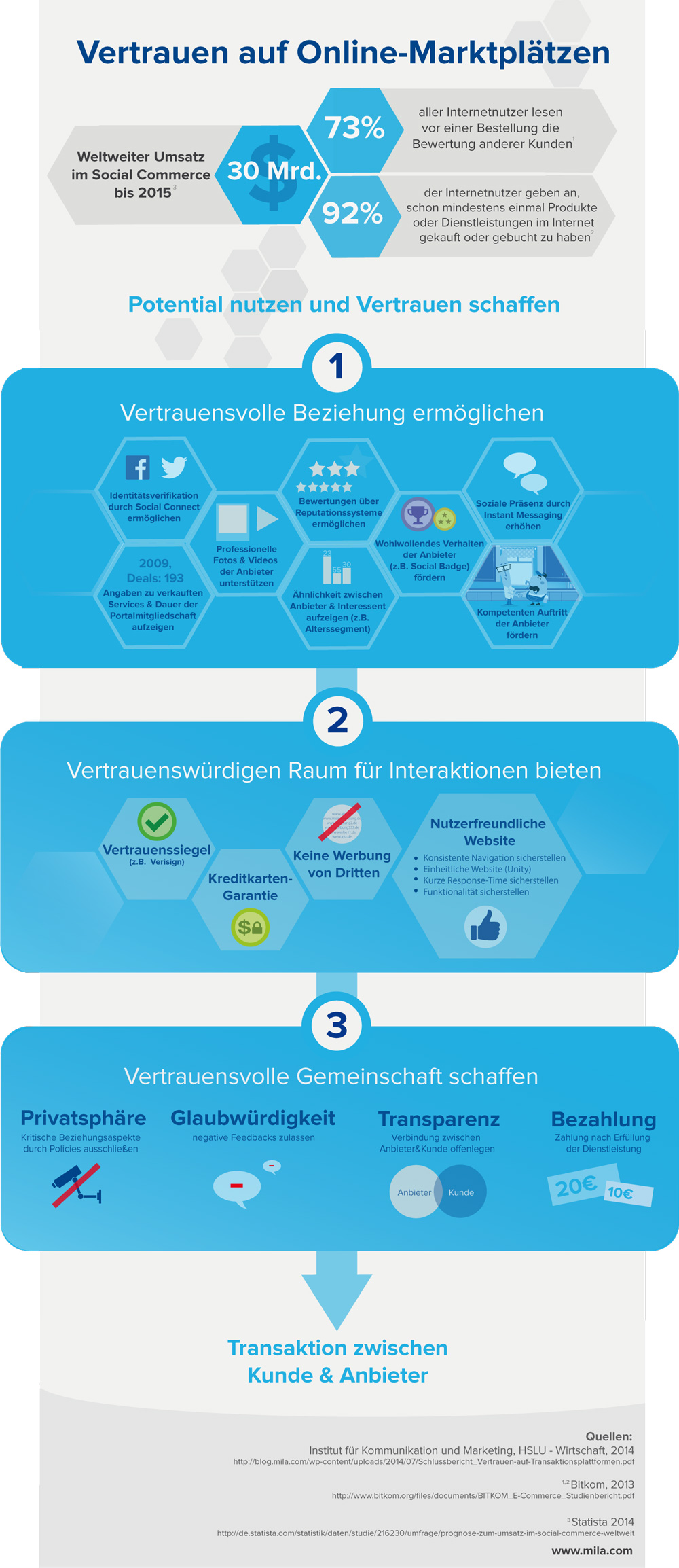
Checklist on how trust can be created on online platforms along the three dimensions of "trusting relationships," "trusting space," and "trusting community."Building a trusting sense of community is a long-term matter and takes place at various levels. A privacy policy can contribute to this. However, reputation systems themselves can also be made credible, for example by allowing negative feedback to be published or by making it transparent whether the rater and the rated are private friends or only know each other through platform transactions.Authors: