
Despite skepticism, social media is becoming increasingly central to communication


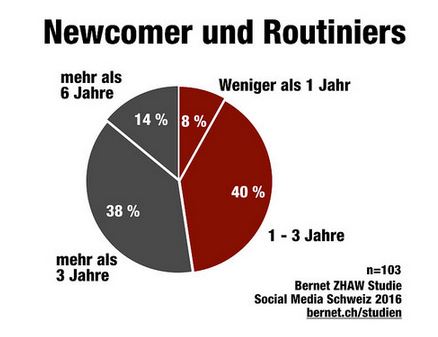
STUDY The social media engagement of Swiss organizations is growing: nine out of ten organizations are now present on a platform such as Facebook, Twitter or YouTube. Facebook and YouTube are the most important, followed by Twitter and the business platforms Linkedin and Xing. Companies see the high cost of producing content as a critical factor.The Bernet ZHAW Social Media Switzerland 2016 study is being published for the third time after 2012 and 2013 (www.bernet.ch/socialmediastudie). Guido Keel, Scientific Director of Studies at the Institute of Applied Media Studies (IAM) at the ZHAW: "The development in recent years is clear. Today, social media are accepted as central communication channels." Irène Messerli, co-author of Bernet_PR, recognizes new challenges for organizations: "In recent years, we have had to do a lot of convincing and awareness-raising. Now many organizations have recognized the potential of social media: more transparency, proximity and speed in communication. Today, it's no longer about the why, but about the how, where and how much."Uncertainty around integration, measurability, ROIIn the meantime, the organizations have gained experience and developed strategies. Three years ago, only half of those surveyed had a written social media strategy; today, this figure is 83%. Despite this strategic approach, the new channels are mainly used for brand management and campaigns. Customer-facing areas such as service or sales are less integrated into the activities. The main aim is to achieve reputation goals and visibility. The goals are primarily measured quantitatively - with web traffic, the number of fans and likes. There is skepticism when it comes to assessing the costs and benefits: For 41 percent of respondents, they balance each other out, with 31 percent rating the effort higher. In future, digital communication is to be integrated even more into the overall organization. The importance for personnel marketing and for image/sales is perceived as increasing.the most important findings at a glance:Significant increase in commitment - 89 percent involvedAlmost nine out of ten Swiss companies, public authorities and non-profit organizations have a presence on social media. The differences between the various types of organization have been significantly reduced. All large companies surveyed are active on social media, as are all non-profit organizations. Administrations/authorities (89%) also have a large presence on the channels.Fewer beginners, more routineA large proportion (42%) of respondents have been active for over three years, while only a minority have only been running channels for one year. This means that the wealth of experience in dealing with dialog and content is increasing. However, two fifths of the organizations have also been active for one to three years. Many are still learning and developing.
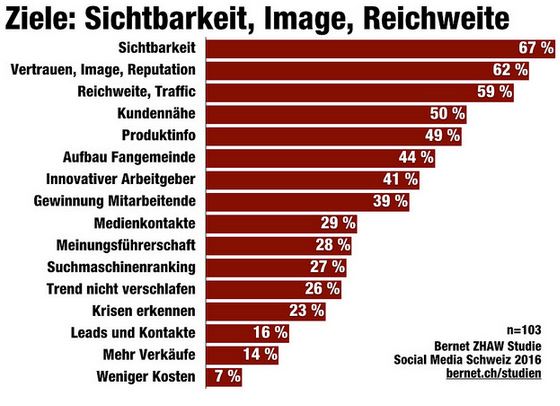
Social media at the center - more strategic considerationsDialogue-based online channels are increasingly becoming the focus of overall communication. Over three quarters of all respondents are using the channels "at the center" of their activities (27%) or at least "seriously" (49%). Only around one in ten are still in the experimental phase. The number of organizations with a social media strategy has also risen sharply. 83% have written down strategic considerations (2013: 55%), 36% of which only for parts of the organization.Social media for the image - little serviceSocial media channels are used the most for brand management and campaigns. Only a few respondents see a good integration of recruitment, service, internal communication or sales. Company-wide anchoring and the involvement of all departments in content maintenance and dialog remain important.Visibility, reach, proximityWith social media, respondents are primarily aiming for increased visibility, a better reputation, greater reach and more traffic to their own website. Significantly fewer want to use social media to achieve goals in media relations, search engines or sales.
YouTube and Facebook firstChanges can be seen in the ranking of the most frequently used social media platforms: YouTube has caught up with Facebook (both 87%), Twitter is 12% behind, followed by the business platforms Linkedin and Xing, which are tied on points. Blogs have moved up three positions again with 44%. The image platform Instagram has also developed positively. Newer platforms such as Pinterest, Snapchat, Vine and live streaming services such as Periscope are still little used.

Effort primarily for contentThe most effort is put into creating content. Dialogue management follows a long way behind. Slightly more than half of the respondents award contracts externally, most likely to specialized agencies. Technical support is most in demand, followed by strategy, advertisements and content creation with significantly lower shares.Visits, friends and echo are measuredAwareness of online monitoring and evaluation of effectiveness has increased significantly. Around 90 percent of all organizations conduct monitoring and evaluate effectiveness. However, the measurements are still very quantitative: mainly the number of followers, likes and visitors on the web are tracked, as well as the proportion of reports on the social web.Despite skepticism: even more integration in the futureThe respondents disagree on how exactly social media activities can be measured. They are particularly skeptical about the relationship between cost and return. 41 percent believe that these are balanced. 31 percent see the effort as positive. In future, they want to integrate the activities even more into the overall organization and believe that they will become increasingly important for personnel marketing and sales: www.bernet.ch/socialmediastudieSource: Bernet and IAM





