Smartphone instead of wallet?


Paying with a smartphone is slowly becoming fashionable in Swiss retail: 17% of customers already use it, and almost as many want to try it out soon. However, sales generated with Twint or Apple Pay are still very low. The new study also shows "Smartphone instead of wallet?" According to a study by the consulting firm Deloitte, the Swiss like to scan their products themselves when shopping and pay at vending machines. New digital technologies have led to customers of Migros, Coop, Ikea and the like behaving differently today than they did ten years ago. More and more purchases are being made online: Since 2010, online sales in the Swiss retail sector have risen by almost half. What's more, almost nobody shops without online support anymore: according to a Deloitte survey from the summer 83% of consumers in Switzerland use their smartphone or laptop to make purchases before, during or after their visit to the store. The boundary between online and offline customers is becoming blurred and digitalization has also changed the use of payment methods: In 2000, around three quarters of sales at stationary points of sale were made in cash; in 2016, this figure was still just under half. Although notes and coins are still used much more frequently at the checkout in Switzerland than in the USA or Sweden - where a cashless economy is already being targeted - the trend is pointing in the same direction: away from cash and towards cards and new digital payment methods.
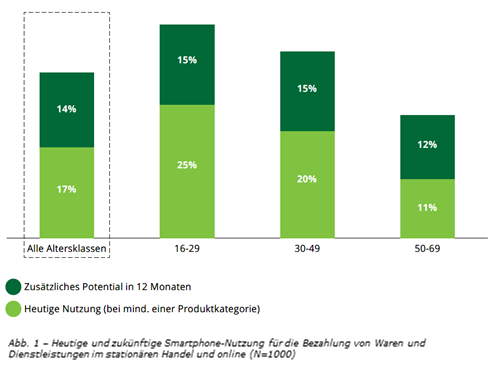
Paying with the appFor some years now, more and more points of sale in Switzerland have been allowing consumers to pay directly with their smartphone via an app. According to the latest survey of 1,000 consumers in Switzerland, 17% of consumers do this at least occasionally. "The usage rate seems very high, especially when you consider that mobile payment still accounts for less than one percent of the transaction volume in Switzerland. A considerable proportion of Swiss consumers appear to have installed mobile payment applications - but they are only used actively by a much smaller proportion," explains Konstantin von Radowitz, Head of Consumer & Industrial Products at Deloitte Switzerland.Doubling of use expected for Twint, Apple Pay and Co.In addition to the 17% who already pay with their smartphone, 14% of those surveyed stated that they intend to do so in the next twelve months. Almost three quarters (73%) of smartphone payers use apps from third-party providers such as Twint, Apple or Samsung. In addition, more and more chain stores have integrated a payment function into their own apps and are combining this with bonus programs and special offers: Almost half of consumers (46 percent) already use such payment apps from specific brands.Among third-party providers, Twint (40 percent of users) currently has a narrow lead over Apple Pay (33 percent). While Apple Pay and Samsung Pay are equivalent to a virtual credit card and the data is transmitted via near-field communication technology (NFC), Twint does not require a credit card, just a bank account. "The direct connection without a credit card and the function for paying and claiming money from private contacts is a clear plus for Twint. On the other hand, Apple has a clear convenience advantage thanks to NFC technology, and Apple Pay and Samsung Pay can also be used internationally," explains von Radowitz.Customer becomes cashierDigital technology is also changing the way customers pay for the products they select in-store: Customers pay for them themselves at a machine at the exit of the store. This self-checkout turns the customer into a cashier, so to speak, and the supermarket has outsourced the payment process, which seems to appeal to the majority of Swiss people: Introduced just a few years ago, self-checkouts are now an integral part of the Swiss retail trade. This is mainly due to Migros and Coop, which have equipped their stores with automated checkout systems across the board. It is therefore no coincidence that a large majority (69%) of Swiss consumers already like to pay for their purchases themselves.
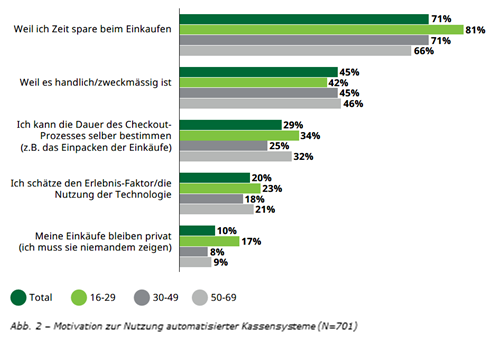
Independent customers feel good"These figures are very high and clearly show that automated checkouts are well received," says Karine Szegedi, Partner Consumer and Industrial Products at Deloitte Switzerland. "Customers feel good about shopping when they can decide for themselves how to pay. They also have the impression that they are saving time - which is not always the case in reality. "For retailers, such checkout systems lead to greater customer satisfaction, better use of space and cost savings. "However, there is still room for improvement in terms of user-friendliness, security and the retraining of employees, who are increasingly being deployed to provide advice and customer service," Szegedi continues.Supermarket without a checkout becomes realityUltimately, the decisive factor from the customer's point of view is likely to be how user-friendly, secure and efficient the entire scanning and payment process can be. In the longer term, payment could even bypass banks if the big tech companies offer their own bank accounts. In addition, Amazon has already opened stores in the USA where there is no payment infrastructure. The customer scans and pays for the goods using their own smartphone via the store's app. "In China, the retailer Alibaba is already much further ahead and is testing payment using facial recognition. The Store of tomorrow will connect customers, employees and offerings at various levels using combined technologies," says von Radowitz, venturing a look into the future of the retail trade.digitalization has also changed the use of payment methods: In 2000, cash accounted for around three quarters of sales at stationary points of sale; in 2016, this figure was still just under half. Although notes and coins are still used much more frequently at the checkout in Switzerland than in the USA or Sweden - where they are already aiming for a cashless economy - the trend is pointing in the same direction: away from cash and towards cards and new digital payment methods.