
From Workplace to Workspace


1 Workplace becomes Workspace
Due to changes in the habits of employees (bring your own device/application, etc.) but also changes in the policies of companies (shared desk, home office, etc.), some processes in the working world have fundamentally changed. Employees are equipped with smartphones as a matter of course, can access files from any location, and virtual conferences are held via Skype, during which presentations can also be switched on. Let's remember that most of these possibilities were not widely available five years ago. The discredited workgroups are being replaced by dynamic communities in which structures, hierarchy and formalism are not required. Instead, the focus is on developing topics in an agile and creative manner and solving relevant tasks in an ad hoc manner. According to Gartner, Millennials will make up 50% of the global workforce by 2020 - this group is characterized by mobile, visual and social.
2. "What can be digitized will be digitized".
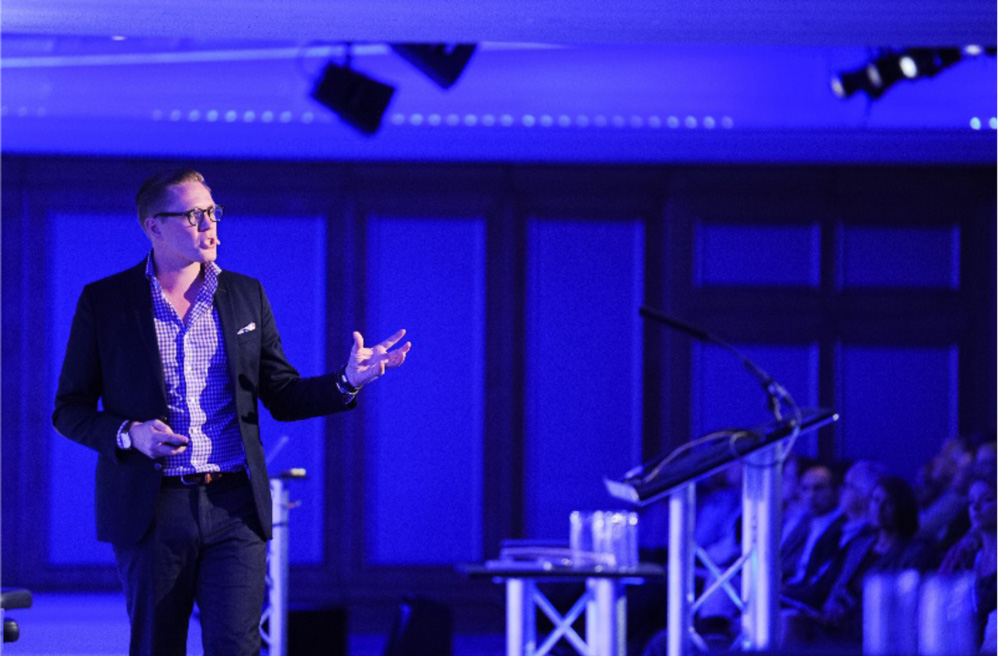
Anders Sormann-Nilsson, the Swedish futurologist, called out to us: "What can be digitized will be digitized. (Fig. No. 1) Now, one can rightly say that this is yet another wildly exaggerated statement by a trend researcher. But Sorman-Nilsson was able to make it credible that this statement is about a mindset that can protect companies from suffering the same fate as Kodak or Nokia, for example. Gravity is a law of physics, but my observations show that it is also applicable to the topic of digitization. More and more observers of the scene are finding that digitization "just happens." Nobody called for digitization, it just came and is spreading - everywhere and fast.
3. the "gamification" myth
Brian Burke from Gartner showed very clearly in his presentation that gamification is often misunderstood and hastily equated with things like videogames or rewards. Brian Burke defines gamification as follows: The use of game mechanics and experience design to engage and motivate people to achieve their goals. Thus, gamification (see Figure #2) is just one element in a triumvirate.

4. social collaboration pays off
In an empirical study at Deloitte in Australia, two teams were compared with each other. The first worked with Yammer as a social collaboration tool and the second with conventional methods. The results are remarkable: The employees of the "social" teams were not only more satisfied and had a better team spirit, but also achieved significantly better work results. It would be presumptuous to conclude that social is the magic bullet. Social must also be contextually coherent in order to achieve a sustainable impact on productivity.
5. knowledge management 2.0
Conference chairman Nikos Drakos almost apologized before his presentation titled "It's still Knowledge Management - but not as you know it". Bringing back such a well-known and discredited topic. However, Nikos also made it clear in his introduction that the topic has not lost any of its relevance - quite the contrary. This statement is corroborated with the fact that in the USA, since 1975, the proportion of non-routine work has increased from 40% to over 60% today. The fact that efficient access to information and knowledge is thus crucial to success needs no further explanation. Two technological achievements can help the ailing knowledge management to reach the level 2.0. On the one hand, we are talking about the possibility of automated information organization and, on the other, high-performance filtering tools. In summary, Drakos said that successful Knowledge Management 2.0 needs a clear business context with an understandable purpose and realistic goals at the beginning.On the plane between London and Zurich, I summed up the Gartner Summit for myself once again. My central thought is that the statement "from Workplace to Workspace" is not a semantic gimmick. Rather, it makes it clear that various boundaries in our working world have already dissolved and will continue to dissolve as a result of ongoing digitization. This leads to disruptive changes that also affect the customer interface and therefore also belong on the marketing agenda.


