Evaluation of the purchasing process as a preliminary stage of content distribution



According to Hubspot's model, the customer goes through three different stages in the purchasing process.Distribution makes content relevant. The right distribution technique brings the right content to the right target group at the right time, and today's customers have several touchpoints. For the key to success and a better understanding of these touchpoints, a sound analysis or measurement is necessary. The Buyer's Journey designed by Hubspot illustrates the different stages in the buying process that customers go through in their search for a solution to their problem: The Awareness stage, the Consideration stage and the Decision stage:

The Buyer's Journey from HubspotIn the awareness stage, the consumer becomes aware of the problem and tries to give it a name. In the Consideration stage, a solution is sought and the search for a possible provider is continued. As soon as possible providers are available, they are evaluated in the decision stage and a decision is made. The duration of this buying process can be longer depending on the product/service and the number of decision-makers, especially in B2B.qualitative individual interviews or focus groups are suitable for recording the buyer's journey in order to confirm the contact points of the journey. The use of focus groups makes it possible to record the frequency and relevance of contact points in order to optimize the buyer's journey. Cell phones are used in practice as a survey tool. During the survey phase, respondents can rate the contact points they come into contact with on their smartphone. The following presentation "different stages of Buyer's Journey" by Hubspot looks a little deeper into the appropriate use of content:
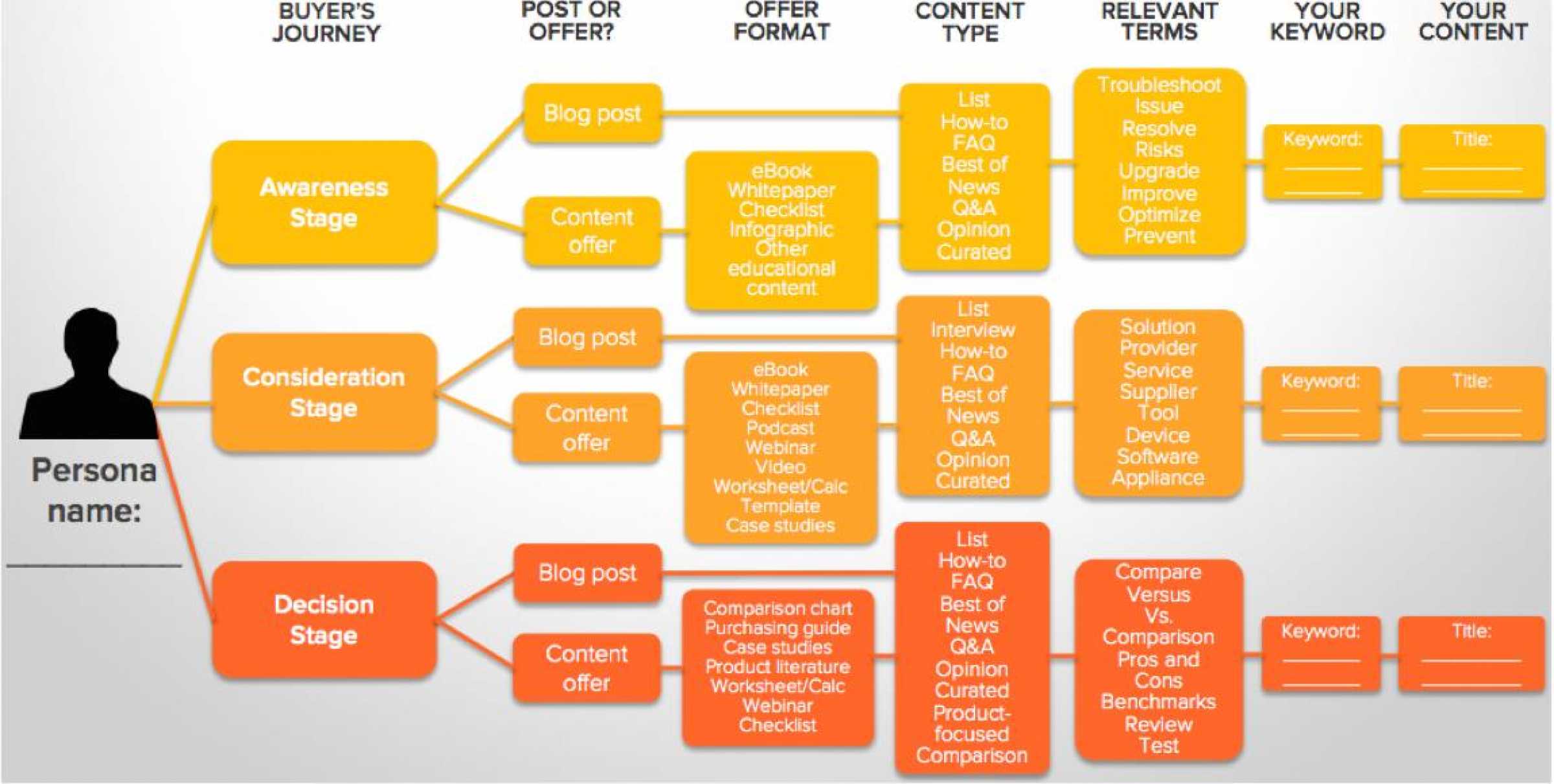
Different Stages of Buyer's Journey from HubspotThis shows which content formats and content types are suitable for the corresponding stage of the purchasing process. The relevant conditions are also taken into account depending on the stage. At the awareness stage, analyses and informative content are suitable for taking the user one step further. Solution-oriented content should be created and published for the Consideration stage and comparative content is useful for the Decision stage. Benchmarks, reviews and tests also help consumers in their decision-making process. In my last article on the impact of content formats, I described a few formats such as infographics and whitepapers: https://mk-marketing-und-kommunikation.hamster.ch/mediabros-content-august. There are, of course, a few more, as can be seen in the Hubspot illustration. The target group-oriented preparation and the distribution of the content adapted to the various stages of the purchasing process are decisive for the relevance of the content, and the inbound marketing method is ideally suited as a distribution method. What use is the best content if it is not found or shared by users? Finding the places where the target group is located is another very exciting challenge in content marketing. This includes knowing which communication channel to use in order to place the content there most efficiently.