
Digital transformation: "People are not use cases"


DIGITIZATION In the second series of articles "Digital - from Talk to Walk", Christoph Oggenfuss* talks to exponents from business and research about the implementation of digital transformation. The sixth and final interviewee is André Morys, CEO of Web Arts/Frankfurt and founder of the Conversion Summit.

Founder and board member of the Web Arts company André Morys.With André Morys, I have Germany's leading head in the field of conversion optimization in conversation. He founded his own agency, Web Arts, with a focus on this service and held the first Conversion Summit in Frankfurt five years ago.Victims of their own successFirst, I ask Mr. Morys what significance the topic of digitization has at Web Arts. Morys tells me that the company has been "100% digital" from the very beginning. Since 2008, the entire growth has been based primarily on inbound marketing, i.e. customers are directed to the blog "konversionsKRAFT.de" through good and useful content. In the meantime, the blog is better known than the actual brand "Web Arts" - so one becomes a victim of one's own digital success.In working with customers, Morys sees how companies struggle with digital transformation even 20 years after "the beginning of the Internet." Old organizational structures are reaching their limits in light of today's agility. In terms of digital vs. analog, Morys describes his business model as hybrid. With classic consultants and programmers, they are a kind of "manufactory" when it comes to service delivery. In the front office, on the other hand, Web Arts is digital, e.g., with the previously mentioned blog. In order to be able to scale its own business model even more in the future, the digitization of further business areas is being driven forward.The power of digital processesNow I want to know from Morys what practical example can be used to illustrate digitization. Web Arts organizes its own annual conference - the Conversion Summit. The event is completely non-commercial in the style of Inbound Marketing and is characterized by the quality of the content. Morys elaborates, "We have been organizing the event for five years now, and all tickets are sold exclusively via online social channels and email. We have just sold the first 80 tickets in a very short time with just one announcement email. This shows the power of digital processes when understood correctly. With our blog posts, we reach 30,000 interested people every month at marginal cost. This is what we mean by marketing automation or scalability."
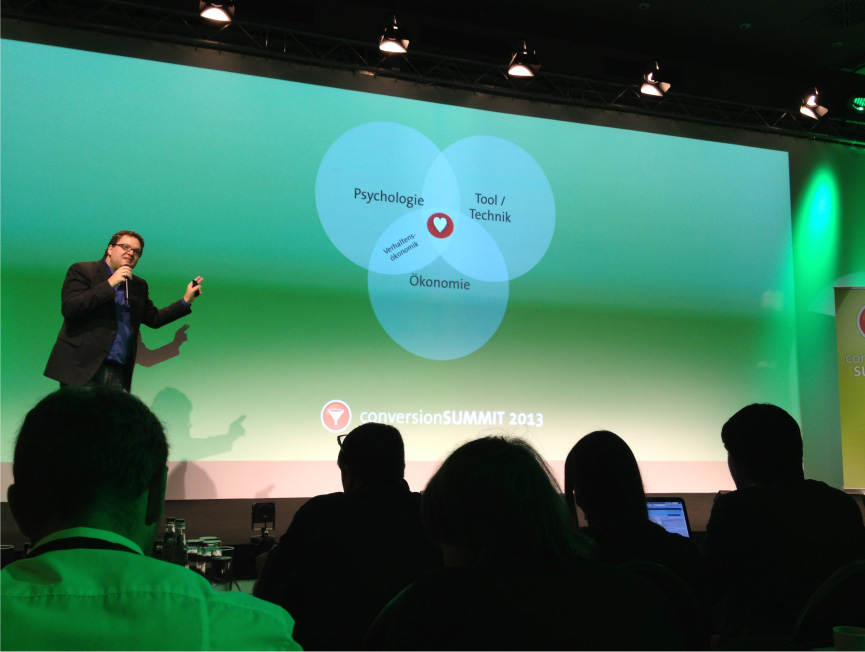
Host André Morys in action at the Conversion Summit.Digitization as the basis for scalabilityIn my next question, I want to find out whether André Morys sees digitization more as a growth driver or as an opportunity to cut costs. My interlocutor sees digitization as the basis for scalability, i.e., whenever it is possible to get the marginal costs to zero in the context of digitization and the benefit or attractiveness for the consumer exceeds a certain value, then digital processes achieve a certain virality. Most startups use this effect in their freemium models. Unfortunately, the "old economy" has not yet fully internalized these principles. Of course, any reduction in marginal costs also offers the potential of a cost saving - but it really gets exciting in the previously mentioned case. The combination of "virality in distribution" and "habit in use" has killer app potential in Morys' eyes.Pure digitization not yet a winWhat are the medium-term digital offerings for your customers? The specialty of Web Arts is to find out what has any value at all for consumers and how something has to be presented so that it sells. This means that pure digitization is not yet a win. A process must not only be usable for the consumer, but the entire offer must be attractive. So-called "implicit values" play a major role here. In addition to the explicit utility value ("I can buy a rail ticket online"), there may be an implicit benefit ("I look smarter when I show my online ticket on my smartphone at the ticket check - other passengers will envy me and wonder how that works..."). Car manufacturers show us very well how important consumers' implicit motives are and focus their brand strategy completely on implicit values, for example.Focus on people and needsFrom talk to walk - what are the key challenges or stumbling blocks on the way to implementing digitization projects? Morys points to the examples mentioned, where you can see that digital processes can only be successful in business terms if you focus on people and their needs. Many companies would first have to figure out how to answer these qualitative questions in a quantitative environment. The classic catalog-based mail order business can be used as an illustrative - and unfortunately negative - example. The internal mail order professionals have translated the analog processes technocratically - instead of considering what the customer needs are in the 21st century.Start-ups are ridiculedAnd then I want to know from conversion specialist Morys who the primary beneficiaries of digitization are? "I would say it's exclusively those who have understood the principles and methods of digitization. Many start-ups are ridiculed ("They have to make money first") - until they dominate a market with the help of their strategies (Facebook, Google, Amazon)." Certainly, the situation for traditional, analog companies is not hopeless. But if they can't put their analog "legacy" to one side in their strategic considerations, it will definitely be difficult.Idea comes up shortAnd as you know, the last word in my discourse always belongs to the person I'm talking to. André Morys still wants to get to the point: "It's still people sitting at the other end. This idea usually comes up completely short. Irrelevant or unusable digital products are created, mostly without any cooperation of real consumers - people are not use cases..."!As part of the digital series in Marketing&Kommunikation by Christoph Oggenfuss (markITing ag), the first season was entitled "Digital - not trivial". The articles are available here.


