"Demarcation is self-care"
Prof. Oliver Hoffmann advocates for a more nuanced “economy of emotions”: less pathos, more clarity. For freedom does not begin where we feel everything, but where we can choose what we want to feel. Big words. We wanted to know more.


m&k In your book "The art of psychological self-management", you describe empathy as the "moral imperative" of our time. Would you say that our society overvalues empathy - and if so, why?
Oliver Hoffmann: Yes, I would say that empathy is not only overrated in our present day, but overcoded. Empathy has gone from being a psychological skill to a moral badge: Those who sympathize are considered good; those who differentiate are considered cold. This is a dangerous shift. Empathy is no longer used according to the situation, but is demanded across the board. This leads to a kind of obligation to respond, which in many social, professional and media contexts no longer even asks whether empathy is appropriate, helpful or psychologically viable in a specific situation.
It is particularly irritating that empathy is often confused with attachment. It is believed that the more one resonates, the more authentic the relationship is. In reality, excessive empathy can push people beyond their limits, drive them into secondary traumatization and make them vulnerable to manipulation. The exaggeration of empathy is therefore also a silent economy of exploitation: if everyone is always supposed to understand, some people always have to deliver. And these are usually the sensitive, the caring, the well-socialized women, the employees in care professions. My criticism is therefore not directed against empathy as such, but against its moralization. Where empathy becomes a permanent requirement, people lose their right to inner distance - and thus to psychological sovereignty.
How did you come up with the term "ecpathy" - and how does it relate to classic concepts such as emotional intelligence or resilience?
The term ecpathy was originally coined by Spanish psychiatrist Luis de Rivera, who introduced it into the psychological debate in the early 2000s. De Rivera wanted to create a counterweight to the inflationary use of the term empathy - not to devalue empathy, but to complete it.
In his clinical studies, particularly in the field of psychotraumatology and burnout research, he observed that excessive empathy in therapists, doctors and nurses leads to exhaustion, identity diffusion and secondary traumatization. He therefore defined empathy as the "conscious ability not to take on other people's emotions", as an active protective mechanism of psychological autonomy. While empathy enables the influx of other people's emotions, ecpathy describes the necessary counter-process of draining them out - a form of emotional hygiene that keeps closeness and distance in balance. I was immediately fascinated by this term because it highlights a deficit in current psychological thinking: we constantly talk about openness, resonance and empathy, but hardly ever about separation, filtering and self-protection. Yet empathy and ecpathy are not opposites, but two movements of the same psychological system - inhalation and exhalation.
In my further theoretical development, I have detached ekpathy from its purely therapeutic context and developed it into a universal principle of inner economy: the ability to remain emotionally selective without becoming cold. Etymologically, ekpa-thie - from the ancient Greek ek ("out of") and pathos ("suffering, affect, experience") - refers to an escape from pathos, i.e. the conscious decision not to become emotionally absorbed. It is not an escape, but a form of conscious non-appropriation, a controlled closing inwards. When emotional permeability is considered a moral virtue, it is almost subversive. In relation to classical concepts, ecpathy can be described as the missing third instance. Emotional intelligence helps us to recognize and understand feelings. Resilience helps us to deal with and survive stress. Ecpathy decides which emotions we allow into our mental system in the first place. It is the preventative dimension of psychological self-management - the ability to consciously shape affective boundaries. Without it, emotional intelligence quickly turns into self-exploitation, resilience into compensation and empathy into moral blackmail. In this respect, I understand empathy as the foundation of emotional sovereignty: as a conscious, responsible form of saying no from within, which makes relationships possible in the first place because it prevents overwhelm. It is not a contradiction to compassion, but its condition.
You talk about "emotional sovereignty" as a future skill. What skills should education and business promote in order to develop this ability in a targeted manner?
If we really take emotional sovereignty seriously as a future competence, then it is not enough to offer mindfulness courses and resilience training. We need to start earlier and deeper. Firstly, we need differentiation skills: the ability to differentiate between our own feelings and those of others, to separate secondary from primary emotions and, above all, to recognize the source of an emotion.
Many people are not unsovereign because they "feel too much", but because they don't know whose feeling they are feeling. Secondly, language skills are needed. If you can't verbalize emotions, you can't regulate them. We have a huge lack of language around emotions in organizations, which is why there is so much moralizing. Thirdly, distancing skills are needed: the ability to switch to an observer position when emotions are involved without leaving the relationship. This can be taught - through role play, supervision and reflective feedback formats. Fourthly - and this is often underestimated - institutionally protected zones of unavailability are needed.
No one can be permanently confident if they are constantly being emotionally addressed. Sovereignty needs breaks, otherwise it becomes a façade. Education and business should therefore not only teach skills, but also create structures in which non-permeability is permitted.
"Ecpathy is the 'conscious ability not to take on other people's emotions'."
To what extent is your concept of positive indifference compatible with modern leadership ideals such as servant leadership or empathic leadership - or does it run counter to them?
I don't see a contradiction here, but rather a necessary addition. Servant leadership without positive indifference leads to leadership dissolving into complacency. Empathic leadership without empathic correction dumps all the emotions of the organization on the leader and then wonders about burnout at the top.
Positive indifference does not mean that I do not care about people, but that I do not make my inner flexibility completely dependent on their emotional fluctuations. In leadership, this translates into a very simple but rarely practiced attitude: "I see you, I take you seriously, but I won't live your feelings." This creates leadership that touches without being taken over. Servant leadership needs precisely that, because otherwise servant leadership becomes selfless self-abandonment. Empathic leadership does the same, because empathy without boundaries ultimately centres the organization around the loudest feelings, not the factually correct decisions.
Positive indifference is therefore the invisible spine of modern leadership: it holds, but it is not loud about it.
You emphasize that ecpathy does not mean coldness, but self-respect. Where do you draw the line between healthy detachment and emotional avoidance?
The boundary is where the relationship with the other person is still possible. Healthy boundaries say: "I'm here, but I won't let myself be swallowed up." Emotional avoidance says: "I am not there so that I am not touched." In ecpathy, I remain accessible, I remain approachable, I perceive the other person - but I decide which parts of their affective material I integrate into my system. Avoidance, on the other hand, breaks off contact or obscures it: you take refuge in irony, over-intellectualization, cynicism or permanent preoccupation.
A very practical differentiation criterion: after healthy detachment, I feel clear and present. After avoidance, I feel untouched, but also empty or disconnected. Ecpathy strengthens self-esteem because it says: "My psychological capacity is valuable." Avoidance weakens it because it says: "I can't stand life." This is a fundamental difference.
Your book combines philosophy, psychology and spirituality. In your opinion, which discipline offers the most fruitful approach to emotional sovereignty?
Each discipline provides a different organ. Philosophy provides the conceptual organ: it allows us to precisely distinguish phenomena of interiority instead of letting them blur into everyday psychology. Psychology provides the diagnostic organ: it shows which patterns, bonding experiences, traumas or transference lead to people getting too involved or not getting involved at all. Spirituality - I don't mean esotericism here, but practiced, contemplative traditions - provides the organ of experience: it makes it possible to experience the state that I call "quiet clarity", i.e. presence without entanglement. If I had to choose, I would say that the quickest and most fruitful approach is the combination of psychological self-enlightenment and spiritual practice. Philosophy makes the whole thing sustainable because it provides the language and the concept. Pure psychology without spiritual experience often remains reparative. Pure spirituality without psychological self-enlightenment quickly becomes a workaround. Only triangulation brings sovereignty.
"Empathy as a moral badge: those who empathize are considered good; those who differentiate are considered cold."
You refer to Stoicism and Buddhist equanimity (Upekkhā). Which of these two traditions has had a greater influence on your own way of thinking?
I have adopted strictness from Stoicism and softness from Buddhism. Stoicism taught me that a person can only really dispose of their inner self, so that setting a boundary is initially an act of reason: "This is within my power, this is not." This is essential for the modern idea of boundaries. Buddhist equanimity has taught me that even rational control can be too much, that there are states in which I do not actively set boundaries, but in which phenomena are simply allowed to come and go without me tying them to my self-worth. These two lines meet in the "art of demarcation": the Stoic distinction between what I can influence and what will happen to me, and the Buddhist renunciation of attachment. If you like: Stoicism has sharpened my concept, Buddhism has softened my tone.
If empathy, ecpathy and positive indifference form the "regulatory triangle" - can one of these three attitudes be overemphasized, and what risks does this entail?
Yes, the triangle is meant to be dynamic, not static. Overemphasized empathy sucks you dry; it leads to compassion fatigue, to parentified leadership, to over-therapized teams. Overemphasized empathy makes relationships weak; it can tip over into intellectualized distance or unapproachable professionalism, which is clear but no longer warming. Overemphasized positive indifference, on the other hand, can tip over into arrogant untouchability; it then becomes spiritually cloaked indifference. The risk always exists when an attitude is no longer understood as an attitude, but as an identity. This is precisely what the regulatory triangle wants to prevent: It does not say "be empathic" or "be ecpathic", but "be able to do both - and choose according to the situation". Psychological maturity is not demonstrated by the fact that someone always empathizes, but by the fact that they can control when and to what extent they empathize.
How can emotional sovereignty be practically cultivated in a digital, hypermediaized world - especially in the face of algorithmic manipulation of emotional content?
The first step is disenchantment. We need to realize that our emotions are now part of an attention market. Platforms make money from the fact that we are outraged, moved, triggered - not from the fact that we are calm and clear. Once you have understood this, you can start practising digital ecpathy: not reading every story, not letting in every suffering, not commenting on every picture, not jumping on every outrage. This is not cynicism, but self-protection. In practical terms, this means: fixed time slots for media consumption, consciously curated sources, deliberate "silence formats" in everyday life (writing, walking, doing nothing) and above all: the ability to notice emotional contagion before it becomes identitarian. A simple sentence helps a lot here: "This is not mine." If I can learn again to say "This is not my feeling, even if I am feeling it right now", then I can remain confident in a noisy, affective world. Without this practice, we are emotionally ruled by algorithms.
"We have a huge lack of language around emotions in organizations."
You speak of an "ethics of feeling". What moral guidelines result from this for interpersonal relationships or leadership contexts?
An ethics of feeling means, first of all, that feelings are neither absolute nor relativized. They are true - but only for those who feel them. For relationships, this means: I take your feelings seriously, but I don't make them my job. For leadership, it means: I acknowledge emotions in the system, but I don't manage according to moods, but according to meaning. In moral terms, this means: I do not instrumentalize emotions (neither for manipulation nor for blackmail), I take responsibility for my emotions and I do not impose my emotional interpretation of the world on others. Such ethics protect against emotional moralism - in other words, against the attitude: "Because I am affected, you have to behave." It leads to more mature relationships because it reconnects emotion and judgment.
Your book suggests that emotional freedom does not mean control, but "quiet clarity". How can this state be trained or taught?
You can't prescribe it, but you can make it possible. "Silent clarity" arises when perception is sharpened, reactivity reduced and language refined. This can be achieved surprisingly well through regularly practiced self-observation: diary forms in which not only events but also feelings of others are noted; short contemplations in which one learns to see emotions come and go; dialog formats in which one names feelings without making them a yardstick. It is not the state that can be taught, it is the discipline of repeatedly putting oneself in this state that can be taught. Organizations need role models for this: Managers who accept emotional appeals but do not jump up and down. In therapeutic or coaching contexts, spaces are needed in which non-reaction is not interpreted as coldness. Silent clarity is ultimately a way of practising - like making music. You don't finish, but you get better.
"Ecpathy strengthens self-esteem because it says: "My mental capacity is valuable."
In conclusion: What do you hope will be the social impact of your book - a personal change in awareness or a cultural paradigm shift in dealing with emotions?
I don't expect a book to change a culture immediately. But I do think it is necessary for us as a society to close a blind spot: We have learned to open up, but not to close down. We have learned empathy, but not ecpathy. We have liberated emotions, but not integrated them. If the book helps people to stop thinking of their detachment as selfishness and start thinking of it as adult self-care, a lot would have been gained. If it also helps companies, educational institutions and management to realize that not every emotional imposition creates a moral obligation, then that would indeed be a small paradigm shift. Ultimately, I am interested in a more mature, more differentiated emotional economy: less pathos, more clarity. Because freedom does not begin where we feel everything, but where we can choose what we want to feel.
Prof. Dr. Dr. Oliver Hoffmann
He is a business psychologist, author and board member. His claim: "If you don't know what to do, come to me."
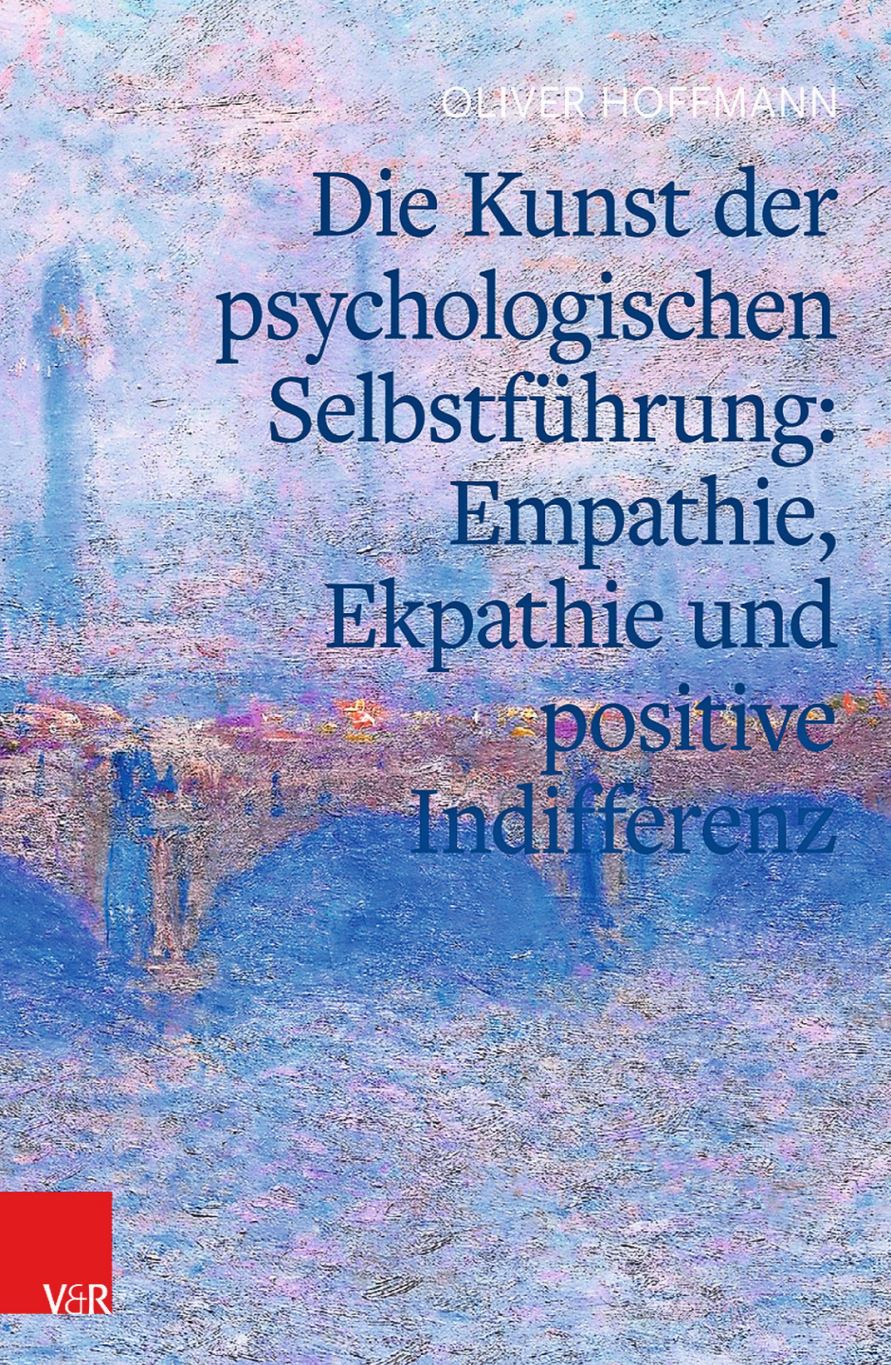
Book cover: zVg