Publisuisse satisfied with SRF's start to the year

The television channels of Swiss Radio and Television (SRF) are posting high viewership ratings in the new year. This is also good news for advertisers, who have been able to benefit from the good value for money offered by the advertised commercial blocks.

SRF's TV stations are off to a good start in the new year. With an overall average of 40.2 percent market share in primetime, SRF 1, SRF zwei and SRF info maintained their position as clear leaders in the Swiss TV market among the overall audience in January 2014. In the advertising-relevant target group of 15-59-year-olds, SRF programs achieved an average market share of 32.0 percent (also primetime). Advertisers are also benefiting from this. "We are very pleased with the performance of the advertising blocks in January," says Martin Schneider, director of Publisuisse. "Thanks to these excellent audience figures, our customers were able to benefit from good value for money," Schneider continues.

Sports and in-house productions very popular

The "Alpine Ski World Cup in Wengen, Downhill Men" and the "Tennis Australian Open, Final" on SRF zwei achieved particularly strong ratings among 15-59-year-olds, with average market shares of 70.5 percent and 68.0 percent, respectively.

SRF's own productions are also very popular. The second season of "The Undertaker" started with an average market share of 38.6 percent, surpassing the already very good prior-year figures for the first season. With a market share of 31.7 percent, the feature film "Der Verdingbub" attracted more than 400,000 viewers between the ages of 15 and 59, and "SRF bi de Lüt - Familiensache" also performed well, with a market share of 35.5 percent. The ten programs with the most viewers also include the information programs "Tagesschau," "Meteo" and "Kassensturz. Furthermore, the DOK series "Auf und davon," which is devoted to Swiss emigrants, was among the most watched programs in January.
 

Butz's moth: the symbolic imagery that nobody understands

Visual styles that convey a message in a relaxed yet precise way often miss the mark. The line between excellent and terrible is very thin… by Theophil Butz

Here’s the idea: Traffic signs use a symbolic image to explain what they’re about in the blink of an eye. It usually works perfectly. People have quickly learned and internalized this kind of language. This method is ideal for conveying an idea quickly. That’s why advertising has always made use of this visual language.

But now a problem arises. If the visual language is incorrect and incomprehensible, it has the opposite effect. In that case, it is unproductive—even negative. The celebrities featured in *Schweizer Illustrierte* on the milk crates are a prime example of this.

My theory: SI’s advertising message has long been that it’s “closer to the action.” The celebrities photographed in the bathtub or in their marital beds are proof of that. Now you’ll find these celebrities crammed into your milk crate. The images aren’t just fake because a Swiss wrestling champion wouldn’t fit in a box like that, but because all the images are fakes—they don’t actually show the celebrities SI is trying to imply.

In reality, this campaign is a scam. If these celebrities had actually been shown, the campaign would have been much better. No one understands the visual concept of depicting a 120-kg wrestler in a 50×30 cm box, and as a result, the message takes on a negative connotation. Or do SI readers see it differently? If they had found a visual language that symbolized the celebrities but also realistically fit them into that box from a milk-crate perspective—such as Wawrinka’s smashed racket or the Miss contestant’s crown—then people would have understood that visual language. But it still wouldn’t be a good advertising campaign. The photographer from an older SI campaign, who is flying through the air while taking a photo with the goalkeeper, demonstrated a much clearer visual language. But as the saying goes: The friend of the good is the worse.

In the past, commissions from publishing houses were a great opportunity to win a gold medal at the ADC. Urs Zeier, the Tagi-Magi marketing executive, briefed me back then to win one of those gold medals. Mission accomplished. But the SI ad won’t even make it onto the shortlist. And rightly so. There are other advertising campaigns that don’t understand the rules of visual language: UBS has placed a giant poster covering the entire facade of its building at Bellevue in Zurich. It reads, «Give your mortgage a new foothold,» and the image shows a wall anchor with a screw. An unattractive symbol—and, to make matters worse, doubly misleading. Especially when we’re hearing that the banks want to tighten the screws in the mortgage interest rate business. I wouldn’t even have allowed a single-column filler ad for a campaign like that.

It is also a mistake for opponents of the SVP’s immigration initiative to use Hodler’s *The Woodcutter*—a visual motif featuring an apple tree and roots—to represent their “No” vote, assuming that every voter will understand it immediately. A basic rule of advertising is: Never use your opponent’s symbolism to draw attention to yourself.

The highlight of the week at the ADC Gala was President Frank Bodin’s laudatory speech in my honor, during which I was presented with an 8,000-gram ADC Gold Cube for my service to the ADC, as well as the honor of being inducted into the Hall of Fame. The atmosphere was festive, and Franz and Oli (Franzoli) served a superb 18-course meal.

Theophil Butz, graphic designer, advertising agency owner, source of inspiration, and—for the past three years—also a complainer for *Werbewoche* readers. Please send relevant information to [email protected].

butz_3

There's a person stuck in a box. On closer inspection, he's actually stuck in a mailbox or milk crate. That's just not right. He's supposed to be a celebrity. Yeah, but a really tiny one. SI deserves better advertising.


Native advertising in vogue?

Categories

Uncategorized

NZZ expands corporate management

The Board of Directors has appointed Steven Neubauer, Frank-Rainer Nitschke, and Felix Peter to the Executive Board.

Steven Neubauer will become Head of Marketing and Products of the NZZ Business Division. Neubauer (37) will share responsibility for the business unit with Head of Journalism and NZZ Editor-in-Chief Markus Spillmann. His focus will be on the development and management of the product range across all channels, as well as the marketing of the "Neue Zürcher Zeitung," the NZZ am Sonntag and other NZZ products. Neubauer already headed the User Market division on an interim basis.

Felix Peter (58), who has been Head of Human Resources at the NZZ Media Group for many years, is now also part of the management team as Head of Human Resources. He will focus his attention primarily on human resources development.

The previous Digital unit and the IT unit will be combined in a new Technology & IT unit. This unit will be responsible for developing and implementing the technology roadmap and for technical operations for the NZZ Media Group. The management of this new unit will be filled in the near future. Peter Baer, Head of IT, will actively support this process until summer this year, when he will retire.

As of March 1, 2014, Frank-Rainer Nitschke (52) will represent the New Business division on the Executive Board. His task will be to manage and further develop the new investments of the NZZ Media Group and to examine and drive forward plans for expansion into new markets and services. Nitschke looks back on a long career - among others at Henkel, Leifheit and Deutsche Bank - with a focus on the development, marketing and operation of new products and service concepts.

As part of Frank-Rainer Nitschke's New Business division, the NZZ Media Group's health activities will be separated from the NZZ division and transferred to the New Business division. Kai Eberhardt (32) will become Head of eBalance and report to Frank-Rainer Nitschke. The previous head, Ruth Ellenberger, has decided to leave the NZZ Media Group. She was already a member of the founding team when the project started in 2005 and took over the management of eBalance at the end of 2009.


Not with the SBB, dear Zukkihund!

He's politically incorrect, not at all G-rated, and doesn't mince words. He goes clubbing, drinking and flirting. Manuel P. Nappo about Zukkihund.

He then shares his experiences in the form of photo series or sayings on Facebook and lets us share the ups and downs of his adventurous doggy life. We're talking about Zukkihund, the creation of Zurich graphic artist, entrepreneur and standup comedian Rafi Hazera. The virtual husky has more than 40,000 likes on Facebook, more than 5,000 followers on Twitter, and he reaches countless Internet users every day with his iconic sayings.

The cheeky online husky has already attacked various companies several times, including the SBB recently. In the form of a typical Zukki dog collage, the cheeky husky made fun of the public transport network. When the first snowfall of the season came last year and with it the obligatory train delays, the husky posted a picture showing perplexed SBB managers in a meeting who were not prepared for the first snowfall. To this the comment: "Han d'SBB trotzdem no gärn." The Zukki dog spoke thus probably the annoyed commuters, who experience this every year anew, directly from the soul. The post was therefore correspondingly well received and was flooded with over 3000 likes, over 120 approving comments and immediately also shared over 300 times.

And how did our federal company react? Surprisingly amusing, one may say. The SBB showed great self-irony and accepted the challenge: They changed the texts in the speech bubbles in their favor, placed the Zukki dog in the picture and shared the new collage on Twitter. So in keeping with the motto: "What you can do, dear Zukkihund, we've been able to do for a long time!" A truly successful counterattack, and not only in the eyes of Internet users: Zukki dog also took the unexpected reaction humorously and showed his appreciation. He published the SBB's counter-post on Facebook and Twitter with the statement "Haha, d'SBB hät mi zruggdisst uf Twitter, gar nöd schlächt".

SBB positively surprised quite a few people with this campaign. 163 retweets and 231 favorites speak for themselves. You could also read comments like "Simply awesome" or "Well done SBB". It was precisely because this counter-post was fresh, authentic and unexpected that it was so well received. And SBB proved that even a supposedly stiff federal company can laugh at itself. So I am happy to say "Thumbs up SBB". Blog.sbb.ch/zukkihund.

Manuel P. Nappo, Director of Studies CAS Social Media Management HWZ Hochschule für Wirtschaft Zürich. www.fh-hwz.ch/smm

nappo_0

Native advertising in vogue?

Categories

Uncategorized

Swiss Star becomes Swiss Packaging Award

This year, the competition for the best packaging has a new name, new categories, and a new judging system. This is a response to changing market needs and an effort to reach a wider audience.

The Swiss Star stands for innovative and forward-looking packaging solutions in Switzerland. The competition is now being reorganized, as announced in a press release on Thursday. The Swiss Star will now be known as the Swiss Packaging Award. The aim of the new concept is to modernize the competition, make it more accessible to companies and bring it closer to consumers. As an adjustment to the dates of the World Star competition, the call for entries will take place at the end of March and the deadline for submissions is the end of June. All information can be found on the new website Swisspackagingaward.ch.

Prizes in eight new categories

The Swiss Star is now awarded in the following categories: Sustainability, Convenience, Design, Marketing, Technology, Construction and the Young Talent Award. The Audience Award will remain in its current form. The "Prototype" category has been dropped. Each submission - regardless of the category - must now state whether it is a prototype. A maximum of three packaging solutions will be nominated per category, one of which will be chosen as the winner.

Participants benefit from the opportunity to present themselves as a company to a broad public. Furthermore, the award-winning packaging can take part in the World Star, the competition of the World Packaging Organization (WPO).
 

The impact check of Werbewoche January 2014

We show how current campaigns are performing with consumers.

In terms of awareness, the SBB thank you poster from the Rod advertising agency came out on top, followed by the Atupri ad from the Fruitcake agency and the Schweizer-Illustrierte campaign from the Krieg Schlupp Partner advertising agency. The SBB poster also won the uniqueness criterion. In second place came the ad for Hiltl by the Ruf Lanz agency and the Zurich Zoo ad by Advico. SBB also won the Brand Fit criterion, ahead of Hiltl and the ad for the Romer bakery from the Erdmannpeisker advertising agency. SBB ahead of Hiltl and the Romer bakery successes also win the Likeability criterion.

The Impact Check of Werbewoche November 2013 (PDF)

Detailed results (PDF)
 

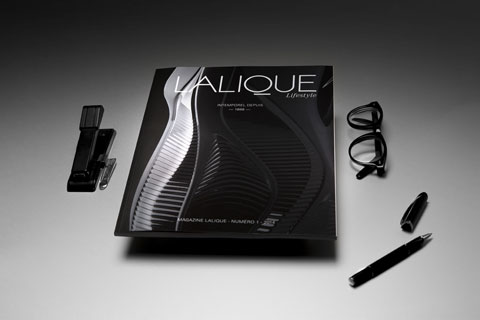
Geyst creates lifestyle magazine for Lalique

Geyst has created the first issue of an exclusive lifestyle magazine for the international luxury and lifestyle brand Lalique.

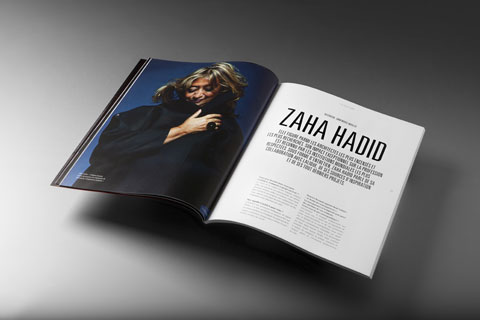
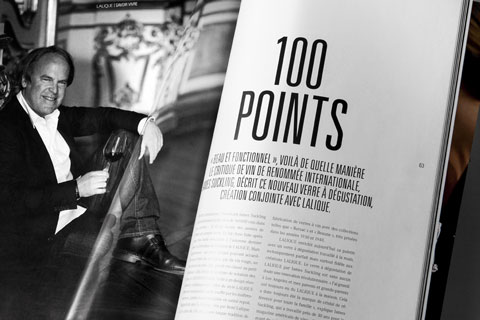
The new, nearly 100-page Lalique magazine was designed by Manuel Bächler and Florian Spierling to match the global lifestyle brand in its opulent presentation, according to a statement issued by the agency on Thursday. It is dominated by spectacularly designed stories about the company, which is rich in tradition, as well as about Paris, its headquarters. A selection of the partnerships Lalique has entered into with international artists, such as architect Zaha Hadid, and companies such as Bentley and Scottish whisky distiller Macallan is also presented.

It is planned to keep Lalique product lovers up to date on the latest developments with two issues a year - each in French and English. The new magazine is available in Lalique flagship stores around the world - including Zurich at Talstrasse 27.

You can find out more about the Geyst Agency in the Portrait the advertising week.

1.lalique.1
1.lalique.2
1.lalique.3

Last but not least: Nutella is now involved

Nutella is one of the most popular brands on Facebook. What’s particularly impressive is that the most successful fan pages were often unofficial ones. For a long time, people wondered why Nutella didn’t actively capitalize on having such enthusiastic fans.

Just last year, Ferrero even called on the founders of "World Nutella Day" to stop using the brand illegally. In doing so, the company missed an incredible opportunity. People with genuine enthusiasm gave up their free time to organize a global brand event and Ferrero could not bring itself to cooperate with them.

The Italian agency McCann is now launching a global campaign that finally does just that. On the website Nutellastories.com anyone can post their personal experiences with the spread. One of the initiators of "World Nutella Day" has been involved in the campaign and calls for an official Spot to take part. Unfortunately, the stories submitted so far are still pretty bland. (sis)

"Para-journalism" as a threat and/or enrichment

The media crisis is creating information gaps that are critical to democracy, which organizations like my employer are trying to fill. Some journalists find this development troubling. So it’s high time to draw a distinction between traditional and necessary PR, says Oliver Classen.

It was a classic case of blaming myself. Or communicative overzealousness, which is often the same thing in my profession. On the way to the second Research Day at the Lucerne Media Training Center (MAZ), I asked colleagues for professional input for the sold-out event. Via Twitter, of course, which an Beobachter editor immediately responded to with the counter-question of what "a lobbyist is doing at #rt_maz". The comment from a former editorial colleague and current MAZ head of studies that I was contributing my knowledge as an NGO researcher provoked a comparison that - in contrast to the understandable initial question - left me rather dismayed: "Every lobbyist says they are fighting for the good. Even the head of the industry association Interpharma."

Okay, I confess: my job primarily consists of creating media resonance for the topics, theories and studies of my employer. That's what it says in my job profile and that's also how I see my professional role. But that's all the similarities between my work (and that of almost all NGOs) and that of the PR headquarters of corporations, associations, authorities and governments. Of course, for particularly good, i.e. particularly critical journalists, this is nothing more than the bold claim of a lobbyist who is particularly concerned about integrity.

It is based on an analysis of the diametrically opposed motives and methods of conventional PR and - in view of a fourth estate suffering from a lack of resources - necessary PR. By definition, THEY represent the positions and institutions of political or economic power, whereas people like WE represent the structurally powerless. Which is why their task all too often consists of passive-aggressive obstruction of journalism, but ours always consists of (supporting or owning) attempts to shed light on dark machinations and opaque contexts.

Accordingly, the same investigative tools are used by editorial offices and research-based NGOs. My main interest at the MAZ was therefore the exchange of experiences in matters of source protection, publicity law, screening of non-listed companies and the use of judicial documents as news sources. And since there are more points of contact than ever in times of booming sweatshop research, offshore leaks and commodity reports, the discussions between the workshops were just as exciting as the workshops themselves.

So it was no coincidence that my last appearance at the Swiss School of Journalism was about shifting role models in the increasingly gray areas between journalism and politics. The host called me a "para-journalist" at the time, which, despite its military connotations, is not entirely inappropriate, is it? In any case, the discussion seems necessary to me and is hereby officially opened.

Oliver Classen is media spokesman for the development policy organization Berne Declaration. Previously, he worked as a media journalist.
 

Print against the rest of the world

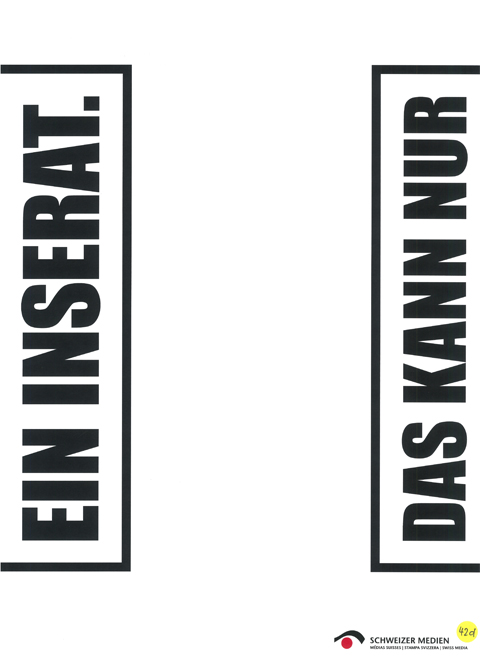
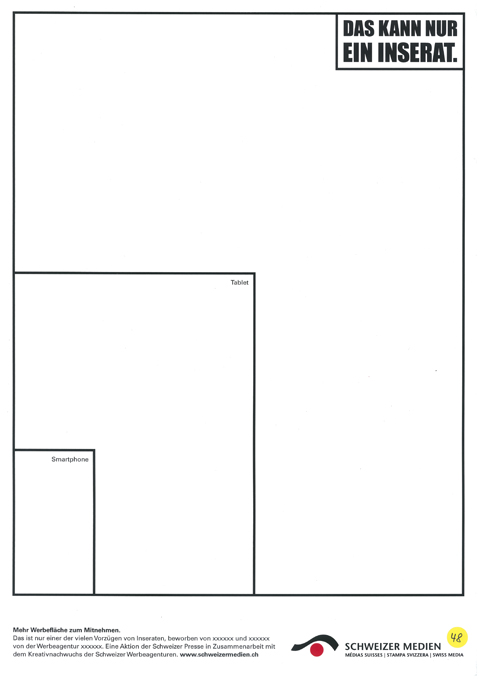
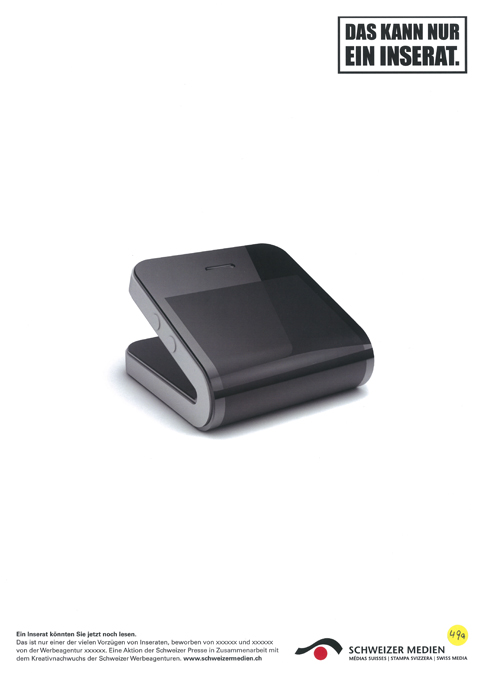
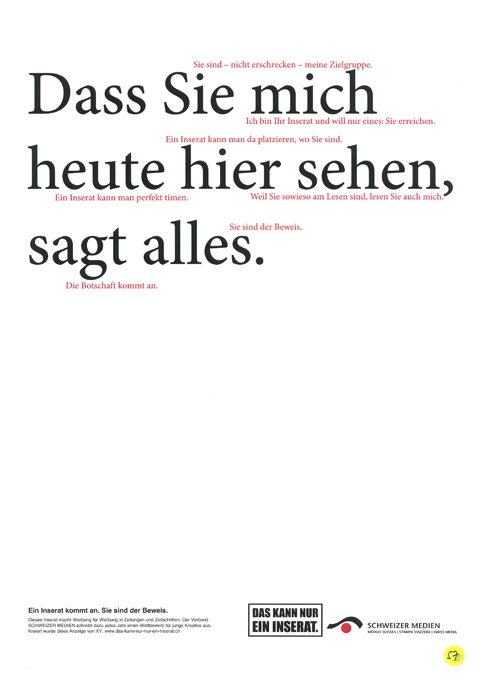
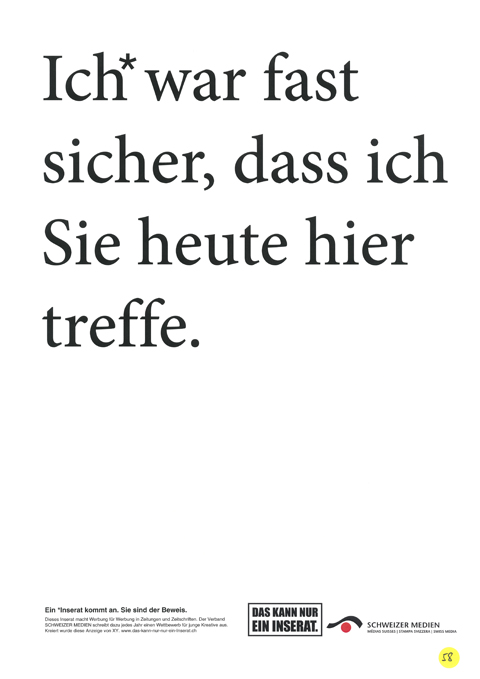
The winners of the «Das kann nur ein Inserat» contest have been announced. Luca Schneider and Yannick Schaller of Havas Worldwide Zurich took first place with a combination of text and images. Their ads will promote their peers in print media starting in April. 

DKNEI14_Sieger
(Luca Schneider and Yannick Schaller, the winners of DKNEI, celebrate. Photo: Tom Stuckert)

The advertisement has advantages that no other advertising medium can claim. The Swiss Media Association has been communicating these advantages for eleven years now. Creating a new idea after 97 advertisement subjects is a challenge. But this was once again the task of the "Only an advertisement can do that" DKNEI competition. 

24 teams submitted a total of 61 works: 32 ideas for individual subjects and 29 ideas for campaigns (with a total of 95 subjects). Slightly fewer than in the record year of 2013, but more than in 2012.


The winners

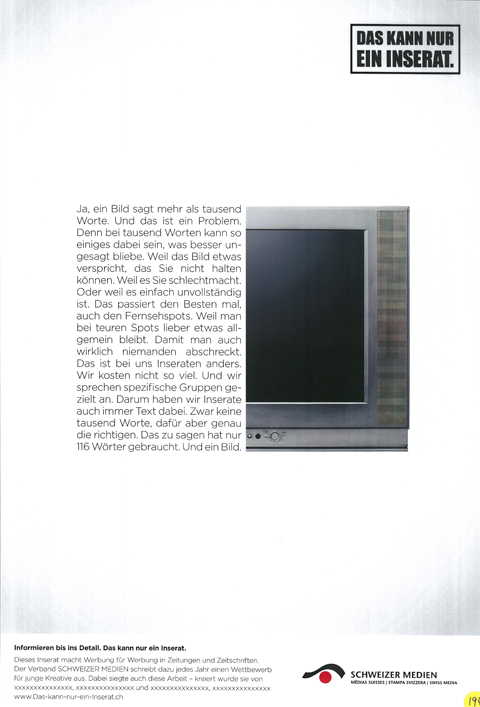
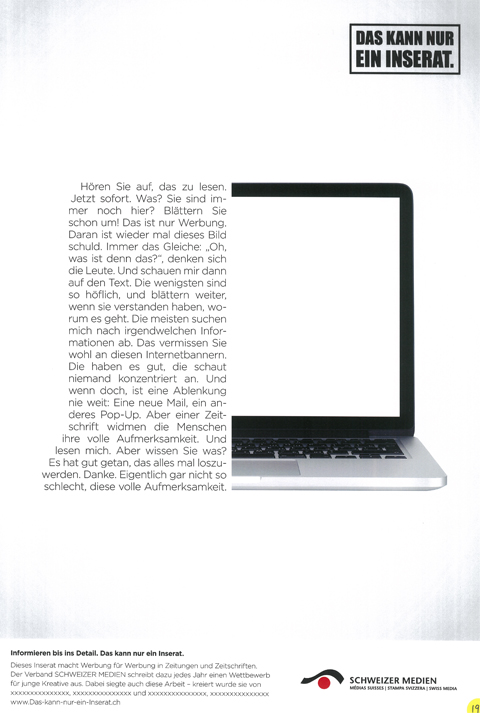
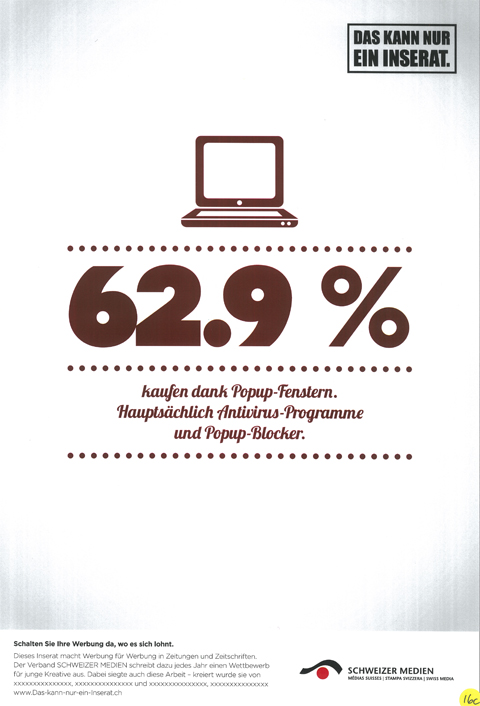
The winner was a campaign with three subjects by Luca Schneider and Yannick Schaller from Havas Worldwide Zurich.
 

19a
19b
19c_0

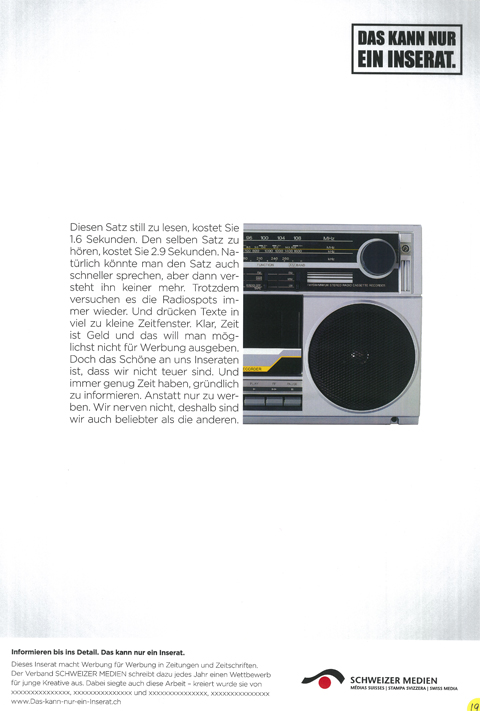
"Subject by subject, the campaign confronts the other media - internet, television, radio - with hard-hitting facts. Credible, comprehensible and without hitting below the belt," comment those responsible. "A campaign with a relatively large amount of text - which is only possible in this form in an advertisement - and yet neither a text campaign nor a mini-format poster." 

The shortlist 

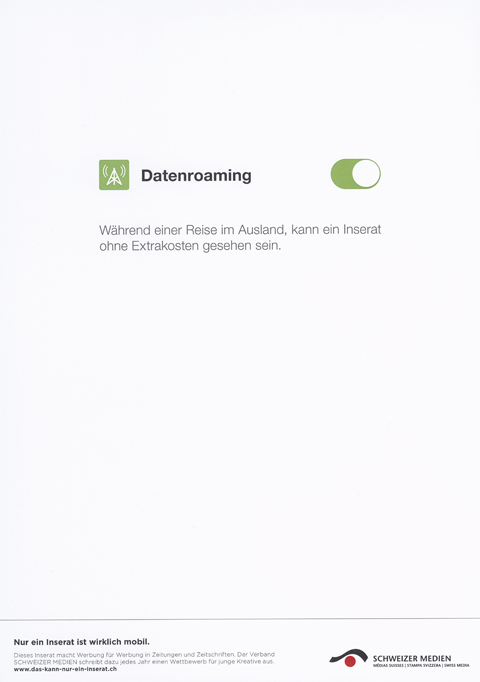
In addition to the winning entry, six other works were shortlisted:

16c
Luca Schneider and Yannick Schaller, Havas Worldwide Zurich 

34a
Gaël Tran, Trio Lausanne, and Gregory Talbot, Freelance, Nyon 

42d
Martin Voggensperger, graphic designer, Basel 

48
An Le and Olivia Gnani, Advico Young & Rubicam, Zurich 

49a
An Le and Olivia Gnani, Advico Young & Rubicam, Zurich 

57
58
Christian Omlin, Sanagate, Lucerne

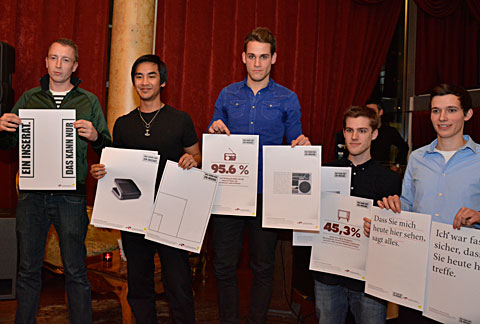
DKNEI14_Shortlist
(The shortlist winners present (from left to right): Martin Voggensperger, An Le, Luca Schneider, Yannick Schaller, Christian Omlin; Photo: Tom Stuckert)

No Best YET 2014

As every year, the winners receive a fee plus the commission to realize their campaign. The subjects will appear in the entire Swiss press landscape from around April. This includes over 120 newspapers and magazines whose publishers are members of the Swiss Media Association.

Unlike in previous years, however, the winning duo will not receive a ticket for the Best YET, which was due to take place in Dublin in May. The European competition of national newspaper and magazine associations was canceled at short notice this year. The reason is the financial problems of individual participating countries, as explained by the Swiss Media Association. Intensive discussions are currently taking place as to whether and, if so, in what form the competition could take place next year. 

The jury

It was made up of three ADC members, a former DKNEI winner, an advertising client and a representative of the Swiss Media Association:

  • Andreas Prokesch (Jury President), hubatka-prokesch-seiler.ch
  • Dominic Beyeler, freelance art director and illustrator, winner 2013
  • Marcel Kohler, Managing Director of 20 Minuten, representative of the Swiss Media Association 
  • Thomas Kurzmeyer, Creative Director Wirz Advertising
  • Simon Staub, Creative Director Leo Burnett
  • Heinz Vögeli, Vice Director VBZ, Head of Human Resources and Corporate Communications, client representative

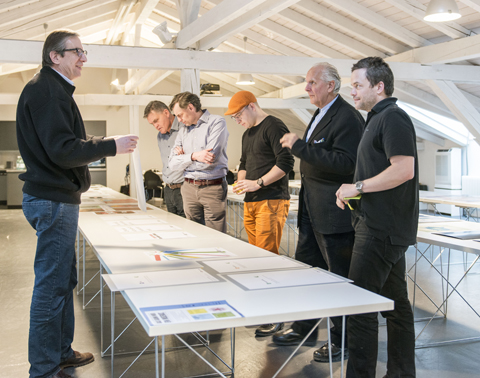
jury
(The jury at work. Photo: Keystone)

Partners and sponsors of the competition 

Keystone made its entire treasure trove of images available for the competition free of charge and without restriction. Other partners and sponsors: Art Directors Club (ADC) Switzerland, Allianz Schweizer Werbeagenturen ASW, BSW Swiss Leading Agencies, Schweizer Werbung SW, Textverband, Cominmag (media partner), Werbewoche - Zeitung für Marketing, Werbung & Medien (media partner) and Swissprinters Zofingen (production of print material) - plus the sister organizations of the Swiss Media Association, Médias Suisses and Stampa Svizzera. 


get_footer();