Artificial intelligence vs. humans - who wins?
A wide range of topics and perspectives on artificial intelligence (AI) dominated the 4th Digital Economic Forum 2018 (DEF) at the Park Hyatt in Zurich.


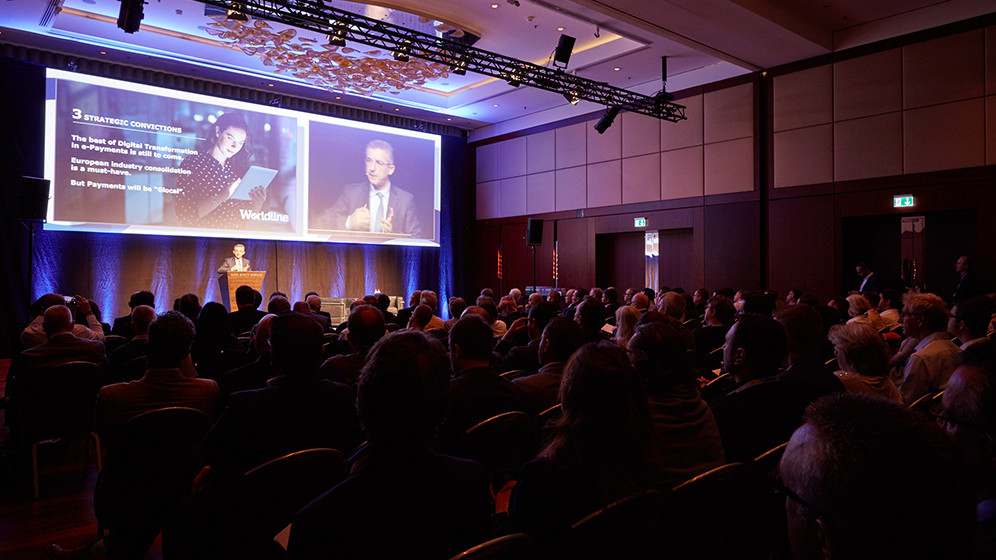
The new DEF organizer Thomas Zwahlen focused on the effects of digitalization on people. The knowledgeable audience heard from experienced speakers about various approaches to artificial intelligence (AI) and its potential for future applications.
Carmen Walker Späh, member of the Zurich cantonal government and Director of Economic Affairs, welcomed the audience right at the start by pointing out that Zurich has developed into a leading ICT location. Industry 4.0 demands enormous pressure for all players to adapt, said Carmen Walker Späh. However, a 4.0 policy is also needed that does not stifle innovation through regulation. Stephan Sigrist, head of the think tank W.I.R.E and co-author of the study "Future Digital Switzerland", called for a new approach to dealing with the unknown digital future, a differentiated perspective beyond the usual myths. Digitalization is the norm today. However, the focus of innovation must be directed towards people and society.
Switzerland's leading role for AI
Lukas Sieber, Co-Founder of Mindfire & Executive Director North America Greater Zurich Area (GZA), found that the world has gotten "high" on blockchain and crypto in the last few years. But don't be fooled, most of it is junk. Together with his co-founder Pascal Kaufmann, Sieber presented the recently published white paper from Mindfire, a non-profit project that aims to decode the human brain with the 100 most intelligent people in the coming years. Mindfire was founded so that Switzerland could take the lead in the field of AI and not leave the development to private individuals or companies. The results of the project should also be generally available and corresponding licenses for the innovative inputs of the participants should be refinanced via IOC (blockchain/token) to create value.
Matthias Plattner, Head Technology & Platform Innovation - Global Financial Intermediaries UBS AG, predicted that the banking business will be heavily dependent on augmented technologies in the future. The risks must be understood and the opportunities exploited accordingly in order to be able to provide people with comprehensive and, above all, trustworthy advice. Karsten Stampa, COO/CFO Healthbank Innovation AG, then took up the topic of trust: "Without trust, a lot of potential in digital health will be wasted," explained Stampa. Digital health could bring an incredible number of benefits based on "live data of real life". However, we need to move away from closed systems and strengthen data protection for users themselves, then trust will also work.
Beware of the Darknet and 007
The Dane Hans Ulrik Staehr, Founder MarketScape, Denmark and Co-founder Munit.io, gave an impressive insight into illegal processes and business (drugs, weapons, cybercrime) in the hidden Darknet with a combination of crypto assets and the TOR browser. Darknet is a threat, but also an opportunity to recognize criminal processes and criminal psychology. In an effective presentation, profiler Suzanne Grieger-Langer explained how to find the 007 types and avoid the 08.15 types. The most important resource today is knowledge. Communication and cooperation at a higher level are now digital. The (00)7 skills orientation; decision; focus; discipline; mindfulness; fitting and individuality make up the "Homo Deus", the leadership personality.
Andrew Garrihy, Chief Marketing Officer Consumer Business, Western Europe of the Chinese technology company Huawei, presented his company and its understanding of artificial intelligence (AI). "We believe that AI must serve humanity," explained Andrew Garrihy. It should help to enhance the potential of the human brain. "At some point, machines will overtake us in a materialistic sense," predicted Prof. Joachim Buhmann from ETH Zurich. The goal is self-learning algorithms that explore reality. Patrick Schraut, Vice President Consulting Europe at NTT Security, saw IT security on its way from a niche existence to becoming a business driver and part of a company's value chain. It is thus becoming both a competitive advantage and a success factor.
Artificial neural networks are changing the world
The Deep Learning Engineer from NVIDIA LTD, Adam Grzywaczewski, impressed the audience with his presentation on "Demystifying Artificial Intelligence". Thanks to ever-increasing amounts of data, eminently improved computer performance and their networking, artificial neural networks with high application potential are now possible. Examples include autonomous vehicles, better detection of diseases and smart robots, explained Grzywaczewski. These artificial neural networks would change the economy and society. In contrast, Thomas Asger Hansen, Senior Manager, Big Data, AI & IoT Lab, Grundfos A/S, estimated that AI should be used to enhance human performance and must be implemented through an "intelligent system" that orchestrates a variety of paradigms rather than relying on a single paradigm. "Our vision is to simplify and automate maintenance as much as possible - even for complex systems - so that even non-experts can safely perform a range of complex tasks," explained Hansen.
Photos: Digital Economic Forum