
Five hairs, a thousand blunders
The first Papa Moll movie hits theaters on December 21, 2017. Filming for the 5.5-million-budget movie is already in full swing, with the main filming location being a cornfield near Bad Zurzach. Werbewoche got an exclusive behind-the-scenes look on one of the shooting days and spoke on set with lead actor Stefan Kurt as well as Roy Oppenheim, the son of Papa Moll creator Edith Oppenheim-Jonas.


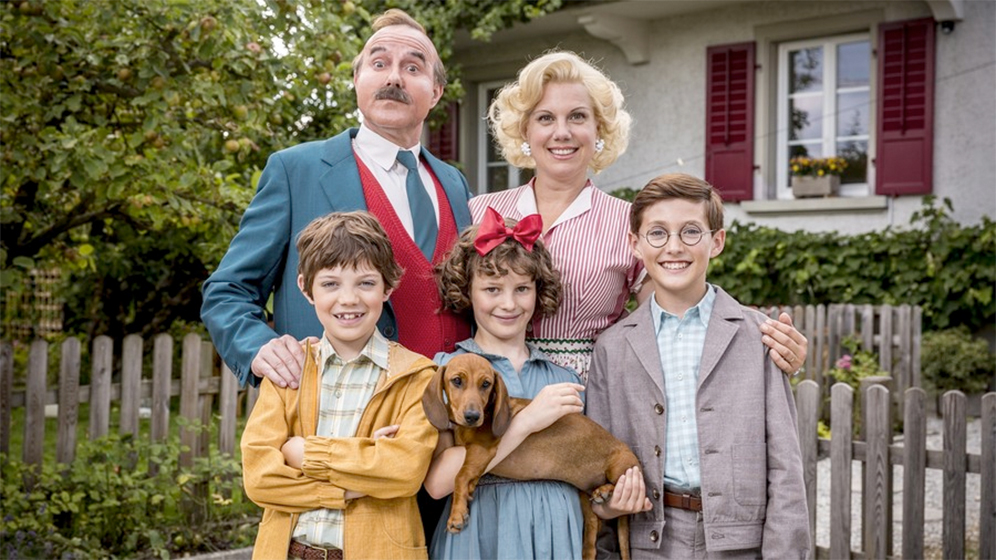
"My sunny disposition connects me with Papa Moll"
Stefan Kurt, were you surprised that you were chosen for the role of Papa Moll?
Kurt: When I was invited to the casting, I was really happy to be given the opportunity to play a very extroverted, funny role.
How much time will you have to spend in make-up before each shoot? What do you do - apart from turning a full head of hair into five?
I spend two and a half to three hours in make-up every day of filming. Two silicone parts are glued to my cheeks to make my face rounder. The parts are then colored to match my skin tone. I don't need to glue on a bald head as I had my hair cut for this. Now just style the tuft of hair on my head (also my own hair), glue on the moustache and Papa Moll is finished.
Which characteristic of the jovial and rather clumsy Papa Moll is closest to your own character?
I was born with a sunny disposition. I think that's what connects us.
You are one of the busiest Swiss actors. What appealed to you in particular about this role?
I find the task of bringing a two-dimensional comic figure to life extremely exciting. And then there's the figure of Papa Moll, who is very well-known and popular in Switzerland. That's very appealing!
What does it mean to you to embody a character who accompanied you through your childhood? A fountain of youth?
It is both a great pleasure and a task for me. For my skin, however, it is not a fountain of youth because of the long mask times, but the opposite.
What is the biggest challenge for you in embodying Papa Moll?
The biggest challenge for me is to bring the essence and the "soul" of this wonderful comic figure, so wonderfully drawn by Edit Oppenheim-Jonas, to the screen.
Stefan Kurt was born in Bern in 1959. He is a film and theater actor as well as a dubbing artist. From 1985 to 1993 he was a member of the Hamburg Thalia Theater ensemble, and since 1993 he has appeared in numerous television and cinema productions. He was awarded the Adolf Grimme Prize in 1997 and 1999 for "Der Schattenmann" and "Gegen Ende der Nacht". Kurt also works as a theater director and composes music for stage and studio recordings.
"Papa Moll means well"
Roy Oppenheim, your mother, Edith Oppenheim-Jonas, invented Papa Moll in 1951. So, like many people, you grew up with Papa Moll - but you were closer to him than other children. Is Papa Moll like a brother to you?
Oppenheim: When Papa Moll was born, I was eleven years old. Papa Moll is more of a father figure for me, too, and he is still with me today. He grew up in our family and contains certain characteristics of my father, my grandfather on my mother's side, who was outwardly very similar to Papa Moll, and he has elements of my mother's character. But Moll is an artificial figure, a caricature that combines - exaggerated - human characteristics. Above all, Papa Moll has a lot of humor, which has always been very important in our family and has shaped me. "Humor is when you laugh anyway." - Humor is an important, spiritual way of coping with life.
You are a publicist. Why don't you tell the story of Moll's adventures yourself?
(laughs) Of course, the question has come up from time to time. After all, I once drew and wrote a Papa Minor book. In 1991, I also wrote a book together with my sister and my mother: For the 700th anniversary of the Swiss Confederation, we created volume 7, "Schweizerreise" (Swiss Journey). My mother was 84 years old at the time and was looking for new illustrators, so it was an experiment. Even if the book is not the best from an artistic point of view, it was successful. To this day, volume 7 is the most successful Papa Minor book. The content, the history of Switzerland, obviously appeals to people. At that time, in 1991, I had long been working successfully in radio and television; moreover, my mother was much more talented at drawing than I was, which is why the question of whether I should take on this task never even arose. Before my mother died in 2001, we looked for alternatives. One thing was clear to us: Papa Moll should live on, as around 95 percent of the Swiss population know him. Today, Papa Moll is drawn by Rolf Meier, "Roloff", and Jürg Lendemann is the versesmith. Both are highly talented artists who bring Papa Moll into our time.
Nevertheless, as the rights holder, you and your sister are keeping a close eye on what happens next with Papa Moll. What do you attach great importance to in the continuation of the Papa Moll stories?
We make sure that the basic idea of Papa Moll is not perverted or misused. This idea can be described as follows: Papa Moll addresses a basic human characteristic: he means well. He wants to organize and shape life as perfectly as possible and - oops, something unexpected has happened again that throws a spanner in the works.
Is this attempted perfectionism the typical Swiss characteristic of Papa Moll?
I think so. Perfectionism is particularly anchored in Alemannic-Germanic culture. Papa Moll is a good father and husband with clear principles and ideals. But his good intentions are constantly overturned and sometimes end in failure through his own fault, misfortune or external circumstances. The Moll story thus reflects a basic human experience: principles are good, but life doesn't always play along. All Papa Moll stories basically revolve around a simple motif: Papa Moll fulfills his responsibility as a teacher with meticulous perfection. But he always gets things wrong. The stories about Papa Moll have an anti-authoritarian streak: Papa Moll's authority is relativized by the superiority of the children, and occasionally also by the superior Mama Moll. Children have an incredible understanding for making mistakes and are downright grateful when they are shown that adults are imperfect too. This is the key to success with Papa Moll. Behind this is the insight that life should be lived playfully and with humor. Otherwise you will fail and despair at the inadequacy of the world.
Two questions for the media specialist: Digitalization is also reaching children's rooms; new children's books are published every day. Papa Moll has been successful for 64 years despite the digital and printed competition. How does he do it?
Papa Moll is perhaps still successful precisely because he has not kept up with electronic developments, the world of Japanese manga, etc. His style and character are anachronistic in a good sense, timeless. The sales figures for the Papa Minor books have been rising for some time now, not just because we are now making the movie, but because the character is right. The trick is to adapt forms and content to a constantly changing world without questioning the basic idea of the Papa Minor story.
Are special marketing and advertising measures necessary to keep Papa Moll at the top of the flooded book and film market?
Papa Moll has been continuously adapted to the world for 20 or 30 years. It has changed over time and that's how it should be. The social and societal changes that we are constantly confronted with should be reflected in the stories, but the basic human idea has remained unchanged. Children love the friendly Papa Moll precisely because of the tragicomic experiences and because he remains himself. Papa Moll is not a rigid artificial figure, but a father from real life - albeit somewhat exaggerated.
Is the 5.5 million franc movie one of the measures to keep Papa Moll in the spotlight?
The reason for the film is that the popular cult figure is particularly suitable for a feature film and therefore for a mass medium. Spending 5.5 million exclusively on advertising would be a bit excessive. Papa Moll is so well known that such measures are superfluous. The main reason for the cinematic realization is of a cultural nature: it is a fine art to create a good comedy. Papa Moll is better suited to this than almost any other Swiss comic character. We want to give people an enjoyable, amusing, gripping movie experience. Producers Lukas Hobi and Reto Schaerli, who have turned "Heidi", "My Name is Eugene" and other Swiss films into considerable box-office successes, know the market and give us hope that this venture will also be a success.
What do you think of Stefan Kurt as the leading actor?
I was skeptical at first. But Stefan Kurt is certainly the best choice for a Swiss Papa Minor feature film. He is an outstanding actor. He brings the comic character to life convincingly and credibly, creating something new that has never been seen before in the Papa Minor world.


