Y&R Group Switzerland: The trends of 2016
2016 will be a year of evolutionary—yet accelerated—development. Not a revolution, then, but a transformation characterized by exponential growth. That’s how the trend researchers at Y&R Group Switzerland summarize it.


The dominant themes at the Consumer Electronics Show (CES) in Las Vegas at the beginning of January 2016 are a good indication of this: Self-driving cars, drones, the Internet of Things, robots and wearables are all not completely new developments. But many things that were recently considered utopian or at least experimental have now reached market maturity and will have a lasting impact on the economy and society.
In the area of marketing, media and technology, the following trends are particularly worth mentioning:
Messaging apps
The main purpose of smartphones in Switzerland today is not to make phone calls, but to send messages. As the Y&R Group Switzerland's Media Use Index shows, 63% of the Swiss population write messages every day and 54% read and write emails. In contrast, only 46% of respondents use their smartphone to make phone calls every day.

Messaging apps are also gaining in importance on a global level and are even overtaking social networks: The four largest messaging apps together have more users than the four largest social media platforms, namely close to 3 billion Monthly Active Users (Businessinsider.com). The leader is WhatsApp, followed by Facebook Messenger, WeChat and Viber.
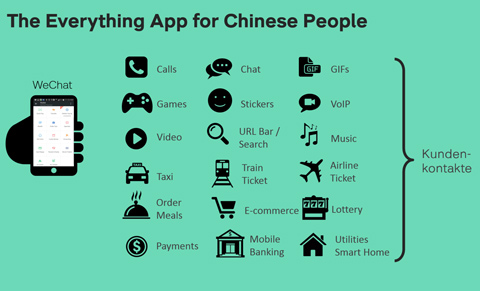
However, the example of WeChat shows that messaging apps are not only used for chatting with friends. The service, which originated in China, also allows its users to order a cab, buy tickets or even carry out banking transactions. Messaging apps are developing into universal service platforms, a "remote control for life". Facebook is also developing Messenger in this direction, as the "M" project shows. It will therefore be crucial for companies in future that their services are available via messaging apps.
Marketing Automation
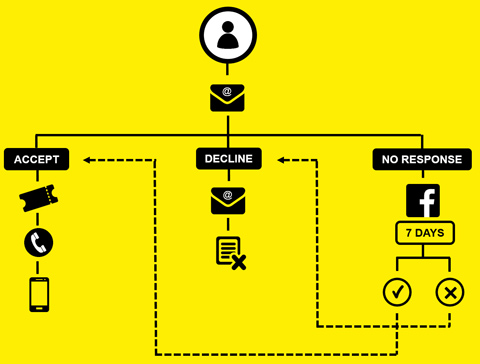
Marketing automation makes it possible to react automatically and individually to the behavior of the target group as part of a digital campaign and thus achieve maximum conversion. For example, a company that invites people to an event can set up different processes for people who a) register, b) unsubscribe and c) do not respond. For example, those who have registered receive a reminder shortly before the event, while follow-up measures are played out via additional channels if there is no response.
Another level of marketing automation involves running different campaigns for individual target group segments. Such complex processes were an organizational nightmare until recently, but can now be managed automatically and efficiently with specialized software. With Adobe Campaign, Marketo, Silverpop or Autopilot, solutions are available to manage all processes across all channels.
Programmatic Buying
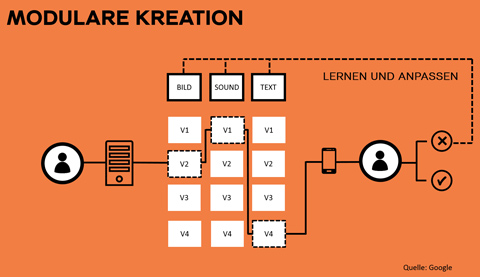
In the area of display ads and text ads, programmatic buying ensures even more effective campaigns than the current fixed placements. Whereas with fixed placements, the advertiser defines who gets to see a campaign based on relatively broad categories, with programmatic buying this is controlled by software. This continuously optimizes an ongoing campaign in terms of conversions and costs. Within 120 milliseconds, it evaluates a large number of parameters and decides which advertising material to display for each individual ad. Programmatic buying also makes it possible to run campaigns worldwide via a single cockpit.
Virtual Reality & Augmented Reality
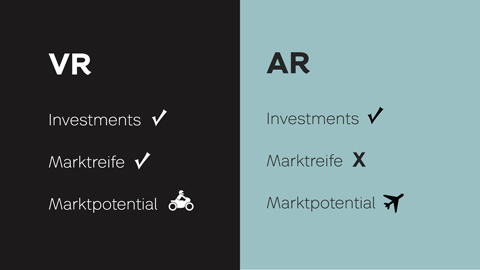
The upcoming market launch of the 3D VR headset Oculus Rift marks a milestone in the field of virtual reality. The fact that the consumer version was sold out for four months within 24 hours of going on sale shows the high level of acceptance of this technology among consumers - despite a retail price of 599 US dollars.
While VR headsets are still often seen purely as a gamer accessory, a wide range of potential applications are now emerging - including in the professional environment. Architects, for example, can make rooms and buildings virtually accessible during the planning phase, while psychiatrists are hoping for new treatment methods for post-traumatic stress disorder or phobias.
The fact that virtual reality is one of the most important trends of 2016 is also shown by the variety of solutions appearing this year: they range from simple cardboards (where a smartphone serves as a screen) to Playstation VR and the high-priced HTC Vive.
Solutions in the field of augmented reality are not yet fully ready for the market. However, Google Glass and Microsoft HoloLens already show the potential of this technology. Many companies are investing heavily in this area - as impressively demonstrated by the more than 800 million US dollars in venture capital that Magic Leap received for a development of which only a few screenshots and animations have been released to the public.
Internet of Things
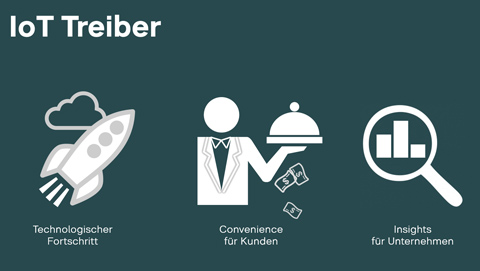
The Internet of Things (IoT) is also one of the key trends of 2016. However, while interest is often focused on the individual products (the "things") and their features, consumers and companies still often fail to recognize the importance of the data that the IoT generates.
The example of Nest Labs, the home automation provider acquired by Google for a record sum, shows that even the room temperature settings can be used to draw conclusions about a family's behavior. The informative value of this data increases many times over when it is combined with data from additional networked devices. This explains why all well-known technology companies are currently trying to establish a standard for networking smart home and other IoT components.
Personal Digital Assistants
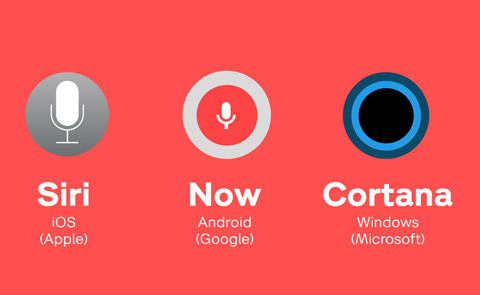
Apple Siri, Google Now and Microsoft Cortana are currently giving us a taste of what we can expect from digital assistants with artificial intelligence. Amazon has also created a good starting position with Echo, particularly as a smart home platform. All of these solutions impress with their voice control, but still fail to carry out chargeable transactions.
Text-based systems are sometimes further ahead here. Both the messaging app WeChat and the "Assist" service integrated into Facebook Messenger make it possible, for example, to request a cab, reserve a restaurant table or order flowers via text messages. It is becoming apparent that consumers will soon no longer make many transactions via a telephone call or a web interface, but via messages in natural language.