Print is premium - daily newspapers on their deathbed
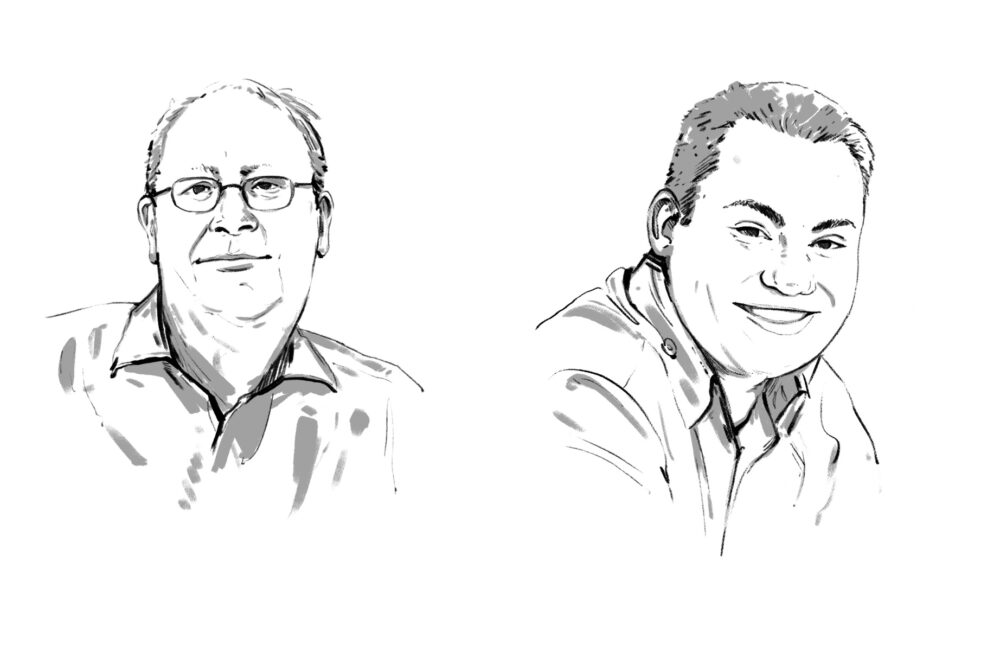
Unter dem Motto «Ansicht, Sichtweise, Weitsicht» haben am Papyrus Symposium Frank Bodin, Rolf Dobelli und Friedhelm Lammoth ihre Print-Sicht dargestellt.


At this year's Papyrus Symposium in the Kursaal in Bern, the focus was on future perspectives and foresight - and of course print in coexistence with the possibilities of new media. The first speaker, Rolf Dobelli, known for his works "The Art of Clear Thinking" and "The Art of Clever Action", presented some fascinating examples. For example, the following simple question: A slim man with glasses is standing in front of you. He likes to listen to Mozart. What would you say, is he a professor of literature at the University of Zurich or a truck driver? Correct, the attributes "glasses and classical music" give no indication of the man's profession. Nevertheless, most people tend to think that a man described in this way is a professor. If you yourself have just guessed that he is more likely to be a truck driver, this is possibly for many reasons - but also for the following? There may be a few professors of literature at university, but there are thousands of truck drivers. Statistically, it is therefore much more likely that the man is a truck driver. This is a classic fallacy called "base-rate-neglect" or "disregard of the basic distribution". In keeping with the motto of the event, "View, viewpoint, foresight", such mental elements aim to throw old prejudices overboard in order to make way for new perspectives. Another "classic fallacy", as Dobelli calls it, is the success monkey.

The successful monkey is the animal that remains when you remove the 50 percent or so of a million monkeys that bet on the "wrong horse" on the stock market. What remains at the end is a monkey that was always right. Now you have a successful monkey that can read and assess the stock market - or has at least done so more successfully than the 999,999 other monkeys. The thinking here was wrong in a predictable direction: According to Dobelli, humans tend to overestimate the role of skills and underestimate the role of chance. On paper, or presented out loud with a clear example, this error seems easy to see. Nevertheless, it apparently goes unnoticed by many.
Print and digital: what now?
Frank Bodin addressed another misconception in his presentation: The advance of online "is just a fad, print will remain irreplaceable". Such a view is the "hope of a carriage builder", said Bodin. Because one thing is clear to him: just as the horse was displaced by the car, the daily newspaper will also be displaced by the digital age. At the very least, the daily newspaper will no longer be a business model. However, this does not mean that Frank Bodin is already eulogizing the print industry in general. We should simply start thinking about what will happen next. Frank Bodin sees two main barriers to success on this path: firstly, EBIT optimization at the expense of investments and secondly, a false pride in the traditional. Bodin cited the free newspaper 20 Minuten as a shining example. It is successful, "whether we like it or not, it is simply a fact". 20 Minuten has developed an interesting model. In a nutshell, it can be summarized as follows: Pictures, teasers, keep on zapping - and a good distribution idea.

As far as print advertising is concerned, Bodin revealed his quality criteria at the Papyrus Symposium. You should be able to answer yes to the following three questions:
- Does it make sense?
- Does it move people and the brand?
- Is it exemplary? (socially and ethically)
He cited the "dumbest ways to die" prevention campaign as an obvious example of such a campaign. The corresponding song was uploaded and liked all over social media channels, was played on the radio on the music list and generated millions of clicks on YouTube.
//www.youtube.com/watch?v=IJNR2EpS0jw
Nevertheless, Bodin is convinced: "Print is and will remain an important part of the cross-media mix". It just has different qualities than Facebook, for example. Because print means "pause, slow down". Accordingly, Frank Bodin sees print primarily as a premium product. Because while online is better suited to fast news, the quality market remains for print. In the subsequent discussion with the evening's moderator, Ellinor von Kauffungen, Bodin answered what this means in concrete terms: "There are still magazines".
Dialogue marketing expert Friedhelm Lammoth, the third speaker at the Papyrus Symposium, blows the same horn - only with a slightly more culturally pessimistic mood. "Never before have people communicated so much," he says. MMS, feeds, emails and tweets are chasing each other, so we have to be careful that attention is not absorbed in a scattered way and people feel pressured. This is because the increasing mass of advertising only slightly increases the effect. And even a digital day only has 24 hours. Lammoth warns that this could soon lead to "ego exhaustion". Nevertheless, the "as well as" of online and print is also a huge opportunity. You just have to be careful not to annoy customers to death and instead choose which medium is more suitable in each case. In contrast to online media, print can serve all five senses. The personal touch is also important in an age of excessive communication on all channels. Lammoth concludes: "We have never done marketing, we have always just loved our customers.

Swiss Print Award
In the spirit of print as a premium product, the Swiss Print Award should also prove that "printers will not only print on paper in the future". Accordingly, the award itself is a cast concrete slab. The Swiss Print Award emerged from the Druckmarkt Award, which the Swiss management magazine first announced in 2004. The Swiss Print Award was presented to the company Kasimir Meyer for the work "Trend. World. Pictures", a print product with pop-ups and three-dimensional paper images. DE Druck was honored with the Swiss Print Award for its "Lovebox". Here, the company's own paper sample book was provided with a number of additions and thus compiled into a collection of different print products. Heller Druck received the Swiss Print Award for its work "Everything is possible". According to the judges, this self-promotion covers the entire spectrum of printing and finishing. The Peter Grob Prize was also awarded. This was in memory of ASW Managing Director Peter Grob, who passed away in 2012 and who helped promote the award from the very beginning. This prize is intended to recognize outstanding work in the field of "self-promotion by print shops and agencies" and thus commemorate the roots of the Druckmarkt Award. This year's Peter Grob Award went to IDFX with the justification: "You can hardly do better self-promotion in combination with online and print".

Text and photos: Ursina Maurer