
Oldies are Goldies
Further training is not a question of age, but a question of will and commitment. What professionals who are no longer very young need to know if they are aiming for a certificate or diploma.


They looked a bit strange in class at first when I arrived," recalls Edwin Lamprecht. What struck the students on the marketing planner course at the Swiss Marketing Academy, all between 25 and 30 years old, as strange was the seniority of their fellow student. Indeed, a 62-year-old rolling up his sleeves for a federal certificate is something of a rarity. But Lamprecht didn't feel too old to want to try again: "As an early retired IT specialist, I wanted to learn something completely different again."
Every marketer knows that the over-50 generation is a relevant target group. With noble labels such as Best Ager, Silver Surfer, Generation Gold, the young old are a market that is as idolized as it is difficult to crack. The hiking holiday/incontinence/mail order catalog pigeonhole has long since ceased to work for a generation that is largely fit, hungry for life and internet-enabled. It is also a generation that is not satisfied with what it already knows: "When I took early retirement at the age of 60, I noticed how my colleagues of the same age were becoming active on the left and right," says Lamprecht. "One studied mathematics, the other law, others threw themselves into other forms of further education." Lamprecht himself looked around for a course in economics, but found nothing that suited him. The IT specialist then realized "that there was a lot to learn about economics in marketing" and enrolled on the marketing planner course - now marketing specialist - in 2007.
The question of motivation
Of course, course participants over the age of 50 are a rarity. And yet: due to the economic situation, which makes it seem advisable for many employees to do something for their own school bag and CV, the topic of further education is also increasingly coming to the fore for some older semesters. After all, it has probably dawned on everyone that in the globalized economy, mere anciennity is no longer a job guarantee. This is noticeable at some schools. While companies may be making cutbacks here and there and therefore sending fewer of their employees on courses, on the other hand, the proportion of professionals who register themselves and therefore pay for the course costs themselves is tending to increase. Even people who are no longer 25: "We are noticing that the higher professional examinations in particular are also attracting more older participants," says Lex Ambühl, Head of School at Simakom in Hergiswil. We would never turn down students because of their age, says Ambühl. Increasing interest from professional veterans can also be seen here and there in the statistics from Swiss Marketing. In 2009, 6.1 percent of successful graduates in the field of marketing specialists were aged between 41 and 50 and 2.1 percent were over 50 - the highest figures since 2005. And among sales managers, the proportion of 41- to 50-year-olds even exceeded 10 percent for the first time in 2009.
"You generally never stop learning, age shouldn't really play a role," says Hansruedi Knöpfli, Head of School at the Swiss Marketing Academy in Zurich. The school often trains older students who have come to marketing in a roundabout way on their career path and now want to have a proper education in order to be able to act competently in everyday working life. Knöpfli would talk about the attribute "old" "from 55 onwards". Those who are fit and have the drive to continue their education will probably never hit a glass ceiling in terms of seniority. Nevertheless, says Knöpfli, people are asked about their age and their motivation to embark on further training relatively soon during a consultation. Anyone who has simply accepted the course as a gift or offers other implausible reasons has a hard time or is rejected.
And the return on investment?
Knöpfli addresses another thing that oldies and goldies need to think about: the personal return on training. "Older people simply have less time to reap the return on investment." Or to put it another way: the later you decide to undertake further training, the smaller the window of time you generally have left in your career. Someone over 50 has a good 180 months left; someone who graduated ten years earlier can hope to amortize their course costs for 120 months longer - or work on it. People over 45 probably need to think more carefully about what their professional and personal goals are. You can feel as young as you like: the older you get, the closer you get - at least as an employee - to the point at which your working life comes to an end. The concept of return on investment may sound a little technoid and more appropriate for financial transactions or real estate investments. But anyone who sees their education and career path as an investment in their own person should give it some thought.
As an early retiree, Edwin Lamprecht no longer had to deal with the issue of "return on investment". And yet: "Of course I also thought about how I could justify the approximately CHF 12,000 in training costs." The young senior from Benglen in Zurich has solved this in a clever way: he works between 30 and 50 percent in his wife's import company, where he takes care of the financials and - thanks to the marketing planner - can also contribute more marketing expertise. Lamprecht's tip for all those who are in the late fall of their working life and are interested in further training: "You should simply take a close look at what add-on the degree you are aiming for will bring for the employer." Or to put it another way: will what I'm aiming to do professionally be of any use in my company and in my position?
The return on investment can be calculated in hard currency - course costs and time spent versus payback - over the remaining time in your professional career. However, there is also the soft factor, which is less easy to calculate, but usually always materializes: the potential for cultivating relationships that further training brings with it. The group dynamic process, getting to know new people, that can't be represented in an Excel sheet, but it definitely has its value. For oldies, it is possibly even more important, because this way you once again get close to people who may be part of the target group in your own business.
Oldies in the classroom: advantages and challenges
The next question arises from the contact between experienced professionals and people at the beginning of their careers: How do old and young get on in the classroom? And what about the personal central computer? After all, it can be assumed that people learn and memorize faster at a younger age and that response times become slower with each year. Lex Ambühl sees advantages in having Goldies at the school: "To put it bluntly, they are good for the youngsters, thanks to their experience, for example. For example, we once had a 53-year-old grandmother next to a 22-year-old student in the same classroom." Ambühl has an apt saying at the ready, quoting communications professional Harry Holzheu: "You should listen to the older people until you're 40. After that, listen to the younger ones." Knöpfli also sees experience as a positive attribute, but notes: "We want to put classes together in a heterogeneous way, but as a rule there is no room for more than one class elder. Because of their life experience, this is usually a mother or father figure who is valued." Lamprecht writes this to mature students: what older participants bring with them in terms of life experience should be used sparingly and not actively, as this could otherwise come across as arrogant. Difficulties can also arise when older participants meet younger lecturers and question their views and assignments: "I had to bite my tongue a few times." When it came to learning speed, examinee Lamprecht remembers: "Everything that had to do with experience was almost a piece of cake for me. But when it came to memorizing things, I found it a bit more difficult."
In initial discussions, head teachers often point out to older participants that they do not receive special treatment. So as an oldie, you have to know that you have to compete with the younger participants on the same terms. This may not be easy at first for people who are used to working in an individual office in their professional lives and are now learning in a classroom. And it can be an unfamiliar situation for managers who are supported electronically by assistants in their day-to-day work to suddenly have to familiarize themselves personally with an electronic learning platform. However, those who overcome the hurdles and are able to fit into a learning community that may be the same age as their own offspring will experience a learning curve that is worth the course fee alone.
Edwin Lamprecht has fond memories of his time in his class. Sometimes he was even a guest at the private weekend parties of his much younger fellow students. And sometimes an older student can be a comfort to someone who is no longer quite so young, Lamprecht recalls: "At the exam in an exhibition hall in Basel, another student came up to me and said: 'I'm so glad you're here too. At 40 years old, I'm already considered an old bag in my class."
Lamprecht, at any rate, has no regrets about having opted for further training at a comparatively advanced age: "I would do it again. Or rather: I will do it again." It looks like the next course is coming up in the near future.
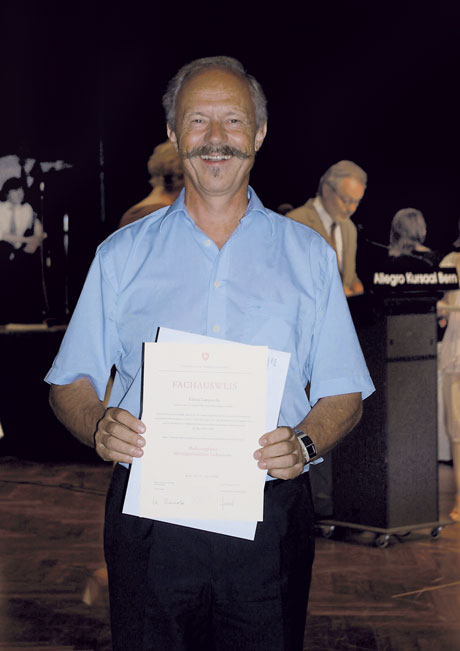
Edwin Lamprecht.


