Decisions are made in milliseconds
Megatrend or just hype? Everyone’s talking about «real-time bidding.» The latest approach to online advertising works like a «banner exchange.» This refers to the auction-based purchase of online ad space in real time, as Remo Prinz of Serranetga explains.


WW: Everyone is talking about real-time bidding. What are these people talking about?
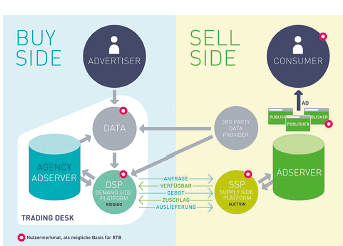
Remo Prinz: This refers to the auction-based purchase of online advertising space in real time. With this new high-tech solution, the exchange between the demand and supply side - i.e. between advertisers and publishers - takes place electronically. For this to work, software systems are used on both sides: the "Demand Side Platform" (DSP) on the demand side and the "Supply Side Platform" (SSP) on the supply side. The entire process, from the request and availability check to the bid to the acceptance and delivery of the advertising material, is completed in just a few milliseconds. This is so fast that the advertising arrives in real time from the point of view of the targeted consumer. Hence the name real-time bidding, or RTB for short.
Are there also misconceptions in circulation?
We are at the beginning of an innovation cycle. It is clear that there are also misconceptions in circulation. First of all, the idea that you can jump on this bandwagon without any prior knowledge is wrong. The emerging DSPs and SSPs are wonderful tools, but you need people who can drive these innovations forward and operate the tools correctly. If you put a layman in the cockpit of a jet, it will never take off, let alone land safely. It's the same with real-time bidding. Even the selection process for the right technologies is complex and requires a great deal of prior knowledge. Only those who are prepared to invest time and money and get the right people on board to build up and expand this expertise will take off with the new technologies and perhaps even fly a loop.
How did this development come about in the first place?
Almost all websites have a lot of unused advertising inventory that cannot be sold by conventional means or through personal contact. Today, individual online advertising networks exploit this situation by bundling the inventory from different websites and turning it into "structured products" - so-called pools or channels - and selling them to advertisers. The problem for publishers is that they cede the lion's share of the margin to the network as a middleman. The problem for advertisers, on the other hand, is that they are buying a "black box" and usually have to be fobbed off with cheap clicks or low CPMs. In online advertising, however, it is not decisive how cheaply volumes or clicks are purchased. Rather, it is the quality that is decisive - i.e. the results that are measured in terms of pure clicks or visual contact. If you look at today's network products from this perspective, they are overpriced, not to say worthless, for the advertiser. This discrepancy between the supply and demand side will be eliminated by e-commerce in the future. Intermediary trading with manually bookable pools will be eliminated by electronic trading in the medium term. The emergence of demand-side and supply-side platforms will bring publishers and advertisers closer together in the context of digitization, which will ultimately optimize value creation for both. The media business is becoming increasingly dominated by technology.
What are solid arguments for real-time bidding?
In my opinion, there are three main arguments:
Firstly, the increase in efficiency compared to manual booking processes is enormous. What today takes a week or even longer - calling each individual website, negotiating, reserving, confirming the booking and sending the advertising material - happens in a few milliseconds with RTB. By way of comparison, we can hardly imagine securities changing hands on the stock exchange in the 1980s with traders shouting loudly. Today, the customer instructs the bank to buy a security, while another customer instructs his bank to sell his shares. The transaction is then carried out electronically. In the near future, online campaigns will be handled in exactly the same way. In the somewhat more distant future, this principle will apply to all forms of digital advertising.
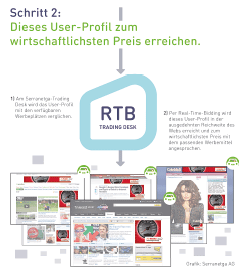
Secondly, the return on investment of the online advertising budget used improves significantly for advertisers. Not only because the middleman is eliminated, but also because the efficiency of delivery is increased. The contact dose per user profile can now be precisely controlled across all placements. Expensive double and multiple purchases by consumers on individual placements are eliminated - the advertising finds its way to the user profile at the most economical price and in the defined contact dose. In addition, all modern targeting options can be combined with RTB. At Serranetga, the return on investment for our customers has improved many times over through the use of RTB.
Thirdly, publishers also earn more money with online advertising thanks to RTB. Their idle advertising inventory can be monetized more easily through electronic trading. In the medium term, supply-side platforms will take over what is known as yield management for publishers - in other words, they are algorithms that ensure maximum utilization of advertising inventory at the best possible prices for publishers. The potential cannibalization of premium inventory is a legitimate concern for publishers. It is therefore imperative that quality titles ensure that they set correspondingly high minimum prices for their premium products that reflect the quality of the advertising environment - including in e-commerce.
What does this mean for publishers?
The emergence of RTB is good news for small and medium-sized websites. It gives them access to the advertising market. Today, it is difficult for smaller websites to get bookings via direct sales. The manual buying and booking process makes it virtually impossible for advertisers to include smaller websites in a media plan due to a lack of resources. This is now changing. Because with the advent of RTB, they too are participating in a centralized electronic marketplace for advertising inventory. Swiss publishers should actually try to sell the unsold residual space, which makes up a large part of their advertising inventory, via an RTB system. This is because an electronic trading system could also achieve a significant increase in efficiency on the supply side. However, there is still little interest on the part of publishers. Which is a shame, because all of this money is currently flowing abroad. However, this will change at the latest when advertisers' RTB budgets skyrocket.
Who can do this in Switzerland?
Only online units with highly trained specialists can do this. It takes a lot of know-how and a certain willingness to take risks to establish a trading desk. If, for example, the ad trader inadvertently fails to restrict a booking to Switzerland, the floodgates for advertising delivery would be wide open and media costs could reach dizzying heights within minutes. As an agency, Serranetga assumes this uninsurable purchasing risk. But it was precisely for these reasons that we first invested several months in testing the technologies and training our specialists internally before we went live with the first RTB campaign. Apart from using a DSP, you also have to master other ad serving systems and program interfaces between them. Only then can a fully functioning trading desk take effect. For all these reasons, very few people in Switzerland will get it right in the foreseeable future, because dealing with RTB cannot be compared with social media, for example, where the barrier to entry for market participants is minimal.
What is currently going on in this business?
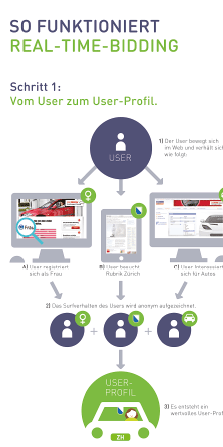
Let me explain this using a current case study: Mobiliar has set itself the goal of reducing the cost of its car insurance leads. In a first step, we created user profiles that matched the target groups as closely as possible. In a second step, we addressed this target group - in this case "women from the Zurich region who are interested in cars" - at low cost using RTB. It doesn't matter which website they are currently on.
How does Remo Prinz see the future of real-time bidding?
At the moment, RTB is mainly used for display banners and remnant spaces. Soon, however, online moving image advertising should also be booked automatically via RTB. The online marketer Stailamedia is already in the test phase for its Swiss Video Network. Everything else is still up in the air. One thing is certain: digitization will ensure that the majority of media use will be via digital channels - including newspapers, posters and television. So digitalization will not stop at media purchasing. In the future, algorithms will decide in real time and not manually working people whether a consumer is addressed at the right place and at the right time. This trend is just beginning in the area of online display advertising and will gradually spread to all digital forms of advertising in the coming years. Interview: Andreas Panzeri

Also possible for the first time: keyword-based display advertising via real-time bidding
Thanks to a new technology, advertising banners can now also be assigned to the desired environments via keywords and delivered via real-time bidding (RTB). Serranetga's trading desk is one of the first providers in Europe to use this technology. Here's how it works: a crawler searches all websites that can be accessed via RTB for the relevant keywords. If the consumer reads an article with the desired keyword, the advertising material is immediately purchased via RTB and displayed directly. This opens up completely new possibilities for advertisers: The targeting accuracy of keyword advertising and the effectiveness of images are thus linked. This is interesting for all advertisers who already use search engine advertising - the relevant keywords can be used one-to-one for display advertising.