"Don't be afraid of tricky questions"
Since early May, elementary school students have been writing weekly reports for the «Kinder-Tagi.» The editorial directors explain how they work with the children to put together the newspaper page and what makes collaborating with the young reporters so special.


WW: As editorial director of "Kinder-Tagi", you design a newspaper page with primary school pupils. Are you more of a teacher or a journalist?
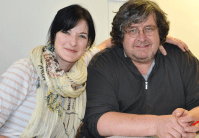
Melanie Kollbrunner MK: Something in between. We don't want to be teachers. But of course, as journalists we have a special role to play: We develop topics, help with the approach and edit.
Jean-Pierre Costa JPC: We accompany the children to events and interviews, they come to the editorial office to draw. We try to establish a connection with the pupils and teach them how to tackle a text, conduct an interview or write a report.
What attracted you to working with children as a journalist?
MK: The job is a great interface between journalism and children. I like having children. And I particularly like being able to work freely and creatively. As we layout the site ourselves, we have a lot of creative freedom. The work is also very varied. No two days are the same.
The content: Suggest topics to the children or let them think about them themselves. you would like to write?
MK: A mixed form: We provide the teachers and the children with a list each. For the first block of 20 classes, there were 60 different topics. Together with the teachers, the children choose five of the suggestions and can also suggest a topic of their own. We then decide on one. We find it desirable that the classes themselves come up with topics. However, our experience is that the set topics are usually better received by the pupils.
In which of the articles already published did the topic come from the children?
MK: One class had explicitly requested the interview with Bligg. Not yet published, but also written by the children, is the article "School in the past and today". The children went to a village festival, visited a museum and talked to village elders.
How do you select the classes?
MK: Admission is on a first come, first serve basis. As long as there is space, we accept classes. The only criterion is that they must be 4th to 6th graders from the city or canton of Zurich.
Why is the "Kinder-Tagi" aimed at primary school pupils and not high school pupils?
MK: This decision was not up to us, but to the marketing department and the exciting, as children of this age have their own tone and a unique visual language. The texts have this authentic, childlike quality. 16-year-olds would perhaps rather copy the tone they know from the newspaper and set different standards.
You mentioned the childlike tone. As a reader, you ask yourself: how much did the children write themselves, how much was edited?
JPC: Our basic maxim is to change as little as possible. We have also told the teachers that the texts should be authentic. It's not about winning a Pulitzer Prize.
MK: Of course, we don't know how much the teachers are involved. The idea is that they don't, or not too much. Of course we correct grammatical errors. After all, we don't want to embarrass the children...
JPC: We do not distort or enrich the articles with words that are not in the children's vocabulary. Over 90 percent of the page is the result of the pupils. I think that's good. The "Kinder-Tagi" should really be their newspaper page.
As editorial director, are you not worried that it will be boring if the "Kinder- Tagi" is published every Saturday?
MK: We particularly value the long term. It is valuable that readers can get used to the site.
What reactions do you get from readers?
JPC: So far, I have only received positive feedback. And although we are fully booked until the end of March, we are still receiving registrations from classes. That shows: The site is being noticed.
The online presence of the "Kinder-Tagi" seems rudimentary. There are only PDFs of the print pages to download...
MK: The website is currently being expanded to give students the opportunity to get to know the online medium better. The site is to become more versatile, more colorful and less static. There will be a blog and a Twitter function. Facebook is out of the question, as a profile can only be created from the age of 13 - although Facebook is of course already an issue for boys. There will be a kind of making-of feature so that readers can gain an insight into how the pages were created. For example, the article about the visit to the zoo could include photos showing how the children experienced the trip, an interview with a keeper or something similar.
JPC: You could also include other drawings made by pupils. It's a shame when excellent drawings disappear just because they don't make it onto the newspaper page for reasons of space or fit.
Last question: What do you learn from the children for your job as a journalist?
MK: A lot: Curiosity, directness and openness... And I'm learning to keep an eye on the very basic questions. The children are less prejudiced in their approach to topics.
JPC: That also applies to me. It's also a return to my roots for me. I come from the teaching profession. It's a re-immersion in processes that were relevant at the beginning of my professional career and were later pushed back by journalism.
MK: It's great to see how children interview. They ask different questions than journalists and are not afraid of sensitive topics. They ask about wages, about touching experiences, about fears. And they have no inhibitions about asking simple questions or questions that have already been asked three times. There are always children who are not satisfied with the answers and follow up. In the case of rapper Bligg, they probed: "But when was the first time you kissed?" or: "Why won't you tell me now?" Children have this straightforward, inquisitive approach.
Interview: Isabel Imper