The down-to-earth cosmopolitan
After many years in Zurich and the USA, Ralf Kostgeld has returned to his hometown. Since the end of 2011, the long-time Creative Director of Publicis has been at Ammarkt in St. Gallen. What led the creative, whose work has won over 180 national and international awards, to the strategy agency?


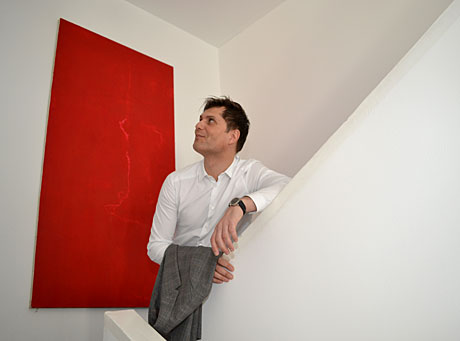
Wearing a white shirt and dark blue jeans, Ralf Kostgeld sits at the meeting table located in the entrance area of the multi-story agency premises in a concrete building near the municipal theater. Although he will often talk about the proximity to his hometown in the course of the next hour, about the feeling of returning to his roots, Kostgeld emphasizes that the location was not a decisive factor for the change to Ammarkt.
After more than a year and a half as a freelancer, Kostgeld wanted to work again in an agency with a larger team. Why did the creative director choose Ammarkt, an agency known for its focus on strategy? "Sure, the normal case would have been to go to a creative agency," says Kostgeld, who looked after major clients like Migros at Publicis. Why not something different, he asked himself. He was interested in the Ammarkt agency, which had won 19 of 21 pitches in recent years, and wanted to know what made it successful. As exciting as he found the focus on strategy, he saw the potential in combining the strategic with compelling creative. This could lead to an interesting partnership, both he and Ammarkt were convinced. Ultimately, St. Gallen's Creative Director brought him on board.
The fact that Kostgeld did not choose the obvious path to a creative agency is characteristic of him. The creative likes to move in marginal areas, as he says himself, wanting to break out when he feels restricted. Already in school, he found it disturbing to have to write an essay according to a predefined procedure. "I wanted to create something new, to use my creativity." When he attended the preliminary course at what was then the School of Applied Arts in St. Gallen, he liked being able to develop freely, and he knew this would become his career. He decided to take the specialist class for graphic arts. Trying things out fascinated him. However, there were too many restrictions for him there, too: "They were very strict." Dogmatic. The Univers typeface was highly praised. Everything was very close to the Bauhaus and the Ulmer School. Kostgeld wanted more, however, and looked away from international and national work. He liked Jean-Etienne Aebi's "Toni in a jar" ad, and knew, "Actually, this has to be it."
After completing his specialist class, Kostgeld moved to Zurich, where he first worked for a smaller agency and later for the international agency network McCann Erickson. His plans to work for McCann abroad also proved difficult. First he had to earn his spurs, he was told. That took him too long. Thanks to a trainee exchange program, he received a visa and a work permit for two years in the U.S., where he first worked as a freelancer, then did advertising and corporate design as an art director at Levinson & Associates in San Francisco, and in the meantime continued his education in languages and film and multimedia. In the process, he realized that focusing on art direction was the right thing to do. He enjoys directing, loves to develop ideas.
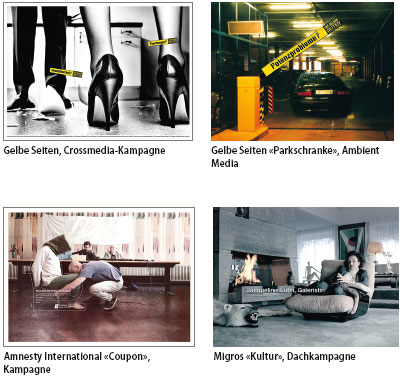
When he was finally approached by Levinson & Associates to join the agency, he was faced with the decision to definitely establish a new existence in the US. "I had a great time in the USA." But he missed Switzerland, his girlfriend at the time and the cultural diversity of Europe. In 1996, he decided to return. Through Claude Martin, then Creative Director of Publicis, he reached the large agency, where he was able to live out his passion for film, cross-media and corporate design in various works. Under the claim "Deeper than you think," he launched a broad-based communications offensive with spots, ads, posters, including guerrilla campaigns with stickers and giveaways to correct Swisscom's high-price image. In a TV commercial, he had Boris Yeltsin and Bill Clinton advertise for the Yellow Pages as an entertainment duo with translation difficulties. And in 2007, a viral campaign he co-developed for Chocolat Frey caused a stir. It began with a video clip of a young couple who claimed to have spotted a unicorn in Val Cama in Ticino. The video spread abruptly on the Internet and was picked up by the media until the advertisers finally revealed the fairy tale to be a campaign. Again and again, Kostgeld ventured into new fields, for example into the topic of "branded entertainment" together with Jean-Etienne Aebi and a team at Publicis that was outstanding for him, when 6-minute blocks were booked for Migros on Swiss television in 2008 for the European soccer championships in order to entertain viewers there with the "fan championships" under the retailer's brand.
There was a caesura in 2009, when the Kunsthaus Zürich asked Topkreative to realize their vision of "100 years of the Kunsthaus" on the occasion of its anniversary. When Kostgeld was awarded the contract, it was the right moment to go independent. "After many years at a large agency, it was balm for the soul to have time for my own projects again," says the creative. "I had a great time at Publicis, great clients." The Kunsthaus project, however, gave him the opportunity to turn inward, work more freely and direct his own films. Working on his film "Chez toi" fulfilled him - personally, too. And although he was attracted to pursuing this line of work further, he felt more at home as a creative director in advertising, the "applied arts." However, Kostgeld likes to incorporate currents from the field of art into communications, as he already showed at Ammarkt in the Alcacyl ad with the steaming cooking pots. Instead of relying on computer animation, he had a Canadian artist paint the feverish faces on the pots with oil.
Kostgeld also wants to expand on his hobbyhorse of film at Ammarkt in the future. And not just in TV commercials. "I think it's a highly exciting time right now," he enthuses. Today, he says, so much is possible: in the online sector, with cross-media or viral campaigns. Just show a teaser as a TV spot and implement the rest online. Or making corporate films where it's no longer clear whether it's a long commercial, a visionary short film or a corporate film.
A good idea or great story alone isn't enough, according to Kostgeld, who is a member of the Art Directors Club and works to improve advertising. "Clients don't want something that's just super creative but doesn't get the job done." Even at Publicis, he found it exciting to advertise for big clients, while other creatives chose clients that were easier to win awards with. "If you're never able to do good work for a big firm that's creative but also works in the marketplace, you've done something wrong." Kostgeld succeeded in this balancing act, for example, with the more than 10-year cross-media campaign for the Yellow Pages, which was both commercially successful and won more than 50 awards internationally.
Bridging the gap between creation, strategy and profitability is now his goal at Ammarkt. Here he feels the proximity to the University of St. Gallen (HSG), to clients and business. CEO Michael Schmid and Heinz Frischknecht (VRP), who founded the agency, also studied at the HSG. HSG marketing professor Torsten Tomczak also sits on the agency's board of directors and occasionally joins in on projects. Ammarkt also attaches great importance to incorporating research findings into its work. While consulting and strategy take a strongly entrepreneurial view, Kostgeld makes sure that customer benefits are implemented in an interesting, creative way. He also wants to raise awareness of what it takes to win a creative award or an Effie. Showing that successful advertising can only come about through good teamwork is just as important to him.
With Kostgeld, not only strategy and creativity come together at Ammarkt, but also down-to-earthness and a cosmopolitan background - two things that are united in himself not only because of the stays abroad. His father, a native of Germany, took Austrian and later Swiss citizenship. His mother is originally Tyrolean. From there, he says, there's a combination of different things inside him: "A mixture ofährschaft and cosmopolitan." Kostgeld has not completely returned to St. Gallen. He still lives in Schlieren near Zurich with his partner. In an emergency - should it take longer - he can fall back on his children's room with his parents in St. Gallen Rosenberg.
Nevertheless, he has a lot to do in Zurich. Individual clients, but above all producers with whom Ammarkt works, are based in the city on the Limmat. And even if the focus is on eastern Switzerland, Ammarkt does not see itself as a purely eastern Swiss agency that exclusively serves local clients. In advertising, much of the focus is on Zurich. Kostgeld's idea is to build up something with the Ammarkt team that carries weight throughout Switzerland. For the future, he would also like to have one or two international mandates.
Kostgeld would also consider the city of St. Gallen itself as a customer, which he feels is seen as being worthy, close to the economy, but not quite as innovative. "I would like St. Gallen to be perceived a little differently." After all, the city in eastern Switzerland offers a lot of interesting things. With the Lokremise, an extraordinary cultural center has been created next to the train station in the former Ringdepot. Companies such as the Akris fashion label, Jakob Schlaepfer textiles, and the HSG are internationally known. Perhaps the city needs to be provoked, tickled, from time to time, he says. "Eastern Switzerland could quietly bring its innovations a little more to the outside world."
Isabel Imper
Ammarkt
The full-service agency for strategy, marketing and advertising has been independent and owner-managed for over 13 years. It was founded by Heinz Frischknecht (VRP) and Michael Schmid (CEO), who today forms the management team with Marcel Odermatt (CEO), Ralf Kostgeld (CD) and Lucia Burtscher (senior consultant). 32 specialists from classic advertising to social media use their know-how for their customers. With the result that 19 of 21 pitches were won against a total of 54 agencies.