2012: Right-Sizing Social Media
Enthusiasm for social media is waning, and companies are adjusting their expectations and approaches—with community building emerging as the ideal solution.


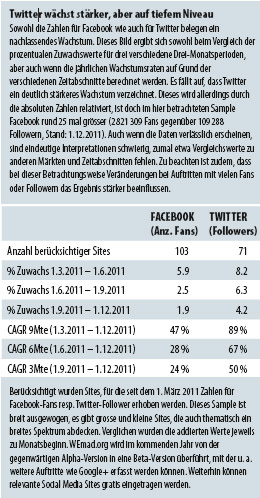
An analysis of the social media sites registered on WEmad.org over the past nine months reveals clear findings (see box): Companies' social media presences have been less and less popular with the public since the summer. The data points to a trend towards a more mature approach to social media. This applies to both users and companies. For example, a survey of marketing managers in the USA showed that they attach less importance to sales-related key figures when assessing social media activities compared to 2010. This is not least evidence that the C-level is becoming increasingly familiar with the special features of social media and no longer uses familiar standard metrics to assess them. It is therefore foreseeable that each company will develop its own assessment criteria that best suit its different social media intentions. From this perspective, even desirable industry-wide comparative values for social media are becoming a distant prospect. Meanwhile, in Switzerland, the agency Yourposition documented in a blog post using web analytics data from four (anonymous) e-commerce sites that social media traffic only generated 0.4 percent of sales. The above-average initiation character of social media, which was clearly superior to all other traffic sources, was also documented.
None of this should distract from the fact that social media has finally become an established media genre for professional communication. This is why the future professional use of social media will not be about down-sizing, but about right-sizing. Many will be satisfied with a trivial zero-eight-fifteen presence in order to be present but avoid the costs of a more far-reaching commitment. It will be attractive to use social media primarily for customer service in order to handle inquiries more cheaply than is possible with existing call center solutions (see the article in this series on Swiss). Although a number crunching tool can still be useful in the context of campaigns, it is advantageous to set up a separate presence for this purpose and limit expectations to the campaign from the outset. After all, once Likers have been won, they are retained even after the campaign has ended (see the series article on the slow-down campaign). In contrast, it is advisable to set up and maintain separate presences where a sustainable and correspondingly long-term dialog with the audience can be maintained. Those who want to strategically anchor social media will primarily introduce in-depth metrics, develop a CRM mindset and deal with new keywords such as social commerce and mobile.
The key word for the next phase of social media use is "community building". This is not about mass, but about class: a dialog should be conducted with the audience about the company, the brand and the products or services. Unlike short-term campaigns, it will be possible to attract far fewer people for this, but they can lead to a higher return on investment: For example, if users help each other in a support forum, call center costs are reduced. They can contribute good ideas to product development. Marketing is supported when brand ambassadors promote the products to the outside world, and cross-selling and up-selling can be promoted in sales support. An active community can also provide valuable insights for market research. Florian Wieser, partner at the online marketing agency coUNDco, is one of the Swiss online scene's community building experts. In an interview with Werbewoche, he reveals: "Our experience shows that communities take up to three years to build up before they even play a commercial role." And he complains that this long-term approach means that community building is at odds with advertisers who think from one campaign wave to the next. He sees a further challenge in reconciling analytically oriented social media monitoring with the more emotionally oriented community support. More important than the number of likes is the engagement rate, i.e. the number and frequency of likes and comments in relation to likes on Facebook, for example. This shows whether the community is active or asleep. This allows you to recognize which content moves the community - both on your own site and on competitors' sites. It is important to find out how customers actually talk and then to meet them in your own personal style, which should not be characterized by the often soulless language of corporate communication. You also have to learn to understand which people write frequent and good articles and what profile they have so that you can align yourself with them. "I'm interested in the customers and how you can get in touch with them and get to know them. It is also important to invite them properly and give them the opportunity to interact, share and contribute in a way that is good and relevant to them." It is the job of a community manager to lead this with campaigns, technology and good ideas. The first steps towards community building, for example at Migros, Swisscom or the health insurance company Avanex, show that this is a challenging path for which - at least in its pure form - not all companies have the same chances of success. Christoph J. Walther