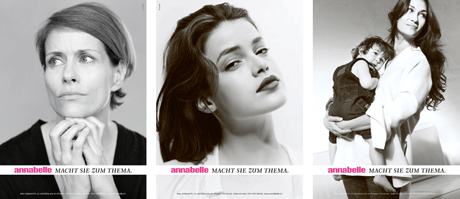
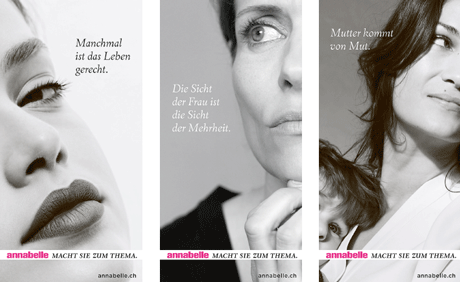
As the most traditional Swiss women's magazine, Annabelle has always focused on the concerns, interests and passions of women. However, it is no longer just "the woman" who is the focus of Annabelle, but women in all their diversity, their differences and their individual life concepts. Because if the social development of recent decades has brought women anything, it is the opportunity to go their own way today in a much more individual and unrestricted way. This is exactly what Annabelle wants to portray on its pages. Also by means of a new advertising campaign that focuses on different women and their personalities. For this campaign, communications agency By Heart developed a unique visual language that "draws attention to individual personalities and their character traits", as CD Hans Siegwart explains.
International star photographer
A photographer of international renown, who is already very familiar to Annabelle readers, was chosen for the realization: Brigitte Lacombe has not only repeatedly portrayed countless greats from film, art and politics, such as Barack Obama, Meryl Streep, Bob Dylan or Martin Scorsese. Brigitte Lacombe has also left her mark in the editorial section of Annabelle with her natural, sharply drawn portraits. For editor-in-chief Lisa Feldmann, the photographer's black and white shots are particularly successful in depicting "more than just the beautiful surface of the people" in front of her lens. This is also one of the key points of the Annabelle concept.
To be continued
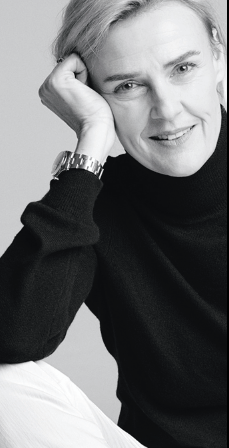
By Heart created four portraits for the launch of the campaign. The mix ranges from a graphic designer and a mother to the successful model Julia Saner and the actress Sabina Schneebeli. A mix that also does justice to the diversity of Annabelle's readers and topics, as publishing director Daniel Schnüriger explains. The claim is: "MACHT SIE ZUM THEMA", capitalized so that "SIE" can mean both the woman in general and the targeted reader. The campaign is still being expanded. The ads are intended to be striking on a full page each. There are also fillers. Annabelle, published by Tamedia, has 303,000 readers with a circulation of 70,000. 21 percent of these are men. pan
"Why should I deny myself something nice just because I'm clever?"
Annabelle editor-in-chief Lisa Feldmann on women's issues, lifestyle, surface with depth and the latest campaign of Switzerland's oldest women's magazine.
WW: Fashion changes regularly. Is the new communication appearance also a fashion adaptation or do you want to change more?
Lisa Feldmann: The campaigns never change anything, but ideally the campaigns should reflect what changes in the magazine. Our advertising accompanies the process and communicates to the outside world on a different level, which is what we normally do with the cover picture. With the current subjects, we have succeeded in creating an image campaign that says: "Who are we? How do we feel?" It was very important to us that we could signal this feeling to our readers. Those who have been reading us for a long time should be able to say: "Aha, that's me, that's who I am." Or those who don't read us at the moment or no longer read us or don't read us yet should discover: "Ah, these are Annabelle readers, that's interesting." Image doesn't mean sales, it's about creating feelings. I think our agency By Heart has pretty much summed up what we wanted. This mixture of great emotion, sophistication, aspiration, IQ and smartness. That's what our readers want, who say to themselves: "It must be possible for me to have it all at the same time." We want to convey this comprehensive attitude to life with our Annabelle. We try to modernize this feeling again and again over the years. Women change, life changes. And of course we change too.
What problems do you face when you want to make a women's magazine?
No problems. We just have to be alert to the fact that we are in this world. Fortunately, the Annabelle team is totally diverse. We are a pretty accurate reflection of our readership. Everyone has their say, everyone gets involved, including the men, quota men so to speak. We have a culture of discussion and a culture of finding topics, which is important. Listening, keeping our eyes open and not just talking amongst ourselves, but also out there in the world where we are out and about - as a single woman looking for men, as a mother with the problem that I want to have everything at the same time. We have female editors at many stages of their careers, just before retirement as well as just after training. The whole spectrum.
So what is the external reason for the campaign?
The campaign has reached a point where we ourselves have reached a very good point with the magazine. We had the feeling that we now needed someone to make this clear to the outside world. So that those who haven't noticed our development can once again say: "Ha, that's Annabelle!"
The black and white appearance of the subjects is appealing. How is it justified?
We have built up a relationship with the American photographer Brigitte Lacombe over four years. She has photographed many great and important stories for us. For example, the magazine where we took erotic photos of women over 50. For example Lys Assia, who was already 80 at the time. That was my first contact with Brigitte Lacombe. I simply plucked up the courage because I really admired her and asked if she would do it. To be able to expect women to take such a courageous step, it had to be a photographer with class. Someone who would present the women with dignity. Brigitte loved the job and the idea became a huge success for us, which of course also provoked people. This led to a relationship and ultimately a regular collaboration. In the current issue, we show that age is not an issue in a series of portraits of Brigitte Lacombe. The youngest girl in this portfolio is 13, a very successful blogger, while the oldest woman is 104. Not forgetting our female Federal Councillors. Brigitte had read in the New York Times that Switzerland is governed by four women and contacted me immediately. We had a precious 45 minutes in Bern where we had all four female ministers in front of the lens at the same time. And so Brigitte Lacombe has become something like our house and yard photographer, with whom we were very happy to do this campaign. We believe that she portrays women the way we want to. Full of respect and with an eye for the real beautiful sides of a woman and not the made-up ones.
You put the four Federal Councillors on the cover: How important is politics in Annabelle?
The split is a classic fifty-fifty. Annabelle has now been around for 73 years. When things started to take off for women in the 1950s and they set out to take their careers into their own hands, Annabelle was already a very important companion. The magazine has always had a strong women's political focus, right up to the present day. Always where there is something to do. Remember our weapons story with the successful petition that we launched. We researched a major story on non-voting behavior. The booklet with the female federal councillors was also the anniversary booklet "40 years of women's suffrage". We commissioned a large survey: Where were our mothers back then? Were they out on the streets fighting or didn't they care? Annabelle is perhaps not politically engaged, but socially engaged. We report on things that affect our lives. That's the beauty of Annabelle: We can show the circumstances in which we live and move socially - and we also show the shoes in which we do so.
How does Annabelle deal with lifestyle?
This aspect of life is just as important. The nice thing for me is that there is no contradiction here. Swiss women find it totally normal to be very critical and committed to the issues that concern them, while at the same time spending 1,000 Swiss francs on a shoe if they have the money. They don't think that's contradictory.
Successful men can also drive a sports car ...
That anyway. But successful women always have the feeling that something cheaper will have to do. That's a bit like the world of our competitor magazine Brigitte. We are much more relaxed in this respect. Why should I deny myself something nice just because I'm clever? I can be just as against nuclear power and still be enthusiastic about other things that are superficial and funny. This mixture is very special. I also get good feedback from Germany.
What sets Annabelle apart from women's magazines from Germany?
There is nothing like Annabelle in the women's magazine sector. We have the worlds of Vogue, Elle, Madame, where it's all about fashion and lifestyle, plus a bit of culture. But no story longer than 120 lines, please. Because these women just want to browse. There used to be a Marie Claire in Germany for a while. It had a very similar concept to our Annabelle. The English Marie Claire and, for a while, the American Marie Claire also used this style. For me, these are good examples that bring together this mixture of both sides. But they no longer exist in Germany. That's what makes Annabelle so special and many colleagues who come to us for a magazine review say: "Come to Germany at last!"
Would that be an idea?
Distribution in the German market is very expensive. Even the Süddeutsche Zeitung can't afford a Sunday paper because the space is too big. We have 2,000 copies at the central newsstands in Germany and Austria. We see this as a service for our Swiss customers who are currently abroad.
Another supplementary market is men. What role do they play in the concept?
We are read by 21 percent men. I find that a bit strange because I think we are a women's magazine. And therefore want to convey a different feeling than a SonntagsZeitung written for both sexes. I find it irritating when it comes too close together. The 20-minute Friday edition is also deliberately designed for both sexes. Such a concept also works up to a certain age. Your interests are much more congruent, especially when it comes to fashion and going out, when you're young. At some point, however, you have a different way of looking at life. As much as we see ourselves as a "general interest" women's magazine, we also want to create a space for women. I want people to have the feeling that you're going into your world a bit. The husband has gone off to Alpamare with the children and the wife now has time to read Annabelle for two hours. After all, our wives read us for 81 minutes on average, which is very long. That's the famous "me time". You need a world that excludes men for a few reasons. As a reader, I want to feel that they are talking to me and not to everyone in the same way. It's all very well for my husband to read along and find a lot of things interesting. But first I want Annabelle for myself. Interview: Andreas Panzeri
LISA FELDMANN
Lisa Feldmann has been editor-in-chief of Annabelle since May 2004. Born in northern Germany, she is the successor to Christa Löpfe. She has a wealth of experience in the field of women's magazines. Lisa Feldmann was deputy editor-in-chief of Elle between 1992 and 1995 and was editor-in-chief of the women's magazine Cosmopolitan from 1995 to 1998 - where she "regularly argued with publisher Jürg Marquard about the right direction for the magazine". Until 2000, she was head of department at the Süddeutsche Zeitung magazine and then helped shape the relaunch of Life & Style magazine. In 2002, she became editor of the trend section of SonntagsZeitung, after having worked as a freelance author in the meantime.