GIK b4p Trends: Video Streaming Has Many Faces
In its latest b4p Trends report, the Society for Integrated Communication Research (GIK) shows how differently streaming platforms are used—and what that means for advertisers and media buyers.


In its latest report, «Germany Streams—Exclusive Insights into a Dynamic Market,» the Society for Integrated Communication Research (GIK) has compiled comprehensive video streaming trends for the German market. The study shows that streaming is not a monolithic phenomenon, but rather a diverse ecosystem with distinct roles, different target audiences, and platform-specific usage patterns. The report provides valuable guidance for advertisers, media agencies, and marketers.
Video Streaming Trends: Each Platform Plays Its Own Role
A key finding of the b4p Trends report is that users clearly attribute distinct profiles to the various streaming services. YouTube and Amazon Prime Video are known for a broad range of content, while Netflix, Disney+, and Paramount+ are associated with movies and TV series. RTL+ has a distinct entertainment profile and is seen as particularly associated with TV series, reality shows, and variety shows. Sky is clearly associated with live sports, Discovery+ with documentaries and magazine shows, and Welt live with news.
The main reasons for using streaming services across all platforms are entertainment (66 percent), unwinding and relaxing (49 percent), and staying informed (39 percent). At the same time, the problem of finding one’s way around is growing: 61 percent of respondents sometimes feel overwhelmed by the large number of providers, and 57 percent by the variety of content within individual services. 59 percent say they often spend too much time searching for suitable content when streaming.

16- to 29-year-olds are the most active streaming demographic
When it comes to frequency of use, 16- to 29-year-olds stand out significantly: 92 percent of this age group watches videos at least once a month on social media platforms such as YouTube, Instagram, TikTok, or Twitch (total population: 69 percent). Eighty-eight percent use subscription-based streaming services such as Amazon Prime Video, Netflix, RTL+, or Joyn at least once a month (total: 71 percent; ages 30–49: 81 percent; ages 50 and older: 56 percent).
As people get older, their focus shifts: social video loses relevance, while the ARD and ZDF media libraries and TV streaming platforms such as Waipu.tv, Zattoo, and MagentaTV remain consistently strong, with 67 percent monthly usage and a balanced age profile. Videos on news sites such as n-tv or Welt Live, with 40 percent monthly usage and an above-average proportion of male and younger viewers, form the fourth pillar of the market.
According to the study, price (62 percent) and available content (48 percent) are the dominant factors when choosing a streaming service. These are followed at a significant distance by flexibility (31 percent), the absence of ads (26 percent), and the timeliness of the content (25 percent).
The TV Remains the No. 1 Streaming Hub
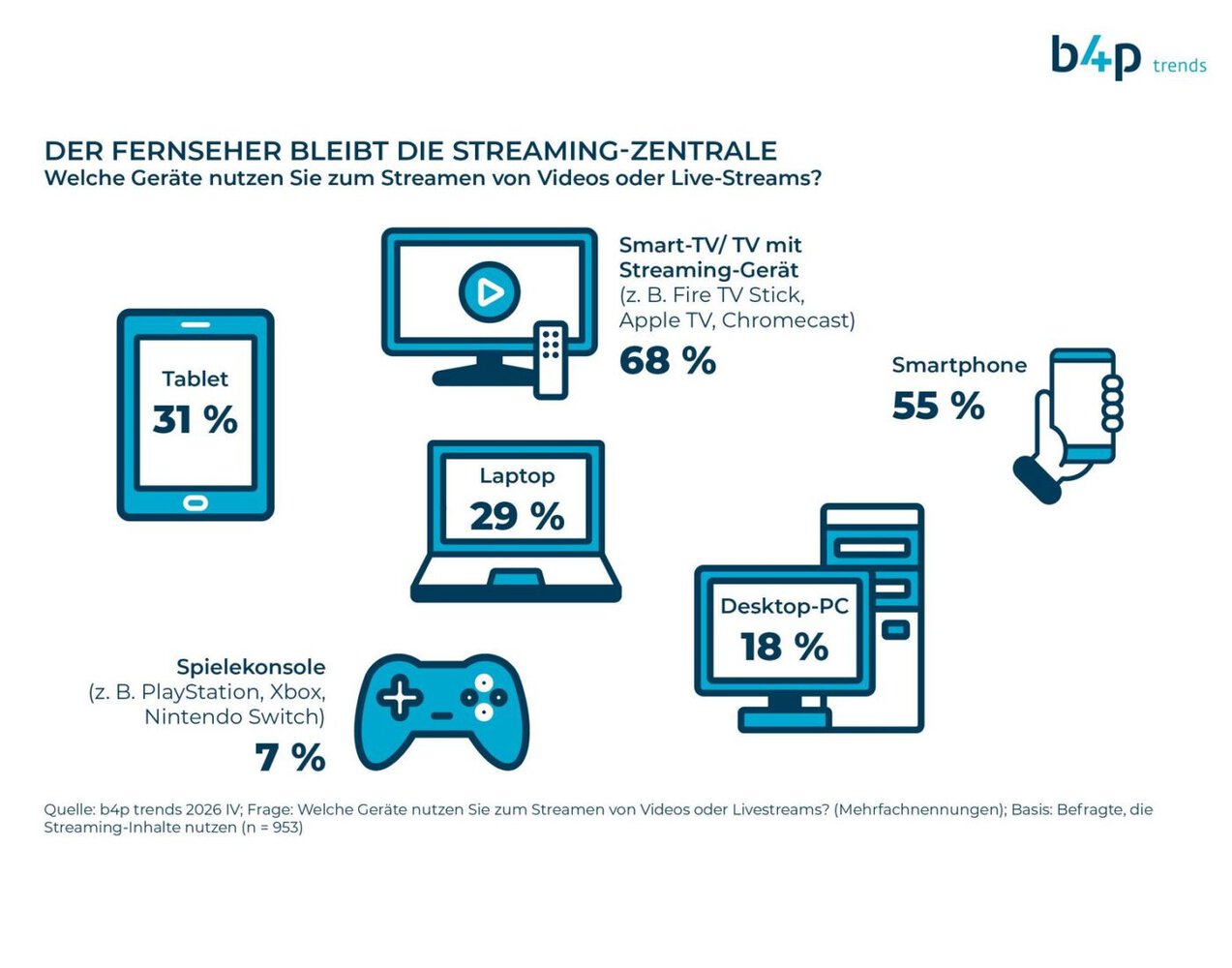
Despite the mobile viewing habits of younger target groups, the TV remains the most commonly used streaming device: 68 percent of respondents stream on the big screen, followed by smartphones (55 percent), tablets (31 percent), and laptops (29 percent). Eighty-four percent prefer to watch movies and TV shows on the big screen, while the smartphone is the device of choice for social media videos (70 percent).
In addition, second-screen viewing is firmly established in everyday life: 31 percent frequently or always use a second screen—not only for entertainment (32 percent), but also for communication (33 percent), additional information (25 percent), or simply out of habit (30 percent). Co-viewing also remains relevant: 51 percent of those who consume content together with others usually watch in pairs.

Advertising in Streaming: Integration Is Key to Acceptance
The b4p Trend Report places special emphasis on how advertising is perceived in the streaming environment. 48 percent of respondents have no problem with advertising in principle, and more than half (54 percent) find short commercial breaks acceptable. For 69 percent, a cheaper subscription with ads is more attractive than a more expensive one without ads—while 36 percent would be willing to pay more for a completely ad-free service.
The type of integration is key to acceptance: 56 percent say that ads at the edge of the screen are less disruptive than interruptions during a stream. 54 percent find ads more acceptable when they align with their own interests. More than a third (35 percent) say they sometimes discover interesting products or offers through ads.
Content Creators as a Growing Benchmark
In the ever-expanding streaming jungle, content creators are becoming increasingly important as a guide. Their recommendations influence users both in their selection of movies, TV shows, or videos (36 percent) and in their choice of streaming service (28 percent). Two-thirds of respondents watch content from creators at least occasionally, and one in two watches creators on Twitch, TikTok, Instagram, YouTube, and other platforms.
Regardless of the platform, users rely on recommendations from the streaming providers themselves (27 percent) as well as on trailers in regular television programming (25 percent). Just under one in five (19 percent) rely on paid TV guides or daily newspapers and supplements from well-known media brands (16 percent).
Clarissa Moughrabi, GIK spokesperson for 2026, summarizes the findings: «In the streaming jungle, every platform is a species of its own—with its own roles, images, and usage scenarios. The b4p trends show that not all streaming is the same. Anyone who wants to stay competitive must understand what a service stands for, what motivates users to engage with it, which screens play a role, and how content and advertising fit into the picture.»
For the b4p «Streaming» trends, a total of 1,000 people aged 16 and older across Germany were surveyed between June 11 and 18, 2026. The survey is representative of the overall German online population.
For more information on GIK's b4p studies, visit: https://www.gik.media