How the Gulf Crisis Is Affecting Advertising Spending
A new analysis by WARC shows that the ongoing Gulf crisis is putting up to $94 billion in global advertising growth at risk. TV, automotive, and travel are particularly affected—while search and social remain relatively stable.


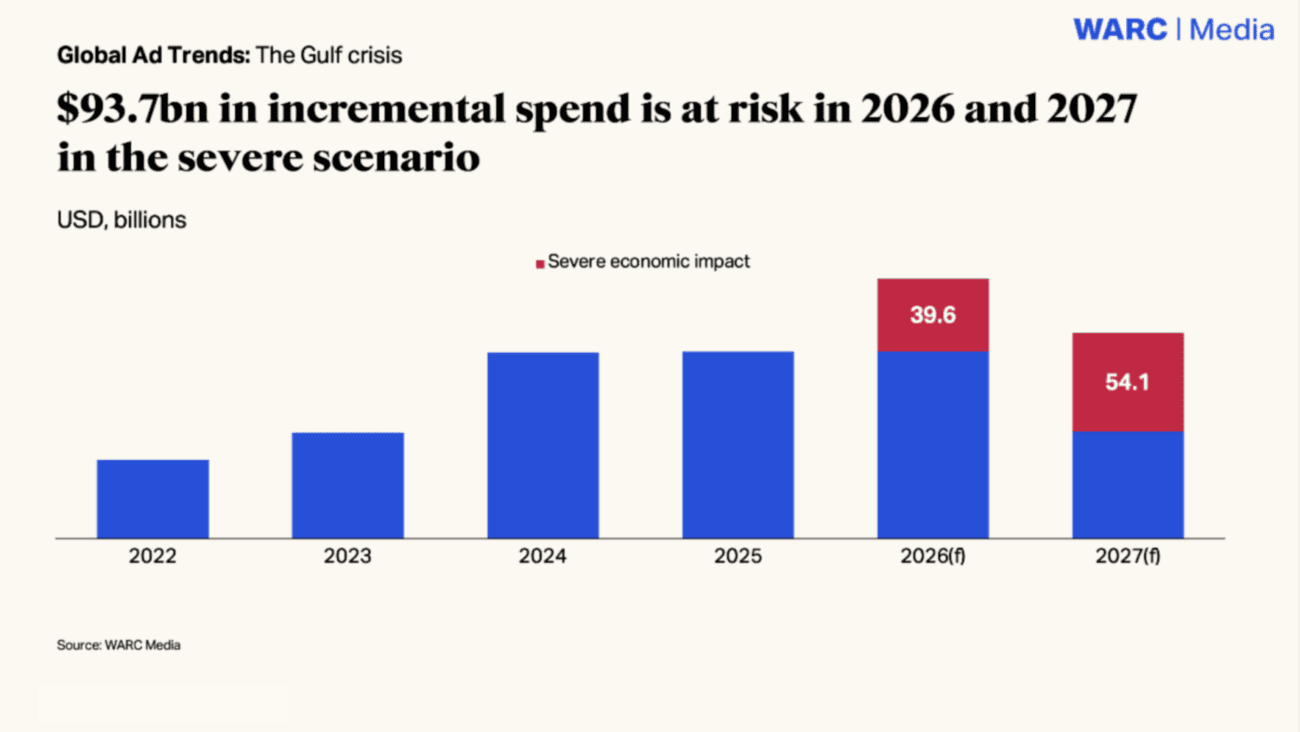
Global advertising spending is under pressure: According to a recent forecast by WARC, the ongoing Gulf crisis could wipe out up to $93.7 billion in expected global advertising growth by the end of 2027. The analysis is based on data from 100 markets and a proprietary neural network that evaluates more than two million data points.
Global Advertising Spending in 2026: Base Forecast Revised Upward
In its baseline scenario for the current year, WARC forecasts global advertising growth of 11.5 percent—an upward revision from the March forecast of 10.6 percent, driven by a strong first half of the year for online platforms. Global advertising spend would thus rise to $1.39 trillion. For 2027, WARC expects growth of 8.2 percent to a total of $1.50 trillion.
However, the baseline scenario is subject to change: If the conflict in the Gulf region—particularly the blockade of the Strait of Hormuz—were to escalate further, up to 3.2 percentage points, or $39.6 billion, could be deducted from growth in 2026. In 2027, the figure would be an additional $54.1 billion.
James McDonald, Director of Data, Intelligence & Forecasting at WARC and author of the study, assesses the situation: «The blockade of the Strait of Hormuz acts like a tax on consumers, driving up prices and eroding real purchasing power. If the conflict persists or intensifies further, the risks will shift toward stagflation, with sectors such as travel, automotive, and food being particularly hard hit by higher production costs and weaker demand.»
Regional differences: Latin America shows the biggest swing
The impact of the crisis is unevenly distributed. While Southeast Asia and Latin America have high baseline growth rates, they are also the most vulnerable. For Latin America—led by Brazil and Mexico—WARC forecasts growth of 12.8 percent to $27.8 billion in the base scenario. In the severe scenario, this figure shrinks to just 3.4 percent—a decline of 9.4 percentage points, the largest swing of any region.
China is facing rising energy and shipping costs, which are weighing on industrial margins and export competitiveness. The baseline forecast for Chinese advertising spending is 7.9 percent growth ($223.1 billion); in the worst-case scenario, this drops to 5.3 percent growth—a loss of $5.3 billion.
The U.S. is proving to be relatively resilient: Core growth stands at 9.5 percent, reaching $452.6 billion; even in the worst-case scenario, growth remains at 7.2 percent, representing a loss of just $9.8 billion. The FIFA World Cup and the midterm elections are providing additional support to the market.
The Gulf Cooperation Council (GCC) markets—including Saudi Arabia, the United Arab Emirates, Kuwait, Oman, Qatar, and Bahrain—are already under pressure from weakened demand from global advertisers. In the worst-case scenario, the GCC advertising market will contract by 0.2 percent.
Travel, Automotive, Food: The Three Most Vulnerable Sectors
At the sector level, travel & transportation, automotive, and food are particularly vulnerable. The travel sector is the only major category that is already shrinking on a global scale: advertising spending is expected to decline by 3.5 percent to $34.4 billion. According to WARC, airlines with operations in the Middle East are already reviewing their budget allocations.
In the automotive sector, the dual pressure of rising manufacturing costs and subdued demand for consumer credit is evident. Germany—one of the world’s largest automakers—is projected to see growth of just 1.9 percent in automotive advertising spending under the base scenario. Should the crisis escalate, this would result in a contraction of 4.2 percent, corresponding to a swing of 6.0 percentage points.
In the baseline scenario, the food sector is still growing at a solid rate of 10.3 percent to $99.8 billion—but rising costs for fertilizers, grain, fuel, and packaging mean that the full impact will not be felt until the second half of 2026 and will become more pronounced in 2027. In the United Kingdom, for example, food advertising spending would decline by 0.2 percent in the severe scenario, whereas the baseline scenario still projects an increase of 4.9 percent.
Media Channels: TV and Print Under Pressure, Global Advertising Spending Shifts
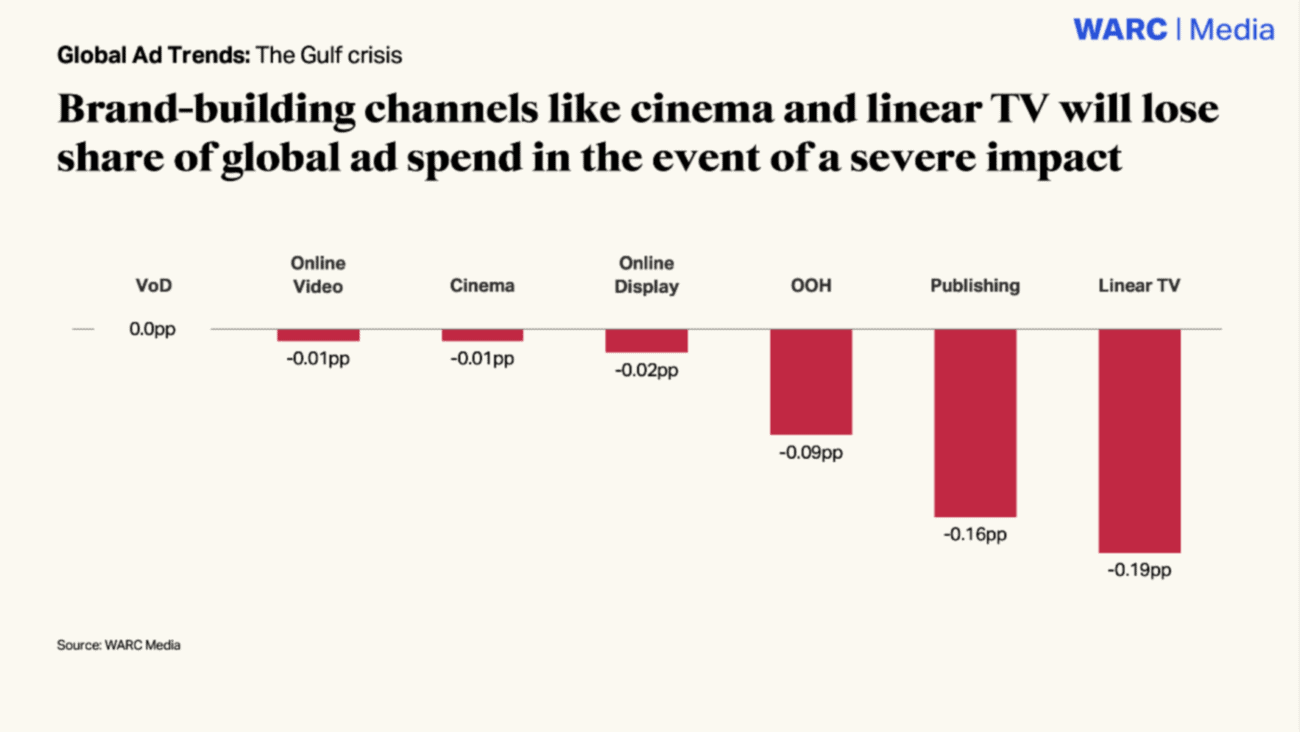
The crisis is affecting brand-oriented and performance-oriented media channels differently. Linear TV is already losing 2.7 percent in the base scenario—a decline that widens to 7.3 percent in the severe scenario. The combined TV market share (linear plus video-on-demand) falls from 12.7 percent in the baseline scenario to 12.5 percent in the severe scenario. The FIFA World Cup partially cushions the decline in the base scenario, but this buffer diminishes as the situation escalates.
In the severe scenario, publishing shrinks by 8.5 percent (compared to a decline of 0.8 percent in the baseline scenario), while the movie theater sector loses 4.0 percent—compared to projected growth of 6.3 percent in the baseline scenario. Cinema, along with publishing, is considered the least resilient channel in the dataset, as it is directly linked to discretionary leisure spending and movie theater attendance.
In the base scenario, social media grows by 20.0 percent; in the severe scenario, by 17.9 percent—a decline of 2.1 percentage points, which corresponds to a loss of 7.8 billion dollars. However, WARC points out that the advertising base for social media is heavily concentrated among small and medium-sized enterprises (SMEs), which could cut their marketing budgets as household demand declines.
Paid search—including generative AI—is proving to be the most stable channel: Even in the worst-case scenario, it is still growing by 11.0 percent, just 3.3 percentage points below the baseline scenario of 14.3 percent. Together with social media and retail media, search platforms are expected to account for two-thirds of global ad spending even in the most extreme scenario modeled.
The full WARC report will be available to WARC Media subscribers starting June 15. A podcast discussing the findings will be available starting June 18.
More information: https://www.warc.com/media