
Coca-Cola: From Detroit to a Swiss Icon
90 years ago, a car importer from Bern brought Coca-Cola from Detroit to Switzerland. Today, the brand is part of everyday life, pop culture, and the Swiss economy. The anniversary celebration at Zurich’s Schiffbau, featuring its own orchestra, told a story that was as refreshing as it was remarkable—about how an American icon came to be a part of Switzerland.


On this May evening, Zurich’s Schiffbau is lit up in Coca-Cola red. One could hardly have chosen a more fitting backdrop: When the halls were built in 1891 for the construction of steamships, Coca-Cola was five years old. It was the era of great inventors, of Bertha Benz’s first car ride, of the first view of Paris from the Eiffel Tower, and of other technological breakthroughs. And somewhere in Atlanta, pharmacist John Pemberton was experimenting with the formula that would later become the world’s most famous beverage brand. Nearly 140 years later, two children of the industrial age are reuniting at the Schiffbau. The anniversary celebration turns into a brief journey through economic history, advertising history, and pop culture.

The Discovery of Detroit
The history of Coca-Cola in Switzerland does not begin in Atlanta, nor does it begin in Zurich. It begins in Detroit. There, during the hot summer of 1934, Max Stooss, a car importer from Bern, was in Detroit negotiating the sale of American vehicles. During breaks, he was served ice-cold Coca-Cola. He was so impressed by the taste that he decided to bring the drink to Switzerland.

This encounter gave rise to a success story that now spans three centuries. Invented in the 19th century, it arrived in Switzerland in the 20th century and remains remarkably vibrant even in the 21st century. What began back then with a cold bottle has grown into a Coca-Cola system featuring local production, Swiss suppliers, thousands of jobs, and a brand that has long been a fixture of everyday life.
More Than Just a Recipe
Of course, at some point during an anniversary celebration, the question about the famous secret formula inevitably comes up. Constance Courtois-Delanoë, Marketing Director for Switzerland at The Coca-Cola Company, smiles. Naturally, she won’t reveal anything. But her answer gets to the heart of the story. «John Pemberton really wanted to create a product that is highly refreshing, but at the same time has this invigorating effect—both emotionally and physically.»

In doing so, she’s describing more than just a recipe. She’s describing a brand effect. Coca-Cola is one of those rare products that you can recognize practically by touch alone. Color, lettering, bottle, sound, taste: everything fits together. «»The secret formula that everyone has tried to replicate, but which no one has really succeeded in doing over the past 140 years,” says Courtois-Delanoë. This is exactly where the real magic begins. Coca-Cola isn’t just a beverage with a history. Coca-Cola is a brand that has created its own code.”.
The Brand That Has Always Been Coca-Cola
Many brands try to stay relevant by constantly reinventing themselves. Coca-Cola did something even more difficult: the brand kept evolving without losing its essence. New packaging, new products, new channels, new target audiences, new cultural contexts—and yet, to this day, a certain shade of red is all it takes to make the world think of Coca-Cola instantly.

That’s brand management at the highest level. Not because everything has stayed the same, but because everything contributes to the same core values: optimism, refreshment, community, and recognizability. Fabio Cella, Country Manager of Coca-Cola Switzerland, sums up this aspect: «Our story has been written by consumers.» This isn’t just a nice anniversary cliché. It describes the difference between advertising and cultural embeddedness. Advertising can buy attention. A brand like Coca-Cola earns a place in people’s memories.
The naturalized American
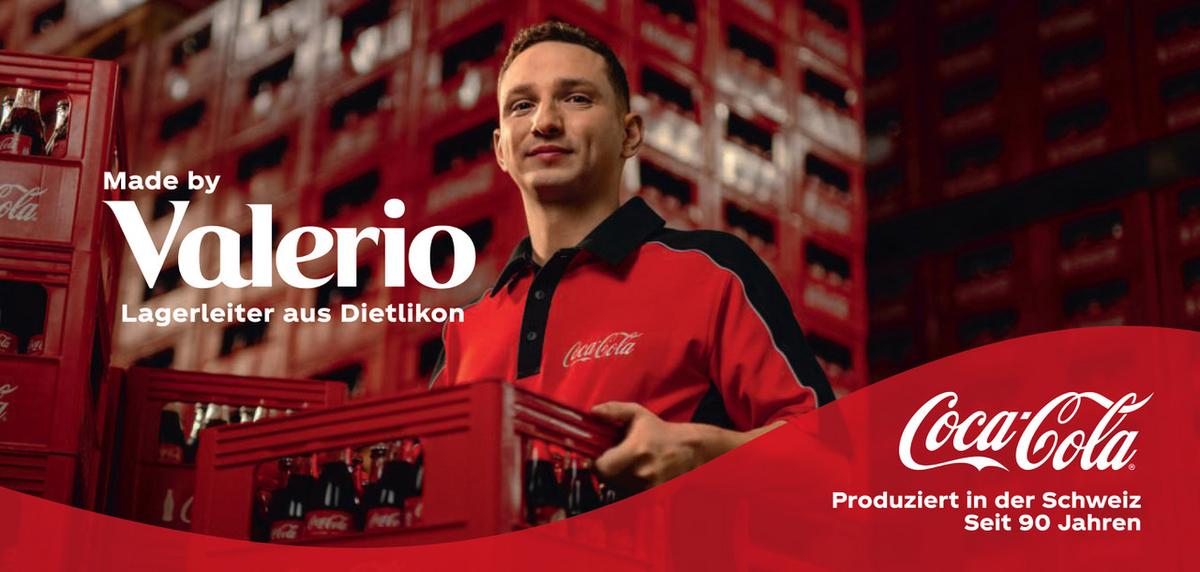
Anyone who views Coca-Cola solely as an American brand is overlooking an important part of its history. About 80 percent of the beverages sold in Switzerland are produced here. 95 percent of the ingredients come from Swiss suppliers. The Coca-Cola system directly employs about 800 people and generates several thousand jobs throughout its value chain.

For Zurich Cantonal President Carmen Walker Späh, that is precisely what matters. «For me, a company is Swiss if it is rooted in Switzerland—if its employees live and work here, if production takes place here, and if value is created here.» Her conclusion is correspondingly clear: «Coca-Cola Switzerland is a local company. And how!» The Coca-Cola representatives nodded happily in agreement.
And with that, the best punchline of the evening is set. One of the most American brands in the world is celebrating its Swiss birthday at Zurich’s Schiffbau—and in doing so, it doesn’t come across as a guest, but rather as a naturalized icon.
Where Life Unfolds
Numbers don’t explain why Coca-Cola is still relevant after 90 years. The brand’s true strength lies in its ability to be present wherever people experience emotions. At music events. At sporting events. At festivals. On vacation. At Christmas. Or quite simply in those moments when people come together.
«One of the secrets is to be there in a meaningful way exactly when it matters,» says Constance Courtois-Delanoë. In fact, this principle runs like a common thread through the brand’s history. Coca-Cola was never just a beverage manufacturer. Coca-Cola saw itself early on as part of pop culture—as a companion to experiences and an amplifier of emotions.
Switzerland is a good example of this. Coca-Cola currently sponsors over 40 music festivals. Manuel Akanji, one of Switzerland’s best-known soccer players, is at the center of the current FIFA campaign. At the same time, the brand maintains just as strong a presence in ski resorts, at open-air festivals, and at concert venues as it does in retail stores. «We have a global DNA rooted in optimism and joy,» says Courtois-Delanoë. «But we have a lot of freedom locally to tell our own stories.»

The Soundtrack of Memories
Some brands are remembered. Coca-Cola is heard. When the familiar Christmas melodies ring out from the orchestra pit at the Schiffbau, just a few bars are enough to conjure up images. The legendary trucks. Winter evenings. The start of the Christmas season. «Holidays Are Coming» has long been more than just an advertising jingle. It’s an auditory marker on the calendar.

Later, historic commercials are shown on the screen. Among them is «I’d Like to Buy the World a Coke» from 1971—a commercial that has long since become more than just an advertisement. People from different backgrounds sing together on a hill—decades before diversity and inclusion became integral parts of many corporate strategies.
Host Zoe Torinesi also recalls personal stories about Coca-Cola: Shakira as a brand ambassador, collectors, fan clubs, and memories that almost everyone associates with this brand. Coca-Cola sells beverages. But the brand collects memories. That’s exactly why its most powerful campaigns don’t just end up in the archives of advertising—they find their way into the memories of entire generations.
Switzerland as a Testing Ground
90 years in Switzerland and over 140 years worldwide raise a simple question: How does a brand remain relevant for so long? Fabio Cella provides a remarkably clear answer. «Our success over the past 90 years stems above all from the fact that we have stayed very close to our consumers and really listen to them.»
Switzerland plays more than just the role of a sales market in this context. It is a production hub, a hub for innovation, and a cultural testing ground. Cella points to Swiss consumers« openness to innovation, particularly in the areas of well-being and health. Zoran Bogdanovic, CEO of the Coca-Cola HBC Group, headquartered in Zug, also looks back on groundbreaking innovations: the launch of Coca-Cola Zero, developments at Valser, and projects that garnered international attention from Switzerland. »Switzerland plays a major and important role for us as a company,” he says.

This role is also evident in investments. A new high-bay warehouse is being built in Dietlikon, logistics are gradually being electrified, and Coca-Cola is embracing the circular economy for PET. This may sound less romantic than red trucks and iconic bottles, but it’s part of the modern continuation of the same story: A brand can only remain strong if the system behind it works as well.
The original
There’s a lot of talk about sustainability this evening. About the circular economy. About electric mobility. About new products. About Zero. About Zero Zero. About the next 90 years. And that’s exactly how it should be. Brands that stand still eventually disappear from the present.
Coca-Cola has continually reinvented itself. New packaging. New products. New target audiences. New channels. The brand has evolved without losing its core identity. That is precisely what sets it apart from many brands that eventually became prisoners of their time.
At the same time, this evening also tells a story of consistency. Less sugar, fewer calories, or less caffeine are responses to real needs. But not everything that’s currently out of step with the zeitgeist is necessarily a thing of the past. After all, sugar only tastes truly sweet when it’s just sugar. And caffeine still provides that little kick that sometimes makes all the difference.

The taste of the original has stood the test of time across generations. Lifestyle trends have come and gone. Today, the buzzwords are “longevity,” “reduced sugar,” and “Zero Zero.” Tomorrow, other terms will dominate the conversation. Coca-Cola will respond to these changes, just as it has for decades. But the Original remains the benchmark against which everything else is measured.
Pharmacist John Pemberton would probably have chuckled at that. His recipe has been supplemented, expanded, and modified over the decades. But it has never been replaced. Or to put it another way: Pharmacist, stick to your recipe.
Jürg Burkhalter sums it up in his own way that evening: «To me, Coca-Cola is simply the greatest beverage humanity has ever invented.» A statement that draws laughter and applause at the Schiffbau. And one that explains why, after 90 years in Switzerland, Coca-Cola doesn’t come across as a brand celebrating an anniversary, but rather as one whose story is far from over.
Always Coca-Cola.


