
New Data for Better Sports and Cultural Marketing
The WEMF's new Sports & Culture module provides a comprehensive database on the Swiss population's interests in sports and culture, as well as their attendance at events.


The year 2026 is a year of major sporting events. The Winter Olympics, the Ice Hockey World Championship, and the Soccer World Cup not only bring sports with large audiences into the spotlight but also raise the question of the right advertising platforms. In line with this, WEMF AG for Advertising Media Research is releasing a new data package this year as part of the MACH studies: the Sports & Culture module. It provides representative and reliable data on the interests and attendance patterns of the Swiss population in the sports and culture sectors.
In addition, the study examines how people volunteer in sports and culture. The data can be combined with other established WEMF studies, such as MACH Consumer or MACH Strategy. This results in detailed target audience profiles that also include media usage as well as consumption and purchasing behavior.
Identifying Opportunities in the Advertising and Media Market
Advertisers, event organizers, agencies, marketers, and media companies can use the data from the new module to specifically improve their sponsorship, marketing, and commercialization strategies. It supports the selection of suitable platforms and partners, precise target audience analyses, market potential assessments, as well as benchmark comparisons and efficiency evaluations. At the same time, it provides well-founded arguments for sponsor acquisition, editorial direction, and user marketing, and complements existing market research and corporate data. The insights into sports and culture are also of interest to associations, government agencies, and other stakeholders involved with sports and cultural data.
Use of Data to Evaluate Events and Target Audiences
The strength of the data lies, in particular, in its practical applicability. A concrete example is the analysis of interest in sports by age and gender (see Figure 1). The module lists over 40 different sports.
«The strength of the data lies, in particular, in its practical applicability.»
The data show, for example, that alpine skiing attracts the most interest among the Swiss population. It is followed by soccer, which has the second-largest share of interested people; however, compared to alpine skiing, the average age is closer to the Swiss average, and men are overrepresented in this sport. Smaller sports such as figure skating, which appeals particularly to women, and bobsledding, which has a slightly older, more male-dominated audience, are also represented in the study.
Two Sports Under the Microscope: Ball or Puck?
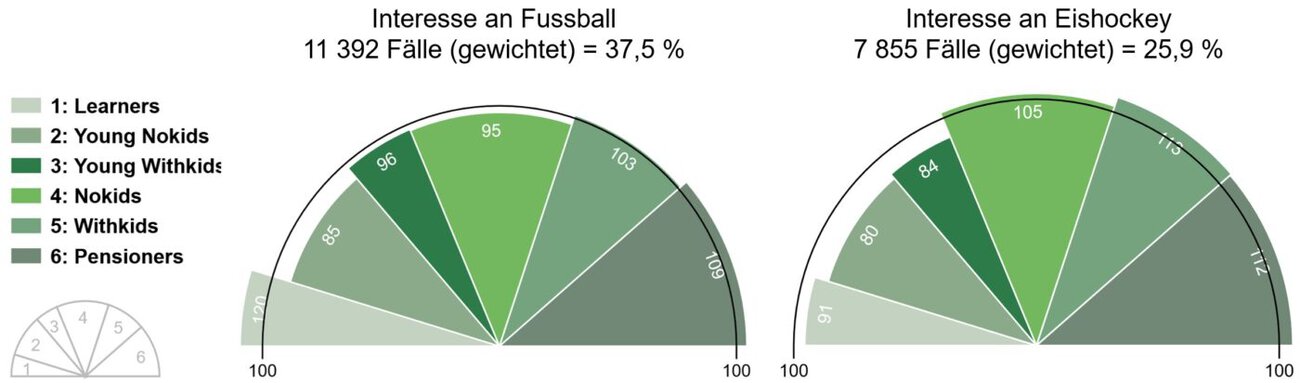
For example, if advertisers want to choose between soccer and ice hockey as a sponsorship platform, the Sports & Culture module provides helpful information and thus a solid basis for decision-making. The suitability of a particular sport depends heavily on the communication goals being pursued or the target audiences to be reached. Overall, 38 % of the Swiss population is interested in soccer and 26 % in ice hockey, enabling a high reach in the Swiss market.
At first glance, both sports appear similar, with a predominantly male following and an age group slightly above average. Soccer, however, is particularly popular among 14- to 19-year-olds, which is not the case with ice hockey (see Figure 2). Ice hockey fans are, on average, slightly older and, accordingly, more likely to have a higher income. In both groups, an above-average proportion holds leadership positions. Similarities are also evident in leisure activities: Both groups volunteer more frequently than average, both in sports and in politics, and also enjoy following other sports. For example, 71 % of ice hockey fans are also interested in alpine skiing, and 39 % in cycling. Soccer fans also show a strong interest in alpine skiing (61 %) and tennis (39 %). These overlaps show that cross-sport sponsorship can be effective for reaching specific target groups more intensively or for appealing to a broader audience.
From Interests to Purchasing Behavior and Brand Loyalty
Another benefit of the module is that it links interests to consumer behavior. The data shows that people interested in soccer and ice hockey are not just spectators; they also participate in sports at an above-average rate and spend more than average on sporting goods—with ice hockey fans spending even slightly more than soccer fans. Both groups pay particularly close attention to advertising, perceive it as less intrusive, and view it as a useful source of information. This significantly increases the effectiveness of sponsorship initiatives. Both soccer and ice hockey reach a very large number of people in Switzerland, although soccer, as a mass sport, appeals to a broader and more diverse audience and can provide a brand with a wide reach. In ice hockey, on the other hand, the target audience is slightly older and has greater purchasing power, which offers advantages for a more targeted brand approach.
In addition to the sociodemographic data, interests, and affinities mentioned above, WEMF also tracks over 500 brands, which enables a direct link between target groups and specific brand ownership.
Know More, Make Better Decisions
The Sports & Culture module represents a significant advance in the data-driven analysis of sports and cultural target audiences. By combining interest, behavioral, and consumption data and linking them to sociodemographic, geographic, and media usage data, new opportunities arise for strategic decision-making in sponsorship and event marketing. Companies, event organizers, agencies, marketers, and media companies benefit from a solid data foundation that enables them to better understand target audiences, plan marketing initiatives efficiently, and tap into new potential in the sports and culture sectors.
Sports & Culture
- The module includes, among other things, the following data
- Interest in 45 different sports
- Interest in 27 different cultural activities
- Attendance and Intention to Attend 42 Sporting Events
- Visits to and Intention to Visit 52 Cultural Attractions and Events
Can be linked to over 10,000 demographic, consumer, and media characteristics.
wemf.ch/sports-culture


