LSA/SWA industry indicator 2026: Despite good business, customers are cautious for 2026
In recent months, the associations LEADING SWISS AGENCIES (LSA) and the Swiss Association of Advertising Clients (SWA) have once again examined key indicators in the communications industry. To this end, advertising clients were surveyed about their assessments of business performance, budget trends, challenges, and collaboration with agencies. Around 100 advertising clients thus provide fascinating insights into both the past and the future.


Successful financial year 2025 for advertising clients
The majority of advertising companies can look back on a successful year 2025. 48% of respondents reported an increase in turnover, 39% also reported an increase in earnings. For a third of respondents, turnover and earnings remained the same. Only 19% report a fall in turnover, which also leads to a fall in earnings for 28%.
Advertising clients with stable sales and profit prospects for 2026
Overall, customers' prospects for turnover and earnings in 2026 are slightly less positive than in the previous year. Nevertheless, 45% of respondents expect an increase in turnover and 36% also expect an increase in profit. A significant proportion expect no change in either turnover (37%) or profit (44%). Only 18% currently anticipate a fall in turnover, while 19% expect a fall in profits.
Communication and media budgets mostly unchanged or falling
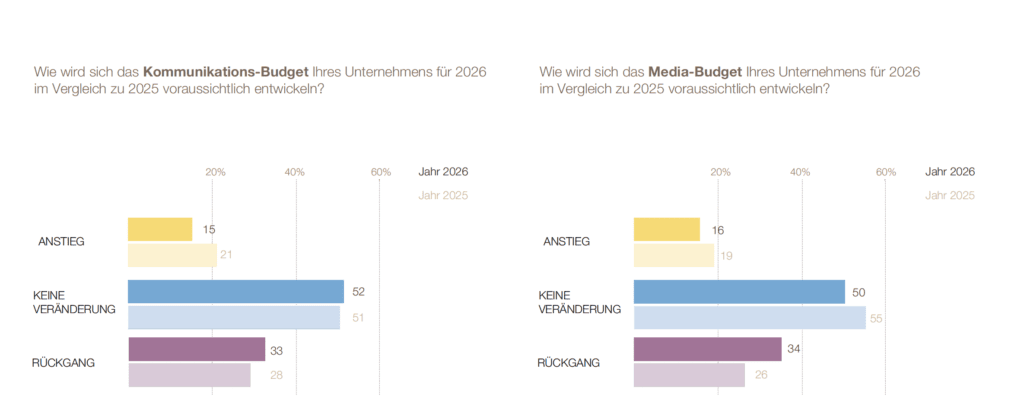
Despite the mostly positive outlook for sales and profits, only 15% of respondents plan to increase their communication budget and 16% plan to increase their media budget in the coming year. At the same time, around a third intend to reduce their investments in communication and media. The majority of advertisers (50%) do not plan to change either their communication or media budget compared to the previous year. This means that respondents are somewhat more cautious for 2026 than they were a year ago.
Traditional advertising is on the decline, digital channels are growing
The allocation of the marketing and communication budget to the individual channels will change only slightly in 2026. Most money will flow into the offline channels of traditional communication (27%), but their share will decrease from year to year. Almost all other channels will be able to increase their share slightly next year. These include social media, events, display, SEO and the company's own website. Content marketing is an exception, with its share falling significantly year-on-year from 11% to 6%.
Brand strategy and brand building are in demand
There will also be little change in the four most popular marketing disciplines next year: Brand Strategy/Building (29%) is new at the top, ahead of Content/Campaign Creation and Management (24%); Sales Support/Enablement (16%) and Marketing Operations (14%). Other disciplines such as Market Research, Analytics and Loyalty Programs are well behind.
Offline media budgets remain under pressure!
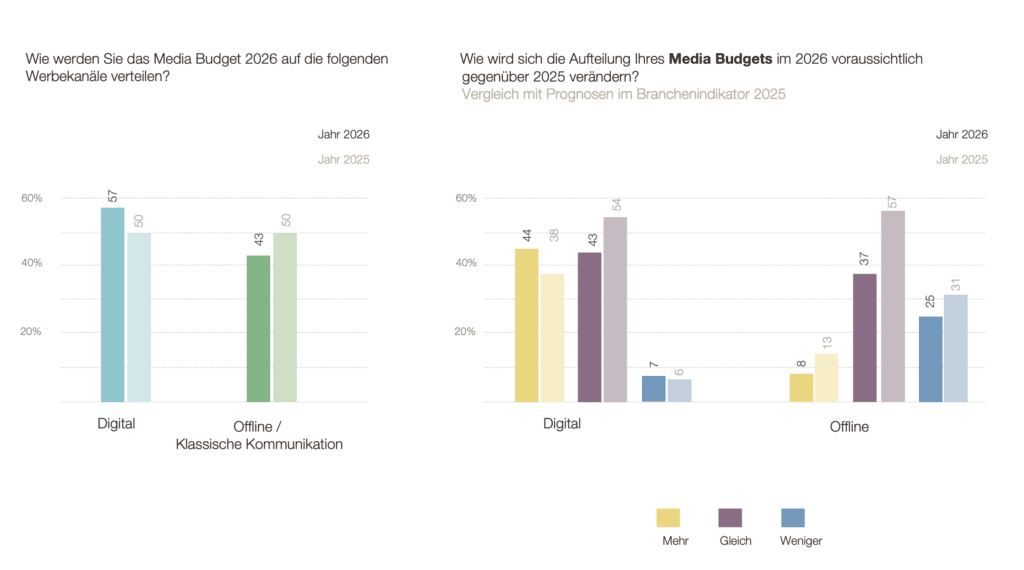
The budget distribution for 2026 between digital and offline is slightly more in favor of digital communication, with a share of 57% compared to 43%. Last year, the distribution was still balanced. Next year, 44% want to spend more on digital, 43% the same amount and only 7% less. The situation is much different for offline, with only 8% of respondents planning to increase their budget, 37% intend to invest the same amount and 25% expect to spend less.
TV and outdoor advertising are trending in 2026
In the coming year, advertisers are primarily planning higher investments in TV (25%) and out-of-home advertising (24%). The most stable budgets are for out-of-home advertising, direct marketing and print, which are largely expected to remain at the previous year's level. The sharpest budget cuts are again expected in print media: 41% of respondents anticipate cuts (previous year 31%). Cinema is not included in the 2026 media mix for 55% of respondents, followed by radio (45% ) and TV (33%).
Out-of-home advertising, print and TV with the largest shares of the offline advertising pie
In response to the question of how the offline media budget is actually distributed, OOH/DOOH (27%), print (27%) and TV (24%) occupy the top three places, as in the previous year. Direct marketing lost some ground in fourth place (from 18% to 13%). All other offline media channels remain at a share of 5% or less.
Video remains in vogue
In the coming year, slightly more of those surveyed plan to buy their digital budget directly (56%) than to book it programmatically (44%). A year ago, this question was answered with half and half. The most popular digital channels among advertisers are video (33%), ahead of display (28%), search (25%), native (11%) and audio (3%).
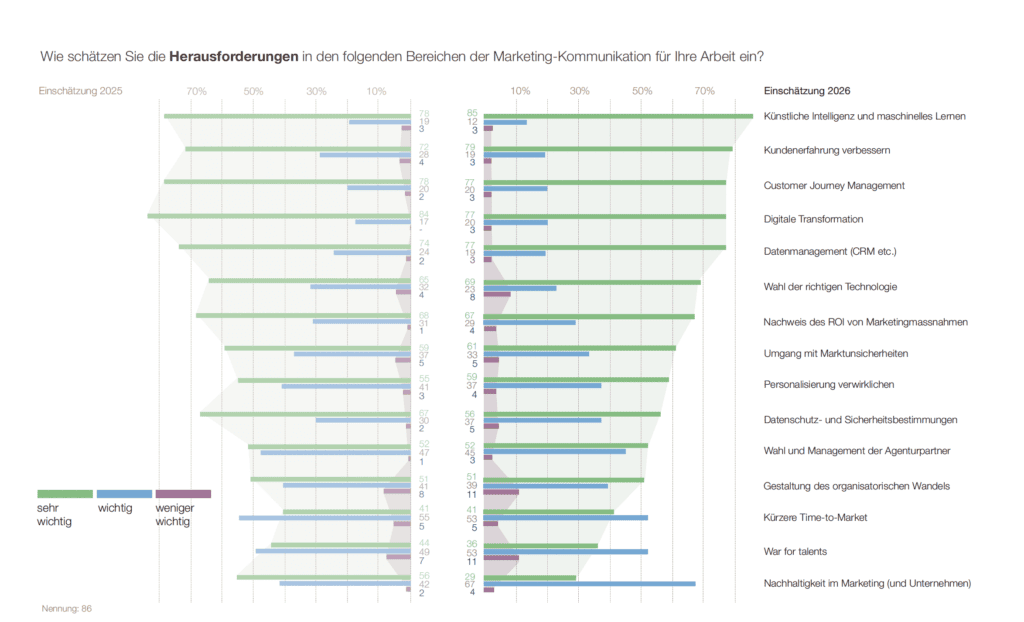
AI, customer experience and customer journey are the top challenges
Marketers will have to deal with many challenges in the coming year. The most important of these are dealing with AI, improving the customer experience, customer journey management, digital transformation and data management. Less important are: War for talents, shaping organizational change or choosing the right technology. As many as 67% of respondents still consider sustainability to be important in 2026.
Personal recommendation is decisive for the choice of agency
The most important sources of information when selecting an agency remain recommendations (79%), clearly ahead of the agency website or social media presence (53%) and contacts with agency management (51%). In addition, the LSA website (21%), the trade press (15%), rankings (Kreativ 15% and LSA 12%) and the Effie Awards (10%) are mentioned.
The most important criterion when choosing an agency is personal chemistry/culture (88%). This is followed by the task and professional expertise (79%), references (68%) and the size of the agency (45%).
Chemistry meetings for agency evaluation is in vogue
The Chemistry Meeting (39%) is now the most frequently used evaluation procedure for agency selection. It is followed by the competition presentation (21%). The written request for proposal (19%), the trial assignment (19%) and the paid strategy workshop (18%) are also frequently used.
A good 50% of clients work with the same main/lead agency for more than 4 years
On average, the respondents work with 4 agencies. At 38%, the relationship with the main/lead agency has existed for more than 5 years, at 15% for 4 to 5 years and at 19% for 3 to 4 years. At 28%, the cooperation has lasted less than 3 years or is limited to the duration of individual projects.
More investment by content creation agencies
In the coming year, clients would like more support from agencies in the following disciplines: content (40%), brand/communication strategy (27%), marketing technology (27%) and creation (25%). Less support is requested in the areas of production (38%), media strategy and live com (32% each) as well as media buying and PR/public affairs (27% each).
No changes to agency fees
The most common forms of remuneration remain the quote (46%), agile pricing (31%) and the percentage fee (18%). Team hire (8%) and performance-based fees (3%) are used less frequently.
More CO2-balanced companies - decline in importance of CO2-footprint
While the proportion of companies with a carbon footprint has increased (56% compared to 47% in the previous year), the importance of CO2-footprint in advertising campaigns has decreased. The footprint is still important or very important for only 23% of respondents in 2026, compared to 34% in the previous year. A majority of 45% rate the importance of the CO2-footprint in advertising campaigns neutrally with "neither".
Clients use AI for strategy, creation and media
Artificial intelligence is widely used in the areas of media, creation and strategy/consulting by both clients and agencies. While the use of AI can still be expanded on the client side in the media disciplines, clients assume that agencies are already making greater use of it. Clients are already making intensive use of AI in idea generation and concept development (82%), text generation (94%) and image and video creation (65%). AI is also frequently used in market and competition analyses (65%), target group insights and persona creation (55%) and customer journey mapping (32%).
About the survey: Between October and November 2025, a total of 145 well-known advertising clients in German- and French-speaking Switzerland took part online in the "Industry Indicator 2026" conducted by SWA and LSA. The detailed results can be obtained from the offices of the two associations