Writing letters is a mental exercise
An advertising campaign almost always begins with a briefing. But what if briefings themselves are the problem? An attempt to bring some structure to this tricky matter.


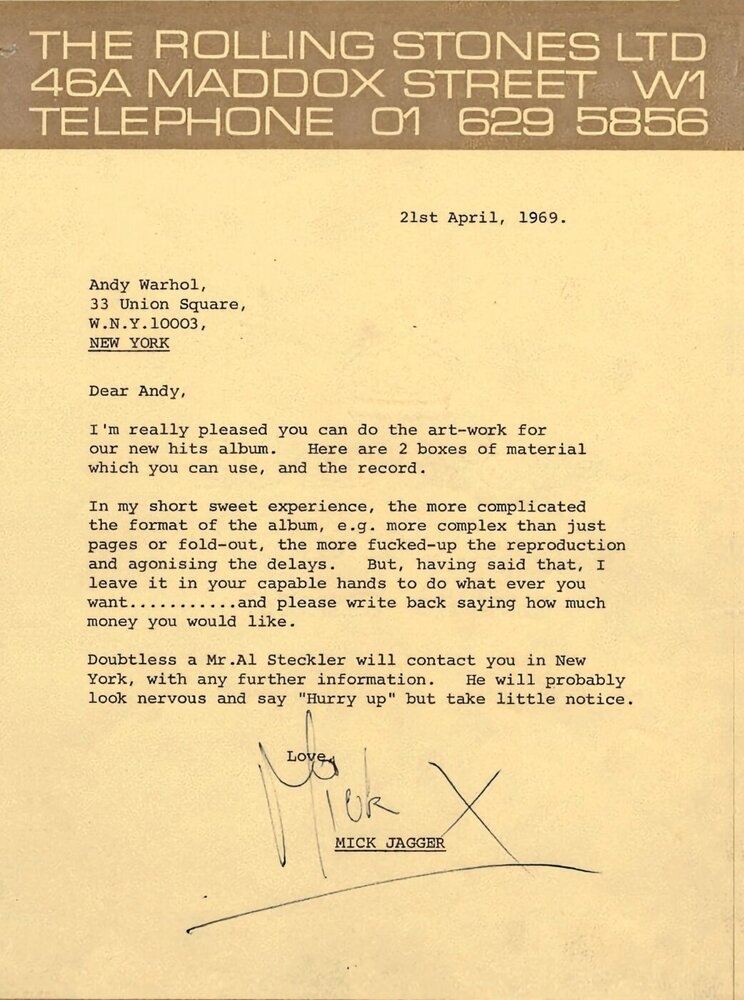
The British advertising strategist Richard Huntington once aptly said: "There is nothing better than a great briefing. But no briefing is still better than a bad briefing." An example of the latter is Mick Jagger's letter to Andy Warhol for the Rolling Stones album cover. Mick Jagger writes that he leaves it to Andy Warhol's competence to do whatever he wants to do. An absolute vote of confidence in Andy Warhol's creative talent and expertise.
Fast, fast, fast
The Jagger/Warhol case is the exception. Usually, briefings are the indispensable starting point, which is understandable from the client's point of view. After all, the agency should be provided with the necessary information to be able to take targeted action. The problem is that the client too often says: "We need to do a quick briefing." The briefing is treated like a credit card application: quickly write down the USP, target groups and other keywords and send them to the agency. Such a briefing may be short, but it does not contain any in-depth considerations.
The other extreme: the briefing mutates into a major event on paper that contains all kinds of information. Abundance instead of focus. This is due to the fear of forgetting something. The agency then has to ask questions in a time-consuming sorting process to find out what was actually intended. And in the end, it is often still unclear which specific challenge needs to be solved creatively.
This makes it all the more important that the briefing is based on a constructive consensus between client and agency. It forces the client and agency to take responsibility and minimizes the risk of downstream idle time, adjustments and coordination.
Co-creation? No, thank you
The term co-creation is cropping up more and more often. It is the process of collaborative idea generation between agency and client. Personally, I don't believe in actively involving clients in thinking up and generating communication ideas. On the one hand, because creative ideas are the result of talent, experience and expertise and not something that is "worked out" in workshops. Another reason is that there must be room and space for absolute garbage and garbage ideas on the agency side during the idea generation phase. Because you often only come across the really good ideas when you have a lot of stupid ideas. I know it's a terrible analogy, but: a truffle pig first has to go through the dirt to find the truffles. In the presence of clients, many a creative person is wary of saying a stupid idea out loud. After all, they don't want to offend anyone or cast doubt on their own intellectual competence. This safe haven for risky thinking must be guaranteed and is usually only possible through isolation.
Co-briefing? Absolutely
The client should be involved at an earlier stage, namely when the brief is being drawn up, in order to identify the problems as accurately as possible. Here it is advantageous if the client brings the inside view to the table and the agency the outside view. This process is an investigative, explorative exchange in the form of an open discourse. The aim is not to fill out a paper together that deals with questions about target groups, USP, etc. Rather, it is a consideration of the overall situation by both parties. In my opinion, the following areas are the most important for this exchange.
Inconvenient truths
A brand can basically be viewed from three angles: the brand itself, the product, the people (who may or may not use the product) and the category.
In all these areas, there are so-called truths that have become established over time. There are both comfortable and uncomfortable truths. What is meant by inconvenient truths? Inconvenient truths are those that are spoken behind closed doors and are rarely made public. These uncomfortable truths offer an enormous pool of opportunities to derive creative communication ideas from them. The primary aim is not to dramatize these uncomfortable truths per se. Rather, the aim is to be able to draw further thoughts from uncomfortable truths, with a positive twist that forms the foundation for a creative central idea in the conclusion. Together, client and agency can collect such uncomfortable truths. The agency should generate key ideas based on uncomfortable truths on its own and then present the results to the client.
"It has advantages when the agency and client are open about
to seek out as many uncomfortable truths as possible."
When we conceived the BDP's guiding principle "BDP. Boring, but good.", it was based on the uncomfortable truth that although good political ideas solve a specific problem, they are often unspectacular. This is a dry fact and makes politics appear boring to the outside world. However, the consequence of this is positive, because good political solutions require objectivity and objectivity. This basic idea gave rise to over 20 different motifs that form the campaign slogan "BDP. Boring, but good." were repeatedly dramatized.
Without openly addressing this uncomfortable truth, this idea would not have come about. Therefore, it only has advantages if the agency and client openly search for as many uncomfortable truths as possible.
Category Entry Points
Another area that should be discussed in the co-briefing is category entry points (CEPs). These CEPs are the reasons, motivations, triggers and occasions for someone to consider buying a product from the respective category. The focus here is on the category, not on the brand itself. From the buyer's point of view, brands are often alternatives, not competing products. The easier a brand comes to mind in a particular purchasing situation, the more dominant it is in this category. There are a number of questions within a category. Why am I buying this product? Where do I use this product? When do I use this product? etc. This approach takes into account the buyer's perspective and behavior when using the product.
An excellent example is the Jeep Grand Wagoneer commercial. Instead of advertising the pleasure of driving - which the majority of car commercials do - Jeep addresses the spaciousness of the vehicle with an unconventional usage suggestion: "The best car to have sex in." This, in turn, can also be seen as an uncomfortable truth: Cars are not only used for road transportation, but also for sexual intercourse. Jeep succeeds in creating a very entertaining product demonstration with this commercial without appearing indecent.
Those who consistently focus their co-briefings on "inconvenient truths and category entry points" are already doing much better than most. This focus lays the foundation for better campaigns.
The author
Parvez Sheik Fareed is a British-Swiss advertiser and co-founder of the advertising agency PAM Advertising.