"Opera is too much of everything" - Interview with artistic director Matthias Schulz
Featuring a ’making-of” video: Matthias Schulz’s perspective on opera is both passionate and pragmatic. The new artistic director of the Zurich Opera House sees it as a space that resonates with society, as a place for humanity in the age of algorithms. And as proof that imperfection is sometimes the most beautiful thing we have.


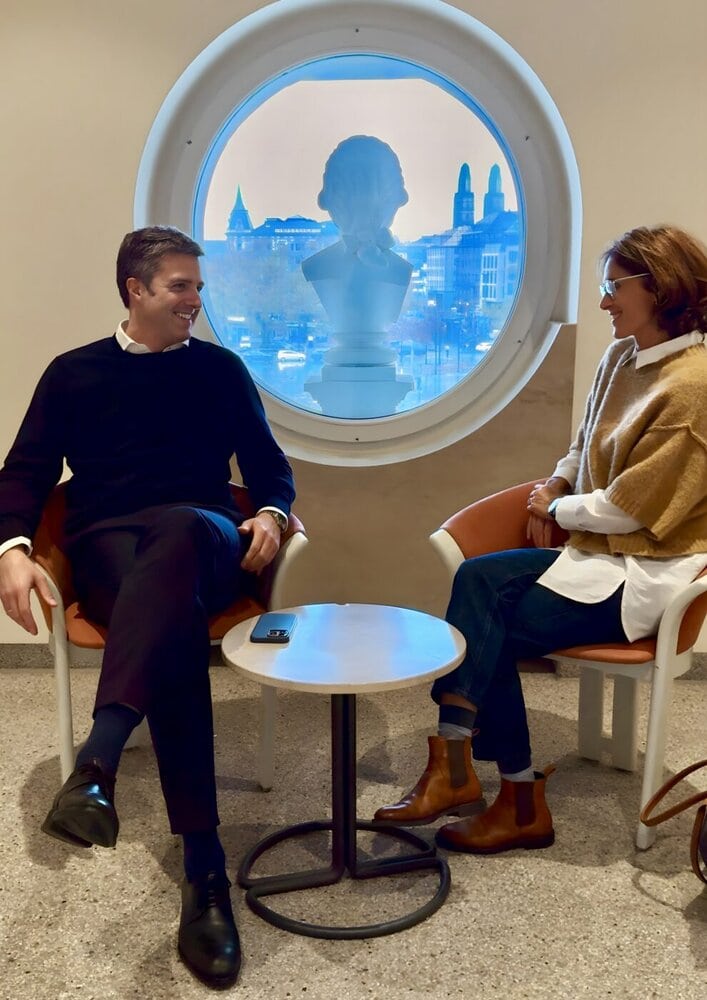
It is late morning, there is hammering going on on stage, in the corridors the team is vacuuming the red carpets. In the upper foyer, however, it is quiet - only the sound of traffic can be heard from a distance through the porthole-like window. Matthias Schulz, artistic director since summer 2025, appears calm and serene. You can sense that he knows - and loves - the tension between art, economics and the public. We talk about opera as a mirror of society, about football, efficiency, artificial intelligence and the question of why the imperfect touches us.
m&k: Mr. Schulz, you once said that football and opera have an astonishing amount in common. That sounds like a bold thesis.
Matthias Schulz: I grew up in Bavaria, so FC Bayern is like a second home. When you watch a game, you realize how expansive it is - dramas, emotions, stories in real time. A striker gets injured, the fans discuss, there are little pauses where you can reflect. It reminds me a lot of the opera: it is also a projection screen for our feelings. Both are places of encounter - and we urgently need that again today.
Because we have forgotten how to feel for each other?
Maybe, yes. We are surrounded by screens, everything is faster, more efficient, more measurable. But football and opera are bastions of genuine unpredictability. Something can go wrong, someone can flop or triumph. This irrationality, this remnant of the inexplicable - that is the magic. And that is deeply human.
There is also a social argument in your example: the opera as a place of democracy.
Exactly. Where else do so many people experience something together that cannot be planned? You sit next to each other and share moments of beauty, failure or overwhelm. Everyone has their own opinion on the experience and can express it freely. That creates a bond. Such meeting spaces are essential - they keep a society alive.
In business, efficiency is considered a virtue. In art, it almost sounds like a dirty word. How do you see it?
Art can be wasteful - but not thoughtless. We plan with great artistic freedom, without thinking about numbers first. But there has to be an efficient apparatus behind it, otherwise the system won't work. Backstage there is business precision so that the magic can happen up front. It's like an orchestra: every note counts, but the whole only comes into being when they play together.
You once spoke of the "rediscovery of slowness" in opera. A nice contrast to KPI-driven marketing.
Yes, opera is the opposite. It demands that you get involved, that you stay with it for three hours. This concentration, this immersion in another world - it has almost become a luxury. Many people sense this and come for precisely that reason. They are not looking for efficiency, but authenticity.
They say that art can be lavish. But Zurich is also an expensive place. How much idealism can a subsidized building tolerate?
Of course, an opera house has to justify itself. We work with public money and are very aware of this responsibility. But: if the result touches people, if it creates cultural identity, then it is not an expense, but an investment. Art is not a luxury, but part of the basic social space.
How much influence does digitalization have on this basic space?
An enormous one. We all live digitally, and we need to make excellent use of digital forms of communication - but with one goal: to attract people into the house so that they can experience something that is completely analog. Digitalization should not replace opera, but make it more accessible.
And artificial intelligence? A curse or a blessing for art?
Both. AI can make processes more efficient - rosters, organization, translations. It can also provide inspiration, for example for stage sets or lighting concepts. But it does not replace artistic handwriting. AI combines existing patterns, it levels them out. The result is often flawless - and boring. A perfect puppet is rarely attractive. Art thrives on breaks, on the human element, on risk.
You said: "Opera is not created in the home office." That sounds like a commitment.
Absolutely. Opera is peak physical performance. Singers, musicians, technicians - they are all in the same room, breathing the same rhythm. You can't reproduce that digitally. When a voice fills the room, when 70 instruments resonate, you can feel it physically. That is the essence of live art.
How do you reach a generation that prefers to watch TikToks?
By showing them that this is not a contradiction. Young people are looking for emotion, for truth, just like everyone else. But they need access. We are working with schools, founding a children's opera orchestra with 36 music schools in the canton, organizing an opera cinema day in 20 cinemas. And we are opening up new spaces: in Oerlikon, a music theater laboratory is being created in an ex-cinema - a place for experiments, improvisation, the unfinished. There you can experience opera up close.
That almost sounds like "opera for everyone".
That is indeed our goal. We are also expanding the familiar format to three days: an opera broadcast, a ballet evening and a live concert on Sechseläutenplatz. Plus public performances at reasonable prices. Nobody should be able to say: "I can't afford it." Opera is not an elite project.
You were director of the Berlin State Opera for eight years. What was the change like?
Berlin was a school of extremes - a building under renovation, discussions about leadership styles and social issues. I could make a Netflix series out of it: House of Opera. (laughs) But it was a great time and incredibly instructive. Zurich is different: more focused, more precise. Here you can think more long-term, plan more artistically - and remain socially relevant at the same time.
You witnessed the start of the pandemic there. Are there any moments that had a particular impact on you?
Yes, in Berlin, shortly before the lockdown came, we performed Carmen - and knew that it might be the last performance. Within two days, we organized a live broadcast with RBB. 200,000 people watched. I still carry that feeling of creating something together in a time of crisis with me today.
Speaking of together: how does your family integrate in Zurich? You have five children, right?
That's right, between 25 and 13 years old. Three have completed their A-levels, two are going to school here. Such changes are always challenging, but also enriching. My son plays water polo and joined a club straight away, my daughter is getting used to Swiss German. I myself am constantly between worlds - professionally and privately.
Does music have the same importance at home as it does at work?
Absolutely. All the children play an instrument - cello, violin, viola, piano. We could theoretically form a family quintet. (laughs) I think music lessons are one of the best schools for life. It promotes concentration, empathy and discipline. And it shows that beauty is created when you get involved in something.
You yourself are a pianist and an economist. An unusual combination.
I found both fascinating: the emotional depth of the music and the ana-lytic clarity of the economy. That helps me a lot today. An opera house is also a complex system - you have to be able to dream artistically and act in a structured way at the same time. Passion and expertise are not mutually exclusive.
One of your quotes says: "Opera is too much of everything." What do you mean by that?
(laughs) Yes, opera really is an emotional monster. Everything comes together: Music, drama, stage, architecture, craftsmanship, passion. Sometimes it's almost too much, you can hardly stand it - but that's exactly what makes it so important. Our society needs places like this where everything happens at the same time. They are like a high-pressure vessel for emotions.
That sounds almost political.
And it is. Cultural institutions are anchors of identity. They shape a city's self-image. Zurich would not be the same city without its opera house, ballet and theater. Incidentally, studies show that people prefer to live in a culturally rich environment - even if they don't go there regularly. Culture makes a city worth living in and attracts talent. That's not just nice, it's also economically smart.
Which brings us back to efficiency.
(laughs) Exactly. But that's just it: Efficiency must not be an end in itself. It must serve creativity. We need calculated risks in the arts. Opera is always a risk - 200 people work together on one evening and anything can happen. But if you don't dare, you lose the excitement.
Courage and risk - reminiscent of Mozart.
Yes, for me Mozart is the prime example of creative intelligence. He constantly defied expectations, irritated and surprised listeners. His music seems orderly, but is highly subversive. That is true creativity: not destroying, but thinking ahead. Deliberately breaking expectations without losing the audience. That's what I want for our house too.
When you think about your work here - what are your hopes for the coming years?
That people feel that the opera is there for them. That they feel invited to come in, to listen, to think. I want Zurich Opera House to remain a place where you can be amazed at yourself. And that we keep the courage to always allow the unpredictable - just like in football. (laughs)
And if you did have to choose: Your favorite opera?
The next premiere! But if you really force me now - Don Giovanni. Because it contains everything: Love, power, morality, comedy, abyss. A play that shows us how human we are. And for the 20th century: Saint François d'Assise by Olivier Messiaen - that replaces any spiritual need, has incredible power.
Mr. Schulz, thank you for the interview.
Thank you very much. It was like a good rehearsal - a bit of risk, a lot of emotion and hopefully a nice sound at the end.