The future or hype?
At the TPC's Media Future Day, attendees looked into the crystal ball for 3D.


On the other hand, all the experts on the 3D panel agreed that tangible illusions will very soon find their acceptance, at least in advertising. A 3D film at a trade show or a virtual presentation of the latest products in space is "certainly an effect," as publicist and consultant Albrecht Gasteiner is convinced. In contrast to the past, where 3D was still a kind of experimental field for the exotic, the future must be interpreted quite differently today, because the industry will soon be ready to invest enormous resources in the new technology. Flat screens have been sold. The market is demanding new gimmicks. However, this topic also shows that the ideas of a common standard from Japan to America are still quite a bit more apart than the approximately 6.5 centimeters that are normally needed for the two lenses in front of a stereoscopic film camera.
"I could imagine watching a 3D movie once a month. But I don't need it every day, and certainly not in the news," said Hans Hoffmann, program manager of a newly founded study group for 3D TV at the EBU in Geneva. At the Media Day, a ski slope recorded with a 3D helmet camera showed in which areas the spatial development of television actually has a fascinating effect. Of course, animal worlds are even more colorful and vivid in 3D. There is also no doubt about the spatial future of Playstation and family.
The industry agrees that Blu Ray will remain the best medium for storing such content for the time being.
Simon Otto has already arrived completely in the 3D world. The Swiss designer is head of animation at Dreamworks in Hollywood and presented his latest work for the film "How to train your Dragon" at the TPC event. For technical reasons, unfortunately, only in 2D. pan
HesseGreutert Film realizes in Switzerland the first 3D feature film of Europe: "One Way Trip
In the USA, 3D movies can already be experienced in well over 900 3D-capable cinemas. In Europe, development is still a little way off. Switzerland, however, is at the forefront. The Zurich-based production company HesseGreutert Film wants to produce Europe's first "real" 3D film for the cinema. HesseGreutert Film will be doing pioneering work with this project, since many of the 3D films on offer today are only 2D films that have been subsequently pimped in the computer.
"One Way Trip" was presented at the Media Future Day by producer Valentin Greutert together with Roger Koller from postproduction On Line Video as well as director Markus Welter. The idea for the cinema was launched in 2006 as a 2D project as "the first horror film in Switzerland". In 2008 the script was ready and with it the idea to realize "One Way Trip" as a 3D film took shape. "Our horror film works like a roller coaster. That's why the third dimension is a promising addition," explains Valentin Greutert.
The feature film has already been financed to such an extent that shooting can begin in September. One challenge was to be able to convince the investors that there will be enough playback points later on. HesseGreutert relies on international marketing as well as home cinema with DVD and Blu Ray.
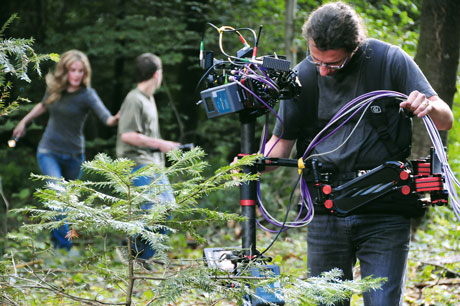
For the technical planning, the Swiss have contacted experts in the USA and Canada. The project is being implemented by Zurich-based On Line Video with Roger Koller as head of postproduction. To be on the safe side, a test shoot already took place almost a year ago. The horror film is set in a forest at night. Between the trees, the steady-cam will therefore be an important stylistic device. To make the most of the 3D effects, the test production installed a playback on the set to analyze the effect of the various images directly on location.
"This experience was also very valuable for the workflow as well as the calculation of the shooting times," explains Markus Welter. The 3D technology has no significant influence on his work with the actors. However, the image and its spatial dramaturgy must be built up in a much more complex way and ideally planned in a storyboard. The "point of interest" must be precisely directed. A new sense of rhythm is needed for action and panning.
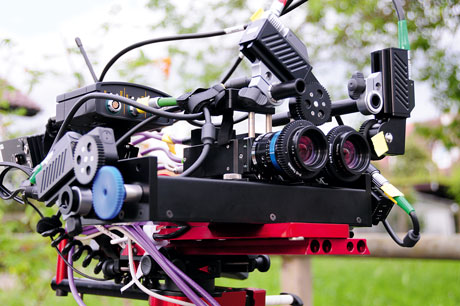
For all this art, there is an important and new specialist on the set: the Stereographer. This calculates, for example, the most effective distance between the two cameras and thus also the complex aspects of the angle of view. For the cameraman, it is important to be able to adjust the colors of his two devices "completely identically.
The experience gained shows about 10 percent more time for setups. The plan for the upcoming production is 20 setups per shooting day. Overall, Greutert estimates the budget to be about 20 percent more than for a conventional film. In the process, "One Way Trip" will rely on a few so-called "money shots" - scenes in which a concentrated amount will be invested in order to make 3D look as amazing as possible. Many key scenes are to be additionally enhanced later in post-production by means of visual effects. The screen level, which is important for viewing, is also determined later in post. Here, it must be determined which action will remain in depth and what should "pop out" of the screen.
For the analysis and editing of the test footage, the postproduction team had worked with a monitor like the ones used in gaming due to the lack of professional equipment. For the upcoming postproduction of "One Way Trip," On Line Video now has a complete stereo workflow available, including HD stereo projection. And the makers of this film can already claim: "We went from amateurs to professionals in the course of the preparations."
Andreas Panzeri
HesseGreutert Film won the Film Award of the City of Zurich in 2009 with "Rocksteady - The Roots of Reggae" by director Stascha Bader as well as a nomination "Best Documentary" at the Swiss Film Award Quarz in 2010.
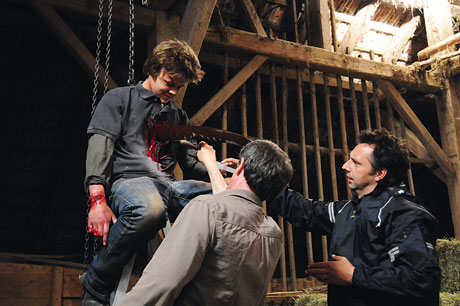
Test shoot for "One Way Trip": The 3D camera rig, Brian Goff at the steadycam, director Markus Welter and set designer Urs Beuter prepare the victim.