Media in crisis - that's right!
The interpretative power of the apparatuses dominates over the enlightening power of independent media. Because trust in the competence and sense of proportion of these media is lost, the connections no longer work. Guest commentary by Karl Lüönd, journalist and author.


"Why pump if it's not necessary?" Pascal Couchepin smiled smugly into the camera. There is much to suggest that he already knew at this point that it would be necessary. But the Federal Council's information policy told him to mislead the public.
When it actually happened, the media - from Blick, which relished Ringier's vendetta against Weltwoche, to "Giacobbo/Müller" - initially mocked Weltwoche and its author Gerold Bührer. The weekly newspaper summarized the state of knowledge on its final day, Tuesday, October 14, not unoriginally with a paraphrase of Ben Vautier's provocation at the Expo in Seville. The fact that the Handelszeitung produced an analogous flop - had to, because it too was subject to the same technical constraints and lead times of a weekly newspaper - was not noticed anywhere.
Shit happens - so what? Colleagues would have been wiser to account for two phenomena that prove that the media are also in crisis, and not just since the 68 billion euro news from the combined vaults of the Federal Palace and the National Bank.
Phenomenon 1: Information is organized, channelled and thus domesticated. The interpretative power of the apparatuses dominates over the enlightening power of independent media. Because trust in the competence and sense of proportion of these media has been lost, the connections no longer work properly.
If it is true that at least a hundred people in the Swiss parliament, the Swiss National Bank and UBS have known about the secret for days, it is a great feat of information management (or manipulation) that nothing leaked out prematurely. As editor-in-chief of an important newspaper or television station, I would ask myself: How good or how bad are my relationships, how damaged is my trust capital that nobody warns me - at least in hints - against premature and apodictic assessments on such days? To the tune of: Watch out, that's all I can tell you, but there's something big in the bush ...
I'm not advocating indiscretions, although I've never had anything against them, especially when I could benefit from them. But the way in which the overpowering information machines of the authorities and the banks, including the National Bank, have dealt with the media reflects the fundamental distrust of those in power towards the media. They use us as amplifiers or as useful idiots, but we are actually a nuisance to them. That's why they harass us wherever they can - just look at the decisions on awarding licenses to private radio and TV stations in the near future!
Phenomenon 2: This mistrust is understandable as long as the interpretations published after the explosion report are as erroneous and tendentious as they were. The media herd of mutton quickly agreed that it was a "rescue operation", possibly at the last minute (and not a quick and decisive proactive move, as one might see it). And it was a kind of subsidy (and not a deal - a risky one, perhaps, but a deal nonetheless - with the speculative interest rate of 12.5 percent).
In any case, the whole story was brought to a head with the bonus issue in close cooperation with the state-believing left. Not only the readers understand this, but above all the writers. They blithely demand that valid contracts should now be broken, and just as blithely quote bonus figures as if they had not been largely blocked and now worthless options, but cash.
The media should have the task of differentiating, creating clarity, demonstrating a sense of proportion. Instead, they blithely localized, emotionalized and personalized. The Tages-Anzeiger sent reporters into the teller halls as if there was something to be learned there about the extent of the migration of savers from the big banks to the cantonal and Raiffeisen banks. Blick is already hyperventilating in its use of language. The commanding tone of the last few days can only be increased by the ultimate headline: "Death penalty for Ospel!"
My bet is still on: not even half of our business journalists are able to read a balance sheet, let alone correctly interpret highly complex processes in the banking sector. As long as this is the case, it serves us right if the PR industry's façade cleaners mislead us through and through.
When it actually happened, the media - from Blick, which relished Ringier's vendetta against Weltwoche, to "Giacobbo/Müller" - initially mocked Weltwoche and its author Gerold Bührer. The weekly newspaper summarized the state of knowledge on its final day, Tuesday, October 14, not unoriginally with a paraphrase of Ben Vautier's provocation at the Expo in Seville. The fact that the Handelszeitung produced an analogous flop - had to, because it too was subject to the same technical constraints and lead times of a weekly newspaper - was not noticed anywhere.
Shit happens - so what? Colleagues would have been wiser to account for two phenomena that prove that the media are also in crisis, and not just since the 68 billion euro news from the combined vaults of the Federal Palace and the National Bank.
Phenomenon 1: Information is organized, channelled and thus domesticated. The interpretative power of the apparatuses dominates over the enlightening power of independent media. Because trust in the competence and sense of proportion of these media has been lost, the connections no longer work properly.
If it is true that at least a hundred people in the Swiss parliament, the Swiss National Bank and UBS have known about the secret for days, it is a great feat of information management (or manipulation) that nothing leaked out prematurely. As editor-in-chief of an important newspaper or television station, I would ask myself: How good or how bad are my relationships, how damaged is my trust capital that nobody warns me - at least in hints - against premature and apodictic assessments on such days? To the tune of: Watch out, that's all I can tell you, but there's something big in the bush ...
I'm not advocating indiscretions, although I've never had anything against them, especially when I could benefit from them. But the way in which the overpowering information machines of the authorities and the banks, including the National Bank, have dealt with the media reflects the fundamental distrust of those in power towards the media. They use us as amplifiers or as useful idiots, but we are actually a nuisance to them. That's why they harass us wherever they can - just look at the decisions on awarding licenses to private radio and TV stations in the near future!
Phenomenon 2: This mistrust is understandable as long as the interpretations published after the explosion report are as erroneous and tendentious as they were. The media herd of mutton quickly agreed that it was a "rescue operation", possibly at the last minute (and not a quick and decisive proactive move, as one might see it). And it was a kind of subsidy (and not a deal - a risky one, perhaps, but a deal nonetheless - with the speculative interest rate of 12.5 percent).
In any case, the whole story was brought to a head with the bonus issue in close cooperation with the state-believing left. Not only the readers understand this, but above all the writers. They blithely demand that valid contracts should now be broken, and just as blithely quote bonus figures as if they had not been largely blocked and now worthless options, but cash.
The media should have the task of differentiating, creating clarity, demonstrating a sense of proportion. Instead, they blithely localized, emotionalized and personalized. The Tages-Anzeiger sent reporters into the teller halls as if there was something to be learned there about the extent of the migration of savers from the big banks to the cantonal and Raiffeisen banks. Blick is already hyperventilating in its use of language. The commanding tone of the last few days can only be increased by the ultimate headline: "Death penalty for Ospel!"
My bet is still on: not even half of our business journalists are able to read a balance sheet, let alone correctly interpret highly complex processes in the banking sector. As long as this is the case, it serves us right if the PR industry's façade cleaners mislead us through and through.
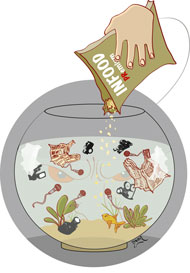
Illustration Davor BakaraI'm not advocating indiscretions, although I've never had anything against them, especially when I've been able to profit from them. But the way in which the overpowering information machines of the authorities and the banks, including the National Bank, have dealt with the media reflects the fundamental distrust of those in power towards the media. They use us as amplifiers or as useful idiots, but we are actually a nuisance to them. That's why they harass us wherever they can - just look at the decisions on awarding licenses to private radio and TV stations in the near future!
Phenomenon 2: This mistrust is understandable as long as the interpretations published after the explosion report are as erroneous and tendentious as they were. The media herd of mutton quickly agreed that it was a "rescue operation", possibly at the last minute (and not a quick and decisive proactive move, as one might see it). And it was a kind of subsidy (and not a deal - a risky one, perhaps, but a deal nonetheless - with the speculative interest rate of 12.5 percent).
In any case, the whole story was brought to a head with the bonus issue in close cooperation with the state-believing left. Not only the readers understand this, but above all the writers. They blithely demand that valid contracts should now be broken, and just as blithely quote bonus figures as if they had not been largely blocked and now worthless options, but cash.
The media should have the task of differentiating, creating clarity, demonstrating a sense of proportion. Instead, they blithely localized, emotionalized and personalized. The Tages-Anzeiger sent reporters into the teller halls as if there was something to be learned there about the extent of the migration of savers from the big banks to the cantonal and Raiffeisen banks. Blick is already hyperventilating in its use of language. The commanding tone of the last few days can only be increased by the ultimate headline: "Death penalty for Ospel!"
My bet is still on: not even half of our business journalists are able to read a balance sheet, let alone correctly interpret highly complex processes in the banking sector. As long as this is the case, it serves us right if the PR industry's façade cleaners mislead us through and through.
Phenomenon 2: This mistrust is understandable as long as the interpretations published after the explosion report are as erroneous and tendentious as they were. The media herd of mutton quickly agreed that it was a "rescue operation", possibly at the last minute (and not a quick and decisive proactive move, as one might see it). And it was a kind of subsidy (and not a deal - a risky one, perhaps, but a deal nonetheless - with the speculative interest rate of 12.5 percent).
In any case, the whole story was brought to a head with the bonus issue in close cooperation with the state-believing left. Not only the readers understand this, but above all the writers. They blithely demand that valid contracts should now be broken, and just as blithely quote bonus figures as if they had not been largely blocked and now worthless options, but cash.
The media should have the task of differentiating, creating clarity, demonstrating a sense of proportion. Instead, they blithely localized, emotionalized and personalized. The Tages-Anzeiger sent reporters into the teller halls as if there was something to be learned there about the extent of the migration of savers from the big banks to the cantonal and Raiffeisen banks. Blick is already hyperventilating in its use of language. The commanding tone of the last few days can only be increased by the ultimate headline: "Death penalty for Ospel!"
My bet is still on: not even half of our business journalists are able to read a balance sheet, let alone correctly interpret highly complex processes in the banking sector. As long as this is the case, it serves us right if the PR industry's façade cleaners mislead us through and through.
Illustration Davor Bakara