SFLB stages a lot of boredom for Tele
Can boredom be funny - and is it still boring? Spillmann Felser Leo Burnett manages the balancing act in three TV commercials for the TV magazine Tele.


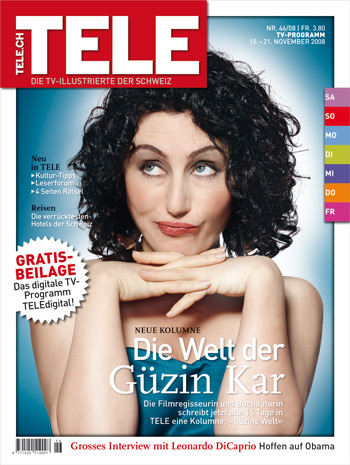
It took Axel Springer Schweiz (ASS) more than a year to prepare for the relaunch of Tele (see adjacent article), but this week the time has come: the magazine is being published with a new look, a new logo and, in some cases, an expanded content concept. Now ASS is also making a big advertising splash: A campaign created by the Zurich advertising agency Spillmann Felser Leo Burnett will be launched on November 13 and will cost ASS a total of over one million Swiss francs. In its communication for Tele, the agency focused primarily on the program section. "We focused on the direct benefits of Tele," says CD and agency co-owner Martin Spillmann. "However, we left it up to the consumer to discover the changes."
And so the campaign now demonstrates the advantage of a high-quality TV magazine like Tele: it provides orientation and an overview of the daily and weekly (over)range of available TV programs. And because there is a need for selection, Tele with its competent information and background reports is indispensable. "Tele, see what's worth seeing" is the claim developed by Spillmann Felser Leo Burnett. This also means: Tele protects against frustration and disappointment in everyday TV life.
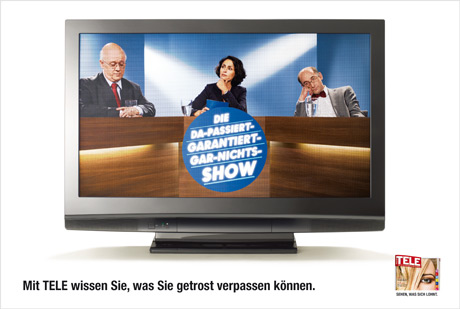
This is exactly where the concrete implementation in the form of three different TV commercials and advertisements comes in. "We show examples of programs that you can miss because they are simply not worth watching," says Spillmann. On the one hand, there is the fictitious "Da-passiert-garantiert- gar-nichts-Show", in which nothing actually happens after the introduction: The presenter doesn't have a conversation, the four studio guests remain silent. Pure boredom. When one of the guests drinks and his gulping is clearly audible in the general silence, things even become embarrassing. "With Tele, you know what you can safely miss," is the first statement. And then follows: "Tele, see what's worthwhile."
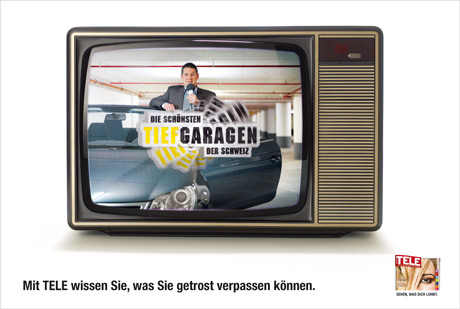
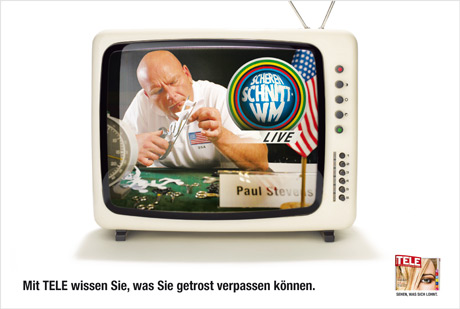
In the second spot, you experience a paper-cutting world championship, but because the motifs are so small, nothing can be seen except women and men cutting doggedly. How exciting! Finally, a program about "The most beautiful underground car parks in Switzerland" is shown. For 90 minutes, according to the announcement, you learn all about a 6,000 square meter grey garage in Münsingen - probably with a lot of love for concrete. Even the introduction is dull. Reflexively, you reach for Tele. Or you wish for it.
It wasn't easy to convey boredom, says Spillmann. "Because there is a danger that the commercial itself could become boring." But that didn't happen, the commercials are bland in a funny way. Despite the threefold staging of boredom, Spillmann sums up: "We enjoyed the work."
Markus Knöpfli