
SPR+: New study on the performance of posters in buildings
With a new study of train stations, SPR+ aims to determine how passersby move through complex buildings and where they encounter posters. The goal is to reveal the performance metrics generated by posters displayed in those locations. Previous SPR+ measurements only tracked posters in outdoor areas.


With the previous SPR+ measurements, it was only possible to find out how many passers-by go into a train station or shopping center and how many come out again. What happens inside the complex buildings, however, was previously unclear. The new station study by SPR+ now aims to crack this black box and find out how passers-by move around inside complex buildings and where they encounter posters. The aim is to reveal the performance values generated by the posters that are displayed there. In Switzerland, around 25 percent of all posters are displayed in closed buildings.
For indoor measurements, SPR+ relies on trained people rather than technology. This is because the geostationary satellites used for outdoor studies are shielded by the building shells and therefore cannot be used to measure pedestrian flows inside buildings. From September to December 2008, experienced counting personnel from the market research institute IHA-GfK will be working in Swiss railroad stations, shopping centers, parking lots and petrol stations. Using smart phones, they will count the number of pedestrians walking past them at the intersections within the buildings, separated by direction. What sounds simple is a complex matter in practice. In Zurich's multi-storey main station, for example, there are 115 different junctions at which passers-by can branch off. Once you have passed through one of the entrances inside the building, you can even choose from a total of 140 different routes (see graphic below).
The frequency data resulting from the measurement campaign is incorporated into a route model and thus enables the simulation of pedestrian flows. This task will be carried out by the Fraunhofer Institute for Intelligent Analysis and Information Systems, which specializes in mobility analyses and is already being used in the outdoor model of SPR+. The station study will be used to incorporate the performance values of billboards in closed buildings into the SPR+ Expert planning software next year, SPR+ writes in a press release.
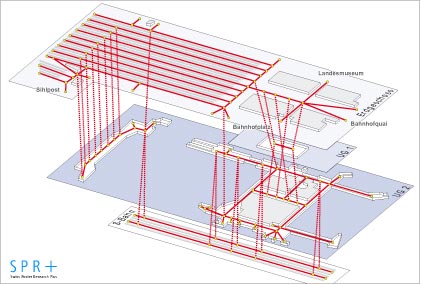
Caption: Route model Zurich main station.


