"Our normality is extremely fragile"
General Sir Richard Barrons led British Army operations in Bosnia, Northern Ireland, and Iraq; he was one of the United Kingdom’s highest-ranking officers. In an interview with m&k, he says the pandemic must make us more resilient.


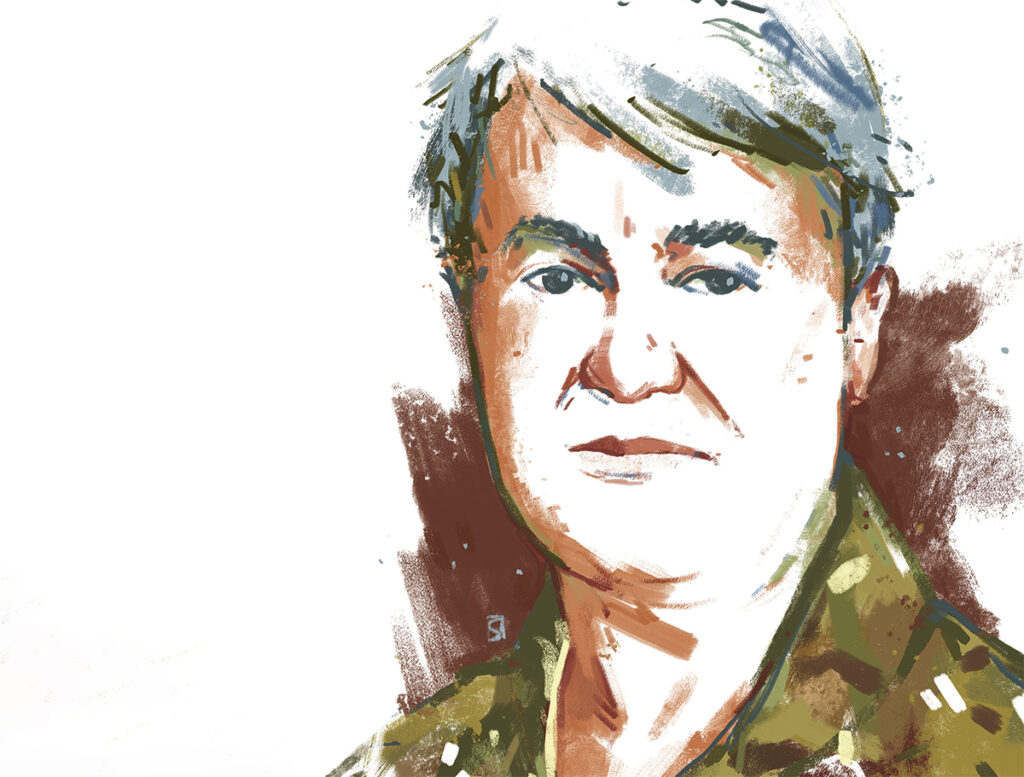
m&k: Sir Richard Barons, you were one of the highest-ranking officers in the British Army before you were honorably discharged in 2016. Which of your duties were particularly challenging over the years?
General Sir Richard Barons: I was Chief of Staff during the first British deployment to Bosnia in 1991, where we got off the plane and immediately had to get to work under rather difficult conditions. Later, as a colonel, I served as Chief of Staff at the British divisional headquarters that launched the first operation in Kabul—that was Christmas 2001. In Kabul, we had to improvise; at first, we slept on the floor of some old stables, and then we had to assemble, organize, and command a multinational force in the blink of an eye. The following year, I established a multinational division in southern Iraq. As a major general, I created structures to negotiate with the Taliban and try, above all, to get the young people there out of the fighting; that was a rather long-term project, incredibly fascinating. You know—in a profession like mine, if you’re lucky, you can find yourself at the forefront of history.
Do you still remember how your career in the military began?
The honest truth is: I’m still not entirely sure how I ended up in the army (laughs). As a boy, I was definitely «crazy about the army» and joined the so-called «cadet unit» at school—which gave me some insight into the army. Before I went to university, I took part in an «academic cadet program,» which took me to Sandhurst for a short time and also kept me quite involved with the military while I was studying at Oxford. At the end of my studies, I enlisted in the armed forces for five years.
But to be honest, I didn't expect to stay in the military for almost my entire working life. As you can imagine, a military career isn't all sunshine and roses. There are different phases, from the early days as a young officer working at the unit level, through a period where you have more contact with command … and then some pretty interesting staff positions. I was particularly fortunate with some of the jobs I had quite early on in the operational field, which then evolved into senior command and staff positions. Every time I encountered a hurdle and overcame it, I was tempted to stay on for a few more years. And here we are now (laughs).
What aspects of your career did you find particularly appealing?
I think the first thing to mention here is … that life in a volunteer army is a calling. It’s not like many of the commercial ventures I’m involved in now, which are fun but also inherently transactional. In the military, you’re committed to an entity; you’re committed to and connected with the people around you. You feel a tremendous sense of purpose when you play at least a small role in defending your nation and your family. But there’s also a strong conceptual dimension to the whole endeavor. I know that for anyone who’s only seen shows like the British series *Black Adder*, there’s a perception that military personnel aren’t particularly smart and spend all their time doing drills (laughs), but the reality is that military life is a very complex undertaking that requires you to work with thousands of people. For example, I led an operation in Iraq where we had to coordinate 50,000 soldiers from various nations and many Iraqi security forces. You’re dealing with people, you’re dealing with complex equipment, you’re dealing with a complex organization, and you’re dealing with complex processes—whether that’s tactics, procurement, or intelligence. There aren’t many other professions where you can do something like this on such a large scale.
As someone who has participated in various international Firsthand Experience of Crises and Wars has: How do you assess the situation? related to the COVID-19 pandemic?
I think this is a turning point—especially in terms of how European countries view their way of life and their place in the world. We must keep in mind that while the pandemic is a shock, it can’t really be called a surprise. Many, many experts had been predicting for years that a pandemic was possible and was becoming increasingly likely given our globalized way of life. And yet we all failed to prepare adequately. Consequently, we found ourselves in a situation where a natural disaster—the virus—was exacerbated by inadequate human interventions. This is a stark reminder of the fragility of what we call civilization, and of the way our rather complex, very comfortable, very well-equipped societies in Europe function. They are based on countless mechanisms that must operate every day in a spirit of broad cooperation and harmony. We have now seen how easily that can fall apart.
I assume you have that fragility Have you experienced this in other situations as well?
Yes. I had my first experience of this kind in Bosnia in the 1990s, where Sarajevo felt like a very Western, cosmopolitan metropolis—just like the places where we all live. But as soon as the fighting broke out there, people were fighting over food and water outside, despite the danger of being shot by a sniper on the street. It takes about two weeks for our civilizations to collapse once the water is cut off, the power goes out, and the supermarket shelves are empty. The pandemic has shaken what many people—and many, many companies—considered a sort of inherent guarantee: that our lives will be a permanent, peaceful, prosperous, and harmonious flow of events, in which each generation is slightly better off than the one before. That is likely to prove a misconception.
So—is this really the end? our «comfort zone»?
Take a look at how we’ve lived our lives. We’ve been pretty easy on ourselves; we’ve paid ourselves good salaries; we’ve accepted a lot of government assistance, which has forced our countries to take on massive debt. And that will likely no longer be sustainable in the future. We’ll have to introduce leadership, organization, and processes that meet the demands of a tougher world. In politics, the focus will no longer be solely on the next election, petty cliques, or money, but on a return to statesmanship and rigor—on tackling problems on the scale at which they arise. At all levels of politics and society, we will have to renegotiate the meaning of resilience, civic responsibility, and the role of the individual. The pandemic has shown us that we must improve our resilience to natural and human-induced disasters, but people like me continue to argue vigorously that we must also improve our resilience against actors who wish us harm. The way we confront these threats has changed because technology has changed. So we also need cyber resilience and resilience against manipulation on social media.
What qualities will leaders need to navigate their companies through the coming years?
The primary duty of corporate leadership is to «make the horizon their own.» They must understand the context in which their company operates. And they must pay close attention to how this environment creates opportunities they can capitalize on, but also presents risks they must mitigate. In the military, this is called «intelligence»; in most companies, it is referred to as the strategic context. Intelligence requires the absolute commitment of executives, because often only they have developed the experience-based intuition that is needed. And even if there is a brilliant vision for the future, there must also be a method for translating it into brilliant action. I’ve noticed that many companies lack such a method and use vague terminology: when they say «strategy,» they often mean nothing more than a list of desirable outcomes. And when they say «plan,» it’s merely a statement of intent. A military campaign, on the other hand, is the orchestration of all available resources: you know exactly where you want to go, and you design a campaign with a sequence of measures and all the resources you need to reach your goal.
Many companies are currently facing the reality that long-term planning no longer seems possible—or do you see it differently?
If you have a good plan, then at least you always have something to deviate from (laughs). No, seriously: It’s essential to create an organization that doesn’t act like five-year-olds playing soccer—where everyone is constantly chasing after the same ball. You need a structure where the people fighting the fire actually fight the fire, but where leaders are also already thinking beyond the immediate problem to decide how to adjust the plan. In the military, «Mission Command» would be responsible for strategic adjustments. In response to changing circumstances, the entire machinery is optimized so that every level delivers the maximum performance it can at any given moment—and in a way that everyone understands, with clear communication. Most companies have really been doing a poor job of this so far.
Let's talk a little more about Decision-making. How As a general, with your enormous Responsibility for Decisions How was it handled?
You can imagine that this was sometimes complex and difficult. However, I believe that, whether you are a leader in the military or in business, you will not succeed unless you possess a certain degree of ruthlessness.
At first glance, this word does have rather negative connotations. So what exactly do you mean by it?
When I speak of situational ruthlessness, I mean that you must distinguish between what is in the best interest of your company or your country and what is in the best interest of the individuals under your command. To put it more bluntly: You cannot weigh an individual tragedy against an institutional tragedy. In war, it is unfortunately necessary to send people on dangerous missions from which they may not return. There are few officers who have never had to do what we call «walk up the garden path»—that is, ringing a family’s doorbell in uniform and telling them that a soldier will not be coming home. But unfortunately, such things happen and cannot become the guiding principle for decision-making. It’s similar in business. You won’t succeed in a very difficult environment if the only thing you’re obsessed with is making every single member of your organization satisfied, happy, and fulfilled. Because if you did that, you’d never fire anyone, for fear that it would have negative consequences for the individual.
Intellectual rigor, however, means It's not that you become indifferent. What So, for an example, you wanted to use Lead by example with your leadership style—which You have been guided by principles, sir Richard?
I believe that integrity and courage must be at the heart of successful leadership in every area of life. «We must recognize that the world we all live in is becoming much more challenging and unstable.» These words can mean many things: For me, they have always meant setting a good personal example. I particularly dislike companies where there are rules set by top management that bosses demand employees follow—but which they themselves do not adhere to. That destroys an organization.
Toward the end, would you mind First, your vision of a world of Reveal it tomorrow?
I think we need to acknowledge that the world in which we all live and work will be much more challenging and unstable. In Europe, we are accustomed to the idea that bad things only happen abroad or affect us only marginally. But we no longer have control over the major dynamics of the world. Whether it’s trade conditions, sources of financing, the ability to access raw materials, or the ability to rely on the enforcement of laws within our country and the way we conduct business… all of this seems more fragile. As I’ve already said, companies therefore urgently need to become more resilient. Having cash on hand is a good thing; planning for contingencies is a good thing. Having a sound balance sheet is important when you need to navigate a few months of rough terrain and simply hang in there. The second point is that the winners in the business world of the future will be those who opt for radical transformation rather than gradual reform. Markets will emerge and disappear before our very eyes, in a world that is beginning to waver. I actually believe that living in such an environment can even be fun. It offers a certain freedom—there are enormous risks, but also enormous opportunities. You know, people really need to be motivated if they want to succeed in this environment. And they need to be able to take a few serious blows.
General Sir Richard Barrons Served until April 2016 as Commander of Joint Forces Command, one of the six «Chiefs of Staff» who lead the British Armed Forces. He was responsible for 23,000 personnel worldwide and a budget of 4.3 billion GBP. His area of responsibility included intelligence, special forces, operational command and control, as well as information systems and communications. Sir Richard Barrons’ military career spans positions from captain to general in military operations in Bosnia, Kosovo, Northern Ireland, Iraq, and Afghanistan.